
May 25, 2026
Chicago 12, Melborne City, USA
AI Business Strategy

AI-Native Networks & The Three-Body Problem: Architecting Beyond the Moat

The Gravitational Instability of AI-Native Networks The Gravitational Instability of AI-Native Networks: Solving the Three-Body Problem in Modern Architecture We are currently witnessing a phase transition in the artificial intelligence sector that mirrors the chaotic dynamics of orbital mechanics. The initial euphoria of generative AI—characterized by the ‘magic trick’ of zero-shot conversational capabilities—is rapidly subsiding.
Read More
Enterprise AI

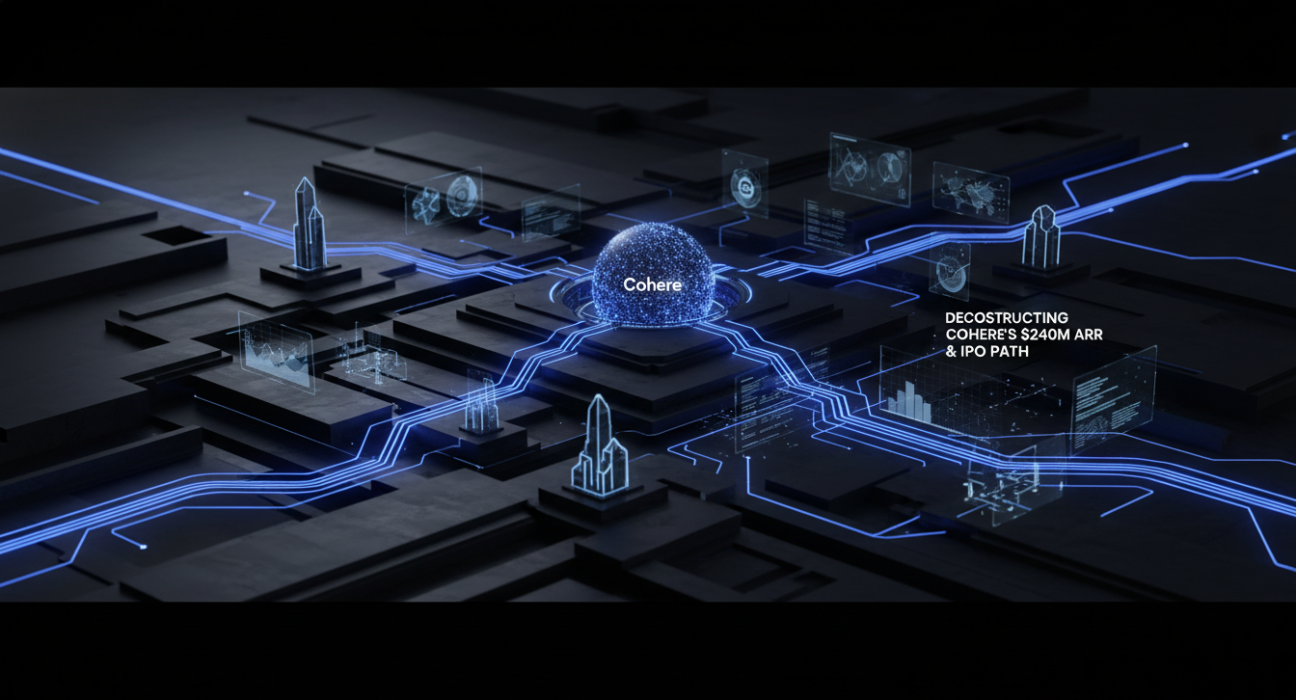
Enterprise AI Architecture: Deconstructing Cohere’s $240M ARR & IPO Path

The Pragmatist’s Singularity: Deconstructing Cohere’s $240M ARR and the Enterprise-First LLM Architecture While the broader generative AI market remains fixated on the nebulous race toward Artificial General Intelligence (AGI) and consumer-facing chatbots, a significant shift has occurred in the underlying infrastructure of the enterprise stack. Cohere, the Toronto-based heavyweight founded by Transformer paper co-authors, has

Read More
Generative AI

Meta Smart Glasses Facial Recognition: Edge Biometric Architecture Analysis

Meta Smart Glasses Facial Recognition Architecture Edge Biometrics and Multimodal Convergence: Deconstructing Meta’s Facial Recognition Roadmap for Smart Glasses The convergence of ego-centric hardware and multimodal AI has reached its predicted inflection point. Recent intelligence confirms that Meta is actively architecting facial recognition capabilities into its smart eyewear stack, a move that transitions the product

Read More
AI Hardware & Infrastructure

Wafer-Scale Revolution: Benchmarking OpenAI’s GPT-5.3-Codex-Spark Architecture

Beyond the GPU Cluster: The Architecture of OpenAI’s GPT-5.3-Codex-Spark Beyond the GPU Cluster: The Architecture of OpenAI’s GPT-5.3-Codex-Spark Analysis: OpenAI’s strategic pivot to Cerebras silicon for the GPT-5.3-Codex-Spark model represents a fundamental architectural bifurcation in Large Language Model (LLM) inference. By decoupling specific high-velocity workloads from the Nvidia H100 ecosystem, OpenAI is effectively declaring war

Read More
Space-Based AI Infrastructure

Moonbase Alpha Architecture: Synergizing SpaceX Heavy Lift with xAI’s Distributed Inference Paradigm

Executive Analysis: The convergence of SpaceX’s Starship logistics platform and xAI’s foundational model development represents a paradigm shift in off-world operations. We analyze the technical feasibility, thermal challenges, and computational sovereignty of deploying high-performance computing (HPC) clusters to the lunar surface. The Convergence of Transport and Intelligence For the past decade, the aerospace and artificial

Read More
Future of Work

IBM’s 2026 Workforce Architecture: Tripling Junior Hiring for the AI Era

The Human-in-the-Loop Renaissance: Deconstructing IBM’s Counter-Intuitive Workforce Architecture Executive Summary: While the prevailing Silicon Valley narrative suggests that Large Language Models (LLMs) and automated code generation tools like GitHub Copilot will render entry-level engineering roles obsolete, IBM has initiated a strategic divergence. By committing to triple its entry-level hiring in the US by 2026, IBM

Read More
AI Search & Discovery

Pinterest vs ChatGPT: 80 Billion Queries & The Architecture of Intent

Pinterest’s 80 Billion Query Anomaly: Analyzing Visual Search Volume vs. ChatGPT’s Generative Inference Executive Synthesis: While market sentiment reacted negatively to Pinterest’s earnings miss, a deeper architectural metric has emerged. The platform reports processing 80 billion searches monthly—surpassing current estimates for ChatGPT. This analysis deconstructs the divergence between visual discovery graphs and Large Language Model

Read More
Agentic AI

Vibe Coding Architecture: Operationalizing Agentic AI for Senior Engineers

Vibe Coding Architecture: Operationalizing Agentic AI Vibe Coding Architecture: Operationalizing Agentic AI for Senior Engineers The discourse surrounding Generative AI in software development has bifurcated into two distinct, often antagonistic camps. On one side, we observe the democratization narrative: non-engineers deploying functional applications via natural language prompting. On the other, the purist architectural perspective: a

Read More
Video Generation

Long-Form Generative Video Architecture: Analyzing the EPFL Breakthrough

Architectural Analysis: Long-Form Generative Video Beyond the Context Window: Architecting Infinite Streams in Generative Video The current trajectory of Generative AI has hit a specific, rigid ceiling: the temporal context window. While Large Language Models (LLMs) have successfully migrated from limited token counts to million-token context windows (via architectures like Ring Attention), video generation remains

Read More
Generative AI

Project Genie Architecture: Deconstructing Google’s First Foundation World Model

Beyond Static Diffusion: Deconstructing Google’s Genie and the Rise of Generative Interactive Environments (GIE) The trajectory of generative artificial intelligence has, until now, followed a linear vector: the synthesis of static modalities. We mastered text generation with LLMs; we conquered static imagery with diffusion; and recently, we began to unlock temporal consistency in video. However,

Read More