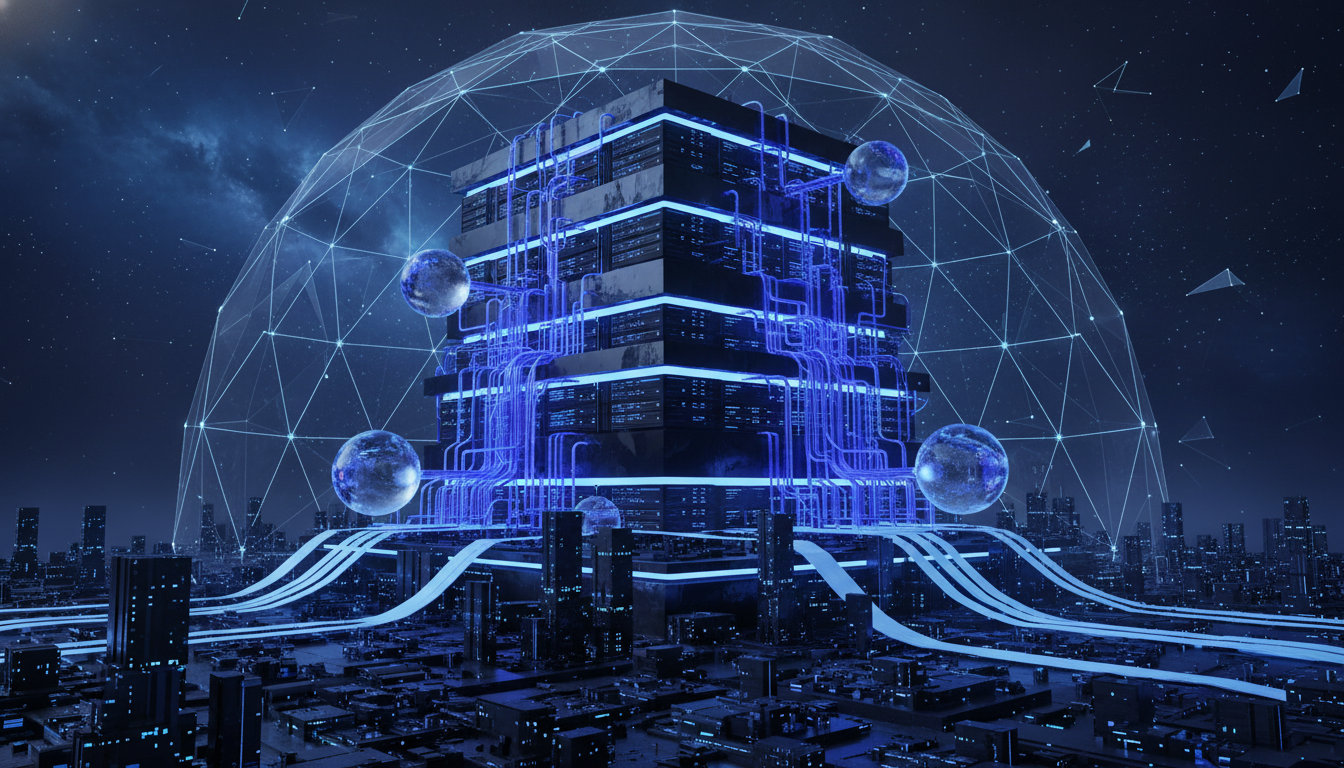
The March 2026 Paradigm Shift: Architecting the Future of Agentic AI
As a Senior Architect embedded in the frontier of machine intelligence, the landscape of artificial intelligence in March 2026 represents a pivotal structural evolution. We are no longer merely tuning large language models (LLMs) for conversational stochastic parroting; we have firmly crossed the rubicon into the era of Agentic AI. The recent injection of capital—most notably OpenAI’s staggering $12.2 billion raise—and the fierce compute wars characterized by Microsoft’s launch of three hyper-specialized autonomous models in direct competition with Google’s latest foundational architectures, signal a fundamental rearchitecting of how neural networks interact with external environments. This analysis deconstructs the underlying topologies, inference optimization strategies, and parameter-efficient fine-tuning (PEFT) methodologies that define the state-of-the-art in autonomous agent frameworks.
Deconstructing Agentic AI: Beyond the Standard Transformer Architecture
The traditional Transformer architecture, reliant on autoregressive next-token prediction, fundamentally lacks the intrinsic statefulness required for true autonomous execution. Agentic AI demands a persistent, mutable memory architecture and a robust action-space routing mechanism. We are witnessing the integration of recurrent state abstractions layered atop standard multi-head attention mechanisms, allowing models to retain execution context over exponentially longer horizons without suffering from quadratic complexity bottlenecks.
Memory State Management and Paged Attention
In classical LLM inference, the Key-Value (KV) cache grows linearly with sequence length, leading to severe memory bandwidth bottlenecks during extended agentic loops. Modern Agentic AI architectures mitigate this via PagedAttention and off-chip memory sharding. By dynamically allocating KV cache in non-contiguous blocks, we prevent memory fragmentation during multi-step reasoning tasks. This allows an agent to initiate an action, wait for an API response, and resume execution hours later without keeping the GPU entirely occupied, fundamentally altering the economics of inference latency.
The Role of Weights and Biases in Dynamic Execution
Optimizing an agent’s decision-making circuitry requires a departure from static weight matrices. The latest iterations of Google’s foundational models, revealed in their March 2026 updates, emphasize dynamic weight routing. Depending on the latent intent of the user’s prompt, the model utilizes sparse Mixture of Experts (MoE) topologies to activate specific neural pathways. The weights and biases are continuously monitored through advanced telemetry systems, allowing researchers to track reward model drift and alignment decay in real-time as agents interact with novel edge cases.
Retrieval-Augmented Generation (RAG) Optimization in Autonomous Swarms
Agentic AI relies heavily on RAG to ground its reasoning in enterprise truth. However, RAG architectures have evolved drastically from simple semantic search pipelines. The 2026 standard is Multi-Agent GraphRAG, which combines traditional vector embeddings with dynamically generated knowledge graphs, allowing agents to execute complex, multi-hop reasoning over unstructured data silos.
Vector Space Routing and Graph Context Injection
When a primary agent receives a complex objective, it dispatches sub-agents to query high-dimensional vector databases. Instead of merely retrieving top-k chunks based on cosine similarity, these sub-agents leverage approximate nearest neighbor (ANN) algorithms, specifically Hierarchical Navigable Small World (HNSW) graphs, to traverse semantic relationships. The retrieved context is not just appended to the prompt; it is injected directly into intermediate attention layers using cross-attention mechanisms, significantly reducing prompt bloat and optimizing inference latency.
Active Reasoning and Self-Correction Loops
A defining characteristic of Agentic AI is its capacity for epistemic humility—the ability to recognize failure states and self-correct. This is achieved through multi-agent debate architectures and Direct Preference Optimization (DPO). When an agent generates a sub-optimal API call or logical deduction, a secondary critic-agent evaluates the output against an internal constitutional heuristic. If the critic-agent detects a hallucination, it forces the primary agent to regenerate the trajectory using a higher temperature setting and a constrained sampling pool, effectively utilizing Tree of Thoughts (ToT) reasoning to navigate complex decision trees.
Overcoming Inference Latency: The Compute Bottleneck
The compute requirements for deploying enterprise-scale Agentic AI are staggering. The continuous action-observation-reflection loop necessitates sub-second inference latency, a formidable challenge when dealing with models exceeding 100 billion parameters. Hardware acceleration and advanced quantization techniques are paramount to operational viability.
Speculative Decoding and KV Cache Quantization
To accelerate text generation within agentic workflows, labs are heavily employing speculative decoding. A smaller, highly quantized draft model rapidly predicts a sequence of tokens, which is then verified in parallel by the massive target model. If the target model accepts the sequence, multiple tokens are generated in a single forward pass, drastically reducing memory bandwidth utilization. Furthermore, aggressively quantizing the KV cache to FP8 or even INT4 precision allows massive context windows to fit entirely within the SRAM of modern AI accelerators, bypassing the von Neumann bottleneck.
Microsoft’s Trifecta: Specialized Tool-Use Models
Microsoft’s strategic launch of three specialized models targets this exact latency bottleneck. Instead of a single monolithic model handling reasoning, retrieval, and code execution, their architecture employs a microservices approach to AI. One model is hyper-optimized purely for code generation and API interaction, boasting an inference latency reduction of 40% compared to generalized models. A second model manages semantic reasoning and planning, while the third handles safety and alignment guardrails. This distributed intelligence framework represents the enterprise blueprint for 2026.
Parameter-Efficient Fine-Tuning (PEFT) for Domain-Specific Agents
Foundational models provide the reasoning engine, but true enterprise utility requires domain-specific knowledge. Full-parameter fine-tuning is computationally prohibitive for continuously updating agentic systems. PEFT techniques, specifically Low-Rank Adaptation (LoRA) and its quantized variant (QLoRA), have become the industry standard for imbuing agents with specialized capabilities.
Dynamic LoRA Adapters and Contextual Swapping
In modern multi-agent swarms, the foundational model remains frozen. Specialized knowledge—such as legal reasoning, financial modeling, or network security protocols—is encoded into lightweight LoRA adapters. These adapters contain only a fraction of the total parameters (often less than 1%) and are dynamically swapped into GPU memory at runtime based on the agent’s current task. This allows a single deployment of a massive model to serve thousands of highly specialized agents simultaneously, maximizing hardware utilization.
Continuous Learning and Alignment
As agents autonomously navigate enterprise environments, they generate massive amounts of interaction data. This data is fed back into a continuous learning pipeline. Through algorithms like Proximal Policy Optimization (PPO), the agents’ reward models are iteratively updated, aligning their behavior more closely with human intent and corporate governance policies. Managing the weights and biases during this continuous fine-tuning process requires rigorous version control and robust interpretability tools to prevent catastrophic forgetting.
Enterprise Security, Governance, and Interpretability
Deploying autonomous agents with write-access to enterprise databases introduces unprecedented security paradigms. The traditional software security model is insufficient for non-deterministic AI systems. Architecting secure Agentic AI requires defense-in-depth strategies, focusing on isolation, interpretability, and robust access controls.
Sandboxing and Execution Environments
Agents must execute code and interact with APIs within strictly isolated sandboxes. Lightweight virtual machines and WebAssembly (Wasm) containers provide ephemeral environments where agents can compile and run generated code without compromising the host infrastructure. Network access from these sandboxes is governed by rigid zero-trust policies, ensuring that an agent cannot exfiltrate data or traverse internal networks maliciously.
Mechanistic Interpretability in Autonomous Pipelines
Understanding why an agent made a specific decision is critical for enterprise adoption. Mechanistic interpretability seeks to reverse-engineer the neural network, mapping specific high-level concepts to individual neurons or attention heads. By visualizing the activation patterns during an agent’s reasoning process, engineers can identify latent biases and logic flaws before they manifest as critical errors in production. This level of transparency is essential for regulatory compliance and trust.
Technical Deep Dive FAQ
How does Agentic AI differ from traditional foundational models in terms of architecture?
Traditional models are passive, autoregressive systems optimized for single-turn next-token prediction. Agentic AI wraps these models in complex orchestration layers that include persistent memory (via external vector databases and advanced KV cache management), planning modules, and tool-use capabilities. The architecture shifts from a simple input-output pipeline to a continuous, non-deterministic action-observation loop.
What role does GraphRAG play in reducing hallucination rates?
GraphRAG significantly reduces hallucinations by grounding the agent’s reasoning in a deterministic, multi-relational knowledge graph. Unlike standard semantic RAG, which can retrieve out-of-context chunks based solely on keyword similarity, GraphRAG maps the topological relationships between entities. This ensures that the context injected into the agent’s prompt maintains logical consistency and temporal accuracy.
How do quantization techniques like INT4 impact an agent’s reasoning capabilities?
While extreme quantization (e.g., INT4) significantly reduces memory footprints and inference latency, it can degrade the model’s ability to perform complex zero-shot reasoning. To mitigate this, architects employ mixed-precision strategies, keeping the most critical attention layers in FP16 or FP8 while quantizing the less sensitive feed-forward networks. Additionally, QLoRA enables high-precision fine-tuning over a quantized base model, restoring lost capabilities.
What is the significance of Microsoft’s micro-model strategy versus OpenAI’s monolithic approach?
Microsoft’s approach mirrors microservices architecture in traditional software engineering. By deploying specialized models for discrete tasks (planning, coding, guardrails), they optimize hardware utilization and reduce overall latency. A monolithic model must activate billions of parameters for even simple tasks, whereas specialized models allocate compute resources proportionally to the task’s complexity, a crucial advantage in multi-agent swarms.
How do engineers monitor weight degradation during continuous agentic learning?
Engineers utilize specialized ML-Ops platforms designed to track weights and biases across iterative training cycles. By comparing the distribution of weights between the foundational model and the updated LoRA adapters, they can detect statistical anomalies that precede catastrophic forgetting or alignment decay. Automated evaluation pipelines continuously run the agent against a static test suite to ensure baseline capabilities remain intact.
This technical analysis was developed by our editorial intelligence unit, leveraging insights from the original briefing found at this primary resource.