The Hidden Dashboard: Why Startups Are Stalling at Series B
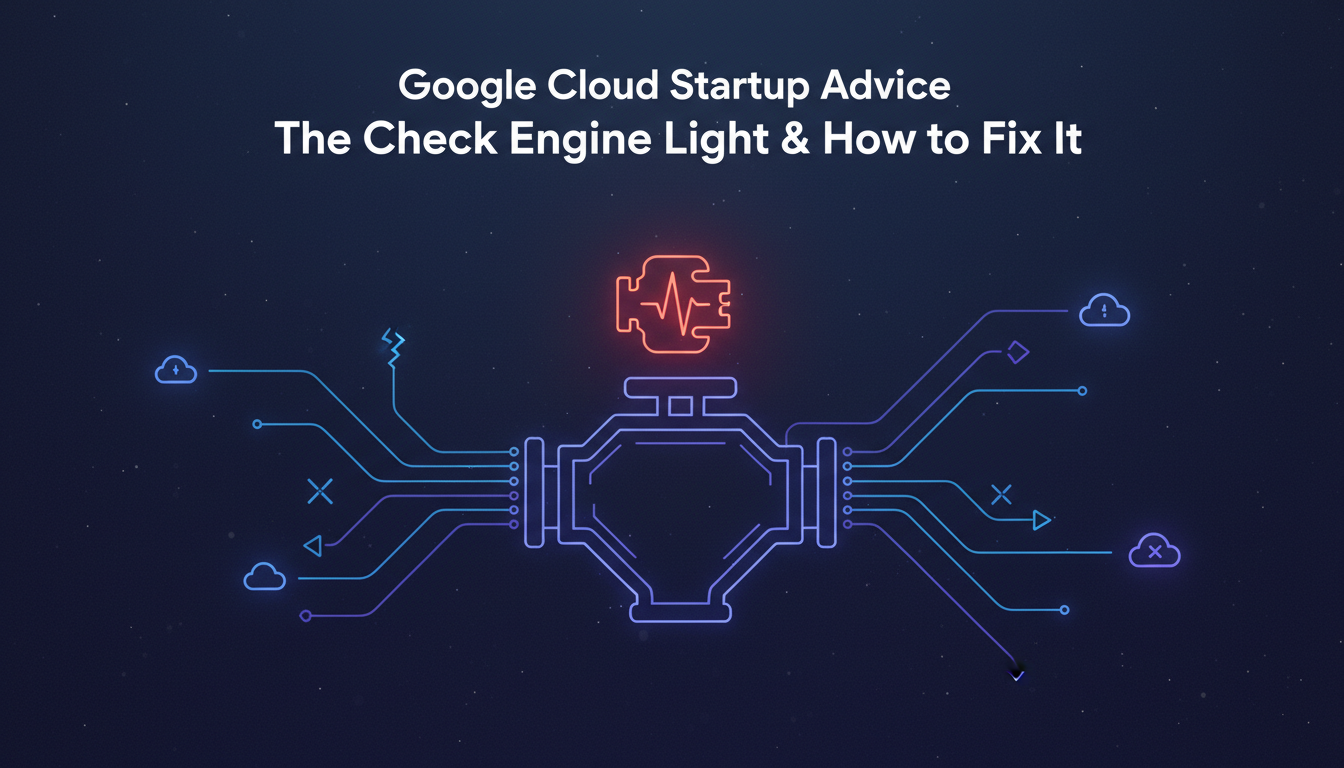
In the high-octane race of early-stage startups, speed is often the only metric that matters. Founders are encouraged to “move fast and break things,” leveraging generous cloud credits and open-source models to ship features at breakneck velocity. But according to Darren Mowry, Google Cloud’s Vice President of Global Startups, this unbridled acceleration is triggering a critical warning signal that too many founders are ignoring: the startup “check engine light.”
The metaphor is precise and alarming. Just as a driver might ignore a dashboard warning light because the car still feels fine, startup founders often ignore escalating infrastructure debt, inefficient architectural choices, and ballooning unit costs because their cloud credits are footing the bill. The engine seems to be humming—until the credits expire, the user base 10x’s, and the unit economics suddenly collapse under the weight of an unoptimized stack.
This article deconstructs Mowry’s warning and operationalizes the advice into a technical framework. We will move beyond the metaphor to provide a comprehensive guide on how to audit your startup’s infrastructure, interpret the warning signals, and re-architect for the “Post-Credit Reality” of 2026.
The Diagnostic Framework: Reading the Signals
The “check engine light” isn’t a single error log; it is a composite signal derived from financial, technical, and operational metrics. Mowry and the Google Cloud startup leadership team have identified specific patterns that precede an infrastructure seizure. To diagnose your own startup, you must look for these four specific warning codes.
1. The Unit Economics Divergence
The most dangerous signal is when your cloud spend grows non-linearly compared to your revenue or user growth. In the early days, a $10,000 monthly cloud bill covered by credits feels irrelevant. But if acquiring 1,000 new users doubles your infrastructure cost while only increasing revenue by 20%, you have a fundamental architectural flaw.
- The Symptom: You cannot calculate the exact COGS (Cost of Goods Sold) for a single API call or user session.
- The Fix: Implement rigorous FinOps tagging immediately. Every resource in Google Cloud Platform (GCP)—from GKE clusters to Vertex AI endpoints—must be tagged by product feature, team, or customer tenant.
2. The “Monolith” AI Trap
Many AI startups begin by deploying massive, general-purpose foundation models for every task because they are easy to integrate. Mowry notes that while this works for prototyping, it is catastrophic for scaling. Using a 70B parameter model to summarize a 50-word email is like using a sledgehammer to crack a nut—it burns unnecessary compute and latency.
For a deeper look at efficient model architecture, consider our analysis of architecting hyper-scale inference, which explores how top-tier firms optimize their compute-to-output ratios.
3. The Observability Black Hole
If your engineering team spends more time debugging production outages than shipping code, your check engine light is flashing red. This usually indicates that observability was an afterthought. In a distributed AI system, you need to trace a request from the frontend, through the API gateway, into the inference layer, and back. If you lose visibility at the model layer, you cannot optimize it.
4. Security Debt Accumulation
Speed often necessitates permissive IAM (Identity and Access Management) roles. Founders grant “Editor” access to everyone to avoid permission bottlenecks. As the team scales, this creates a massive attack surface. The warning sign here is a lack of automated policy enforcement—if a junior developer can accidentally delete a production database, your engine is unsafe.
Architectural Pivot: From Prototyping to Production
Once you’ve identified that the light is on, how do you fix the engine without stopping the car? The transition from a “Credit-Fueled Prototype” to a “Sustainable Enterprise” requires three specific architectural pivots.
Pivot 1: specialized Models vs. Generalist Giants
Google Cloud advises a “tiering” strategy for AI inference. Instead of routing all traffic to a flagship model like Gemini Ultra, architect a gateway that classifies request complexity.
- Tier 1 (Simple): Use lightweight, distilled models (e.g., Gemma 2B or similar) for basic classification, routing, and simple extraction tasks. These run cheaply on standard GPUs or even CPUs.
- Tier 2 (Complex): Route only high-value, complex reasoning tasks to the large foundation models.
This approach mirrors the strategies seen in Google Ask Photos architecture, where a multimodal RAG system orchestrates different models based on query intent.
Pivot 2: The “Shift Left” on Cost
Engineers often treat cost as a finance problem. To turn off the check engine light, cost must become an engineering constraint. This means integrating cost estimation into the CI/CD pipeline. Before a pull request is merged, the system should estimate the potential increase in cloud spend.
Technical Implementation:
Use tools like Infracost or GCP’s pricing API within your GitHub Actions or GitLab CI. If a developer bumps a requested instance type from `n1-standard-4` to `n1-highmem-16`, the PR should be flagged automatically with the projected monthly cost increase.
Pivot 3: Automated Governance
Manual oversight fails at scale. You need policy-as-code. Using Google Cloud’s Organization Policies and Terraform, you can enforce guardrails that prevent the deployment of non-compliant resources. For example, you can restrict the creation of public IP addresses or limit GPU provisioning to specific regions to control costs.
We see similar governance models in enterprise AI middleware architectures, where Access Control Lists (ACLs) are baked into the retrieval layer itself.
The AI Factor: New Signals for 2026
For AI-native startups, the check engine light has new, unique bulbs. The traditional metrics of CPU and RAM are joined by Token Burn Rate and Vector Drift.
Token Burn Rate
Are your prompts optimized? A common inefficiency is sending massive context windows when only a fraction is needed. Monitoring the ratio of input tokens to valuable output is critical. If you are sending 10,000 tokens of context to generate a “Yes/No” answer, you are burning cash.
Vector Store Latency
As your RAG (Retrieval-Augmented Generation) database grows, query latency can spike. What worked with 10,000 documents fails at 10 million. The fix involves implementing hybrid search (keyword + semantic) and re-ranking layers, rather than relying solely on brute-force vector similarity.
For insights on scaling these systems, look at the engineering behind Moonshot AI’s 2M token paradigm, which handles massive context without breaking the bank.
The Executive View: Scaling Without Selling Out
The core of Mowry’s advice is about agency. Founders who ignore the check engine light eventually lose control of their destiny. When the burn rate becomes unsustainable, they are forced to raise funds on unfavorable terms or sell the company at a discount. By addressing infrastructure debt early, you preserve your runway and your leverage.
Google Cloud’s ecosystem is evolving to support this “smart scaling.” Programs like the ISV Startup Springboard and enhanced observability in Vertex AI are designed to give founders the diagnostic tools they need. However, tools are useless without the mindset to use them.
Successful scaling is not just about having the best AI model; it is about wrapping that model in a boring, reliable, cost-effective infrastructure. As seen in the IPO path of Cohere, the companies that survive are the ones that treat infrastructure as a strategic asset, not a utility bill.
Frequently Asked Questions
What is the “check engine light” for a startup?
It is a metaphor used by Google Cloud VP Darren Mowry to describe early warning signs of infrastructure debt, such as cloud costs growing faster than revenue, lack of observability, and inefficient model architecture. Ignoring these signs while relying on free cloud credits often leads to critical failures when scaling.
How can I reduce my AI startup’s cloud bill?
Start by implementing FinOps tagging to understand unit costs. Then, optimize your model usage by using smaller, specialized models for simple tasks and reserving large foundation models for complex reasoning. Finally, ensure your RAG architecture is efficient by pruning context windows.
Why are cloud credits dangerous for startups?
Cloud credits can mask the true cost of doing business. They allow inefficient code and architecture to persist because the financial penalty is delayed. When credits expire, startups often face a “sticker shock” that can cripple their runway.
What tools does Google Cloud offer to fix this?
Google Cloud provides Looker for visualizing cost data, BigQuery for analyzing billing logs, Vertex AI Monitoring for tracking model performance and drift, and Recommender capabilities that suggest cost-saving infrastructure changes automatically.