Llama 4 Architecture & Licensing Analysis: Is Meta’s Next Frontier Truly Open Source?
Executive Summary: As the generative AI landscape pivots from purely generative capabilities to agentic reasoning and multimodal fluency, Meta Platforms is engineering a seismic shift with Llama 4. Currently training on a compute cluster dwarfing industry standards—reportedly exceeding 100,000 NVIDIA H100 GPUs—Llama 4 represents not just a model update, but a fundamental challenge to the closed-source hegemony of OpenAI and Anthropic. This technical analysis deconstructs the architectural specifications, the nuanced reality of its “open source” licensing, and the implications for enterprise RAG (Retrieval-Augmented Generation) pipelines in 2025.
The Licensing Paradigm: Is Llama 4 Open Source?
The core entity driving current enterprise discourse—is Llama 4 open source—requires a dissection of legal definitions versus engineering realities. If historical precedence established by Llama 2 and Llama 3 holds, Llama 4 will likely operate under a custom Meta Community License rather than a standard OSI-approved license (like Apache 2.0 or MIT).
Technically, this constitutes an “Open Weights” release rather than strictly “Open Source.” For the senior architect, this distinction is critical for compliance but negligible for innovation. You receive the trained parameters (weights and biases), the tokenizer, and the inference code, allowing for full on-premise deployment, fine-tuning, and quantization. However, you do not receive the training dataset or the raw training recipe/hyperparameters.
The Strategy of Commoditization
Mark Zuckerberg’s strategy is transparent: commoditize the foundational layer of intelligence to prevent a closed-source monopoly. By releasing Llama 4’s weights, Meta forces competitors like Google (Gemini) and OpenAI (GPT-series) to compete on service layers rather than raw intelligence. For developers, this means Llama 4 will likely remain free for research and commercial use, provided the user does not exceed a massive Monthly Active User (MAU) threshold (previously set at 700 million users).
Architectural Specifications: The 100k H100 Cluster
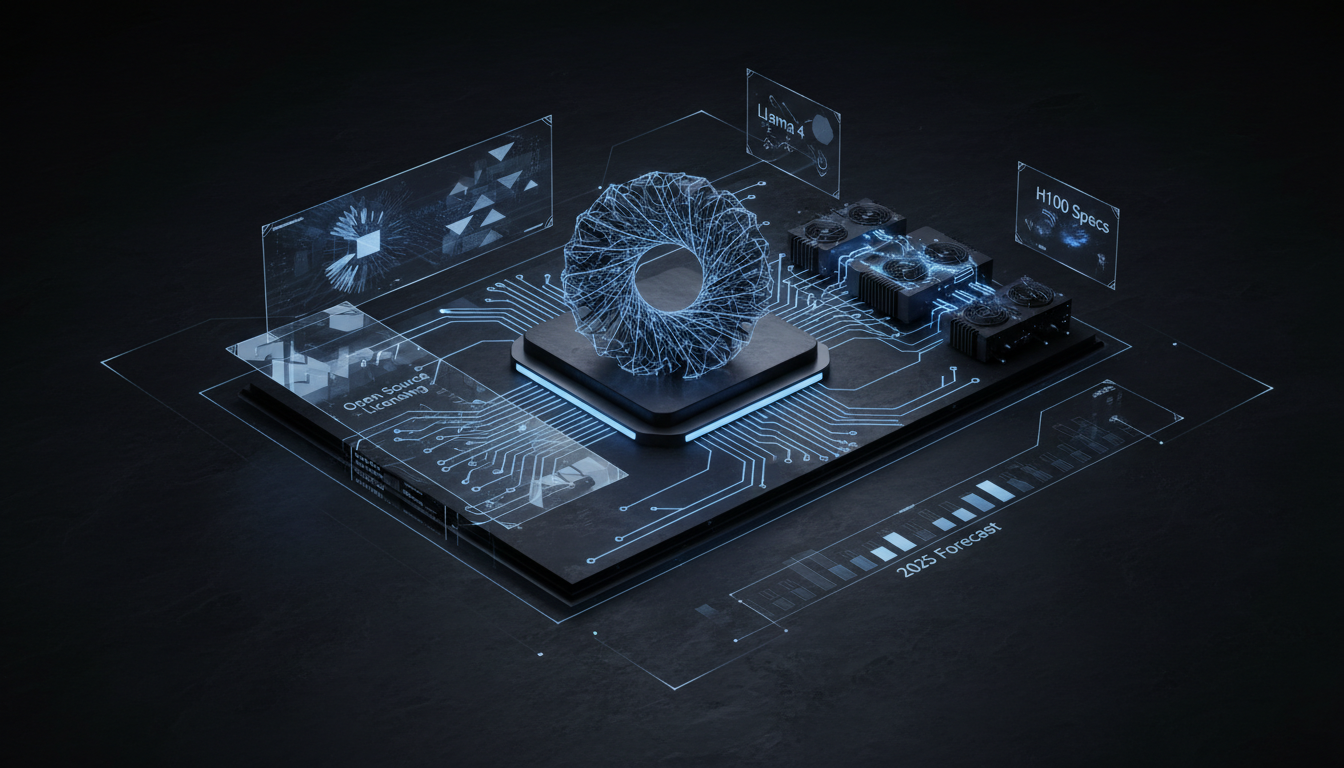
The computational scale allocated to Llama 4 is unprecedented. Reports confirm that Meta is training this next-generation model on a cluster larger than anything used for Llama 3. The infrastructure likely utilizes NVIDIA’s H100 Tensor Core GPUs, interconnected via high-bandwidth InfiniBand or RoCE (RDMA over Converged Ethernet) to minimize latency during the all-reduce operations critical in distributed training.
Training Compute and Parameter Scaling
If Llama 3.1 peaked at 405 billion parameters, we project Llama 4 to push the boundaries of dense models, potentially approaching the trillion-parameter mark, or more likely, optimizing a massive Mixture-of-Experts (MoE) architecture. An MoE approach would allow Llama 4 to maintain manageable inference latency (active parameters) while scaling total knowledge capacity (total parameters) significantly.
- Total Compute (FLOPs): We anticipate training compute to exceed $10^{26}$ FLOPs, placing it firmly in the post-GPT-4 compute class.
- Architecture: Likely a standard decoder-only Transformer with Grouped-Query Attention (GQA) for optimized KV cache usage, but with enhanced multimodal layers native to the backbone.
- Context Window: Expect a baseline of 128k tokens, with potential extended versions reaching 1M+ tokens to support “needle-in-a-haystack” retrieval tasks inherent in legal and medical analysis.
Capabilities: Multimodality and Agentic Reasoning
The frontier of 2025 is not text generation; it is reasoning. Llama 4 is being trained to internalize “System 2” thinking—the slow, deliberative reasoning processes exemplified by models like OpenAI’s o1. However, unlike closed models where the Chain-of-Thought (CoT) is hidden, an open-weight Llama 4 would allow researchers to inspect and steer these reasoning traces.
Native Multimodality
Unlike Llama 3, which had multimodal capabilities grafted onto it post-training or via separate adaptors, Llama 4 is expected to be natively multimodal. This means images, audio, and video were part of the pre-training token stream. This architectural decision results in significantly higher semantic alignment between visual inputs and textual reasoning, reducing hallucination rates in vision-language tasks.
Release Date Projections and Training Timelines
Analyzing the deployment of the GPU cluster and typical training durations for models of this magnitude, a staggered release is the most probable scenario.
- Q1 2025: Announcement and potentially smaller checkpoints (e.g., 7B or 10B versions).
- Q2-Q3 2025: Release of the flagship dense/MoE models (e.g., 400B+ parameters).
Meta has historically aligned releases to disrupt competitor cycles. With GPT-5 rumored for late 2024 or early 2025, a Llama 4 release in the first half of 2025 serves as a strategic counter-measure, ensuring the open-source community does not migrate entirely to proprietary APIs.
Technical Implications for Enterprise RAG
For the technical architect, Llama 4 changes the calculus of Build vs. Buy. The ability to fine-tune a SOTA (State-of-the-Art) model like Llama 4 on proprietary corporate data using techniques like LoRA (Low-Rank Adaptation) or QLoRA offers superior data privacy and domain specificity compared to generic API calls.
Inference Economics
Running Llama 4, particularly its largest variants, will require substantial VRAM. We anticipate the ecosystem to rapidly adapt with quantization formats (GGUF, EXL2) allowing these models to run on consumer-grade hardware or optimized enterprise nodes (e.g., NVIDIA L40S or H200s). The focus will shift from “can we run it?” to “what is the token-per-second throughput at FP8 precision?”
Llama 4 vs. The Closed Frontier (GPT-5 & Claude)
The definitive battle of 2025 will be between Llama 4’s open accessibility and the proprietary magic of GPT-5. While closed models may hold a slight edge in raw zero-shot reasoning due to undisclosed reinforcement learning techniques (RLHF/RLAIF), Llama 4 closes the gap through community optimization. Once weights are public, the global developer community optimizes inference kernels, builds unaligned variants, and creates domain-specific fine-tunes that often outperform generic closed models in niche benchmarks.
Technical Deep Dive FAQ
Will Llama 4 use a Mixture-of-Experts (MoE) architecture?
While unconfirmed, the shift to MoE is highly probable for the largest model variants to decouple inference cost from model size. This allows Meta to boast trillion-parameter scale intelligence with the inference latency of a much smaller model.
What hardware is required to run Llama 4 locally?
For the 70B+ parameter variants, you will likely need multi-GPU setups (e.g., 2x RTX 4090 or A100s/H100s). However, 4-bit quantization will likely allow mid-sized variants to run on high-end Mac Studios or single consumer GPUs with 24GB VRAM.
Does “Open Weights” allow for commercial use?
Yes, generally. Unless you are a hyperscaler with >700M monthly users, the standard Meta Community License permits commercial integration, SaaS deployment, and internal enterprise usage.
How does Llama 4 handle context length compared to Llama 3?
Llama 4 is expected to normalize the 128k context window across all sizes, utilizing Ring Attention or similar mechanisms to maintain coherence over long documents, essential for legal and code repository analysis.
This technical analysis was developed by our editorial intelligence unit, leveraging insights from the original briefing found at this primary resource.