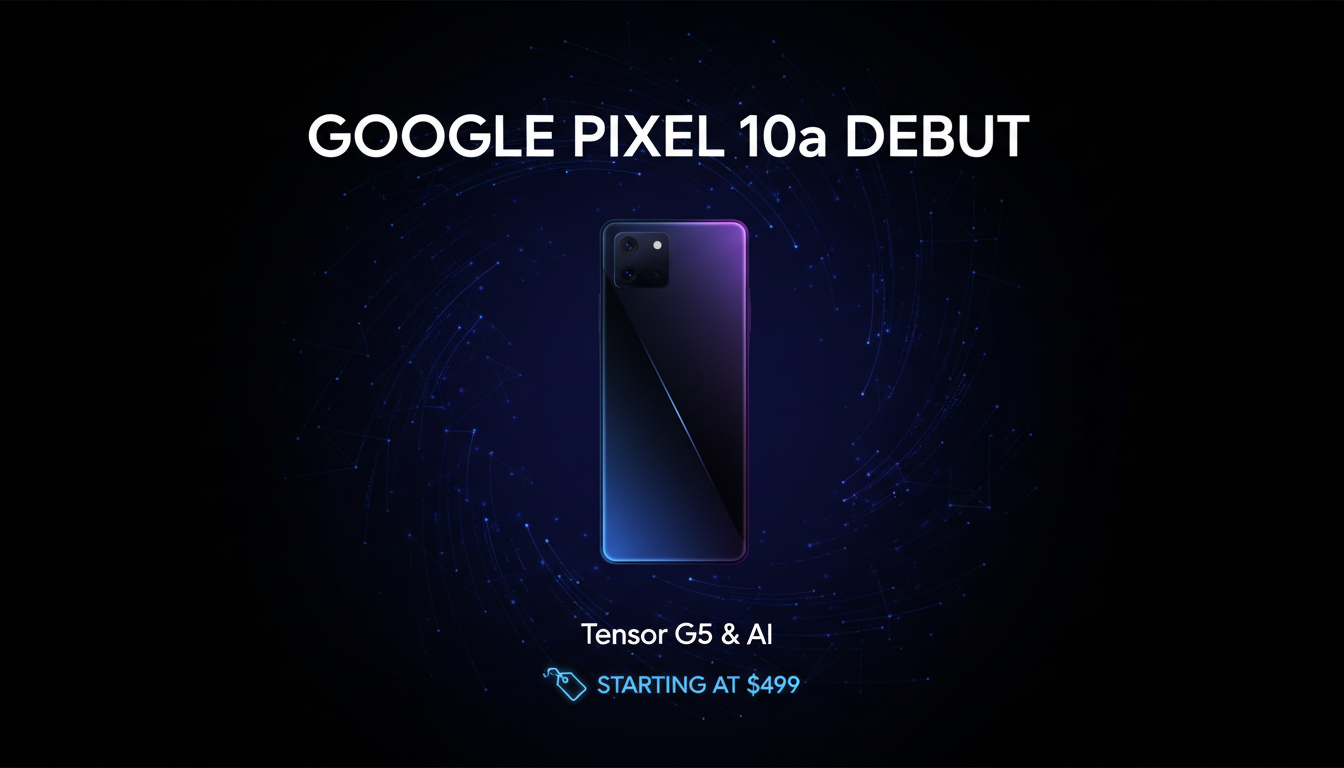
The Democratization of Silicon: Analyzing the Pixel 10a Debut
Google has officially successfully recalibrated the mid-range smartphone market with the debut of the Pixel 10a. Priced aggressively at $499, the device represents a significant architectural pivot in Google’s hardware strategy, most notably by integrating the Tensor G5 SoC—the company’s first custom silicon fabricated on TSMC’s 3nm process—into its “A-series” budget line. This move effectively ends the era of Samsung Foundry-based Exynos derivatives for the Pixel family, addressing long-standing thermal and efficiency criticisms while democratizing access to on-device generative AI.
For technical professionals and enterprise buyers, the Pixel 10a is not merely a budget alternative; it is a case study in component amortization and software-defined value. By bringing the flagship compute architecture of the Pixel 10 down to a sub-$500 price point, Google is aggressively targeting the “AI-native” installed base, leveraging the device as a delivery vehicle for its Gemini Nano and Android 16 ecosystem.
Technical Architecture: The TSMC Turnaround
The defining characteristic of the Pixel 10a is its silicon. Contrary to early supply chain rumors suggesting a retention of the Tensor G4 to cut costs, Google has equipped the 10a with the Tensor G5. This is a critical distinction that dictates the device’s thermal envelope, battery efficiency, and inference capabilities.
Tensor G5 vs. The Legacy Stack
The shift from Samsung’s 4nm LPP+ node (used in Tensor G4) to TSMC’s 3nm (N3E) process node for the Tensor G5 delivers tangible engineering benefits:
- Thermal Design Power (TDP): The N3E node offers roughly 30% better power efficiency at the same clock speeds compared to the previous generation. This allows the Pixel 10a to sustain peak performance for longer durations without the aggressive throttling observed in the Pixel 7a and 8a.
- NPU Throughput: The custom TPU (Tensor Processing Unit) on the G5 is designed specifically for transformer models. This enables the Pixel 10a to run Gemini Nano efficiently, processing summarization and generative tasks locally rather than offloading to the cloud.
- Modem Integration: The 10a benefits from a new distinct modem architecture, addressing the signal stability issues that plagued previous iterations.
For a deeper understanding of the manufacturing implications of this shift, see our analysis on the Wafer Scale Revolution and how node shrinks impact model performance.
Display and Visual Pipeline
The Pixel 10a sports a 6.3-inch Actua OLED display, pushing a variable refresh rate of 60Hz-120Hz. While it lacks the LTPO capabilities of the “Pro” models (which can drop to 1Hz), the move to a 120Hz baseline is a necessary modernization for the segment.
Google claims an 11% brightness increase over the Pixel 9a, targeting 1,400 nits in High Brightness Mode (HBM). This is achieved through a new emitter material stack that improves luminous efficacy, reducing the display’s power draw—a critical factor given the battery constraints of a smaller chassis.
Camera System: Computational Photography on a Budget
The camera architecture of the Pixel 10a reflects a classic Google strategy: utilizing mature sensor hardware and augmenting it with state-of-the-art computational photography pipelines.
- Primary Sensor: 48MP Quad Bayer wide camera. The sensor utilizes pixel binning to output 12MP images with 1.6µm equivalent pixel size, optimizing for low-light signal-to-noise ratio (SNR).
- Ultrawide: 13MP sensor with a 120-degree field of view.
- Missing Telephoto: As expected, there is no dedicated telephoto lens. Instead, Google relies on “Super Res Zoom,” which uses the high-resolution crop from the 48MP main sensor and multi-frame synthesis to reconstruct detail at 2x and up to 8x digital zoom.
The Image Signal Processor (ISP) within the Tensor G5 is the workhorse here. It enables features like “Real Tone” video and “Night Sight” with reduced latency. Interestingly, Google has integrated portions of the Ask Photos architecture directly into the default gallery experience, allowing users to query their local photo library using natural language processing.
AI Integration: The Gemini Nano Implementation
The Pixel 10a is marketed as an “AI-first” device, but hardware constraints necessitate clever engineering. With 8GB of LPDDR5X RAM, the device is at the lower limit for running modern on-device Large Language Models (LLMs).
Memory Management and Quantization
To fit Gemini Nano into the memory footprint without killing background apps, Google utilizes aggressive 4-bit quantization and Android 16’s new memory paging hierarchies. The operating system dynamically reserves a “neural partition” in RAM when the NPU is active, flushing non-essential cache immediately.
This implementation supports features such as:
- Magic Compose: Rewriting text messages in different tones within Android Messages.
- Pixel Screenshots: Using multimodal analysis to index and retrieve information from saved screenshots.
- Call Assist: Real-time transcription and menu navigation.
The efficiency of this setup is comparable to the techniques discussed in our guide on Quantizing LLMs Step-by-Step, showing how lower precision can maintain utility in constrained environments.
Software Ecosystem: Android 16 and Long-Term Support
The Pixel 10a launches with Android 16, an OS update focused heavily on “Natively Adaptive Interfaces.” This version introduces granular control over notification intensity and “Satellite SOS” connectivity, a feature previously reserved for flagship tiers. The inclusion of satellite connectivity requires specific antenna designs and modem support, further validating the architectural upgrades in the communication stack.
Google has committed to 7 years of OS and security updates for the 10a. This longevity challenges the industry standard for mid-range devices, where 3-4 years is typical. For enterprise fleets, this reduces the total cost of ownership (TCO) significantly, aligning with trends we’ve analyzed in enterprise workforce architectures.
Connectivity and Battery Performance
Battery life has been a historical pain point for the A-series. The Pixel 10a addresses this with a 4,600 mAh battery paired with the efficient Tensor G5. Google claims “30+ hours” of regular use. The device supports 30W wired charging, a modest improvement, but sufficient for the capacity.
Connectivity specs include:
- Wi-Fi 7: Future-proofing for high-throughput home and office networks.
- Bluetooth 5.4: Supporting Auracast and low-energy audio.
- Ultrawideband (UWB): Notably absent. The 10a drops UWB to save costs, meaning digital car key features will rely on NFC, and precision finding for trackers will be less accurate than on the Pro models.
Comparative Analysis: Pixel 10a vs. The Market
At $499, the Pixel 10a sits in a volatile segment. Its primary competitors include the Samsung Galaxy A55 (or A56) and the entry-level iPhone SE (4th Gen).
- Vs. Samsung: Samsung offers better raw display specs (often brighter, larger) but lags significantly in NPU performance and software update longevity. The local inference capabilities of the Pixel 10a far outstrip the Exynos mid-range chips.
- Vs. Apple: The iPhone SE provides raw CPU speed but historically compromises on screen technology (LCD vs. OLED) and camera versatility (single lens).
Conclusion: A New Benchmark for Mid-Range Logic
The Pixel 10a is a triumph of component orchestration. By porting the Gemini architecture and TSMC-made silicon to a sub-$500 chassis, Google has created a device that punches well above its weight class in computational tasks. While the 8GB RAM ceiling and lack of telephoto lens are clear compromises, they are calculated trade-offs that allow the core “Pixel Experience” to remain uncompromised.
For developers and AI enthusiasts, the Pixel 10a represents the most accessible entry point into the modern Android AI stack. It validates the hypothesis that Edge AI is not just a premium feature, but a fundamental baseline for the next generation of mobile computing.
Frequently Asked Questions
Q: Does the Pixel 10a use the exact same chip as the Pixel 10 Pro?
Yes, the Pixel 10a uses the Tensor G5 architecture. However, thermal throttling thresholds may be lower due to the smaller cooling solution compared to the Pro models.
Q: Can the Pixel 10a run all Gemini features?
Most Gemini Nano features run locally. However, extremely memory-intensive tasks may be offloaded to the cloud or run with higher latency due to the 8GB RAM limitation, unlike the 12GB/16GB on flagship models.
Q: How does the camera compare to the Pixel 9a?
The hardware is similar, but the Tensor G5 ISP enables faster processing, better video stabilization, and reduced grain in low-light video, marking a significant step up in “shoot-to-save” latency.
Q: Does it support 5G mmWave?
Support depends on the carrier model. The unlocked version typically supports Sub-6GHz 5G, while specific carrier variants (often priced higher like the Verizon model) include mmWave antennas.