Analysis by the Editorial Intelligence Unit | Senior Technical Architecture Division
The initial frenzy of the generative AI era focused almost exclusively on the foundational model layer. Organizations scrambled to secure API access to GPT-4, Claude, and Llama, treating the Large Language Model (LLM) as the terminal solution. This was a fundamental architectural error. As we move deep into the deployment phase, the narrative has shifted aggressively from model capability to contextual utility. The real war is not being fought over who has the smartest model, but who owns the orchestration layer—the middleware that connects frozen model weights to live, proprietary enterprise data.
This analysis dissects the rise of “Enterprise AI Middleware,” with a specific focus on the architectural patterns exemplified by platforms like Glean. We are witnessing a transition where the interface is secondary to the underlying knowledge graph. This is the era of the “Enterprise Brain,” where Retrieval-Augmented Generation (RAG) moves from a Python script novelty to a governed, permission-aware infrastructure standard.
The Post-Model Era: Why Middleware is the New Battleground
For the enterprise architect, the raw LLM is insufficient. It is a reasoning engine without memory. While context windows have expanded to 1M+ tokens, simply stuffing documents into a prompt is neither cost-effective nor latency-efficient for query-time inference on petabyte-scale datasets. The solution lies in the decoupling of reasoning (the LLM) from knowledge (the Enterprise Index).
Beyond the Chatbot: The Knowledge Graph as an Operating System
Glean and similar emerging entities are not building “search engines” in the traditional lexical sense. They are constructing a semantic operating system. In this architecture, the middleware layer serves as a bidirectional translation interface. It ingests unstructured data from silos—Jira tickets, Slack threads, Salesforce records, Google Drive documents—and transforms them into high-dimensional vector embeddings.
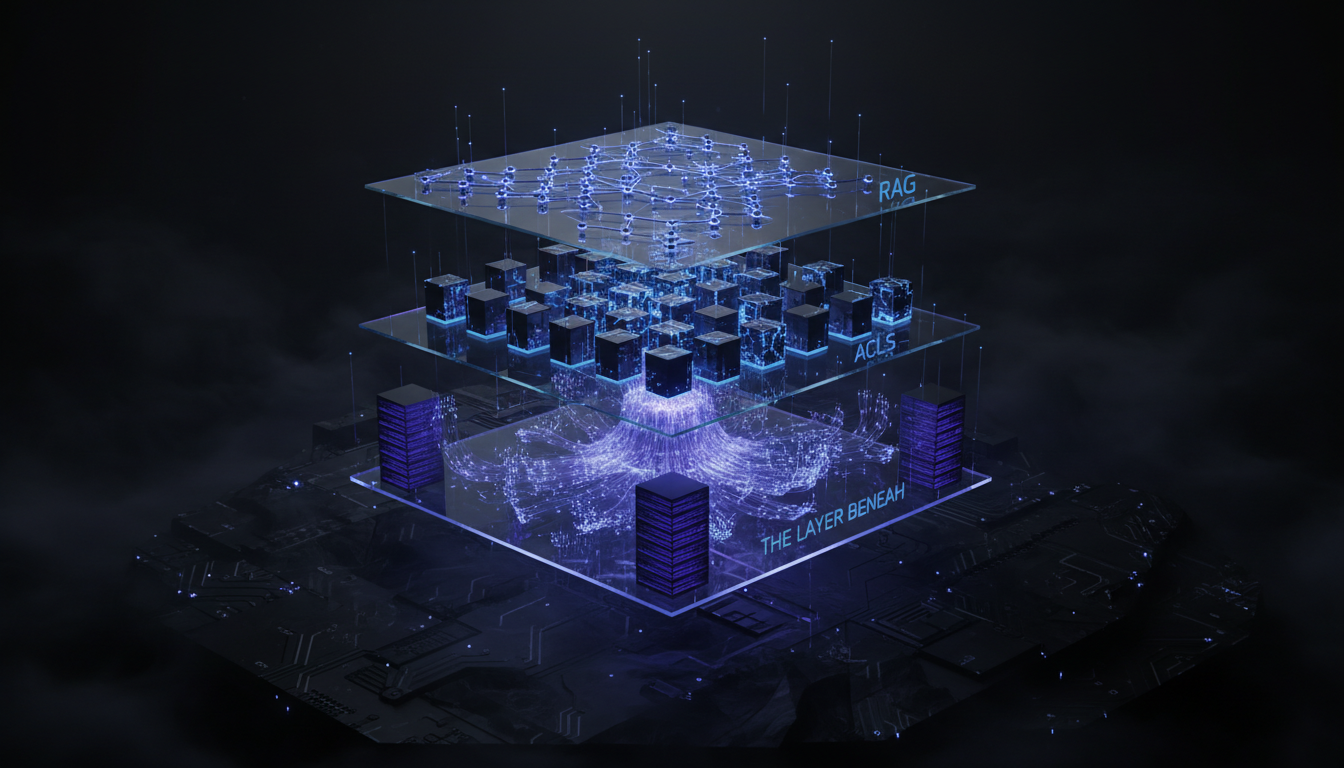
When a user executes a query, the system does not merely keyword-match. It performs a cosine similarity search across a vector database to retrieve context, validates permissions via an Access Control List (ACL) governance layer, and only then synthesizes the answer via the LLM. This pipeline transforms the LLM from a hallucination-prone creative writer into a grounded analyst.
Architectural Anatomy of Enterprise RAG
To understand the “land grab” for the layer beneath the interface, we must technically deconstruct the stack required to make AI work in a SOC2-compliant environment. The barrier to entry is no longer the model; it is the integration complexity.
Vectorization and Semantic Indexing at Scale
The core differentiator for platforms like Glean is the continuous indexing pipeline. In a standard RAG setup, latency in data freshness is a critical failure point. If a sales contract is updated in Salesforce, the vector index must reflect that change near-instantaneously. This requires:
- Incremental Embedding Updates: Rather than full re-indexing, the system must detect delta changes in source systems and update only the relevant vector clusters.
- Hybrid Search Methodologies: Pure vector search often fails at specific keyword retrieval (e.g., product SKUs or exact error codes). The superior architecture utilizes a hybrid ensemble approach, combining dense vector retrieval with sparse lexical search (BM25), re-ranked by a cross-encoder for maximum relevance.
The Governance Layer: Permission-Aware Inference
The single greatest technical hurdle in enterprise AI adoption is not intelligence, but security. A generalized model trained on the open internet has no concept of “User A” vs. “User B.” In a corporate environment, a junior engineer asking “What is the Q3 strategy?” should receive a different answer—or no answer—compared to the VP of Engineering asking the same question, based on document access levels.
This requires Permission-Aware RAG. The middleware must ingest the ACLs from every connected data source (Google Workspace, Microsoft 365, Atlassian). During the retrieval phase, the system effectively filters the vector space based on the user’s identity token before any content is passed to the generation model. This ensures that the AI respects the “principle of least privilege” inherent in the underlying data sources.
Glean and the Commoditization of the Model Layer
The strategic genius of building the “layer beneath the interface” is that it treats the LLM as a commodity. Whether the reasoning engine is GPT-5, Gemini Ultra, or an open-source Mixtral model running on-premise, the value accrues to the index, not the model provider.
LLM Agnosticism: Decoupling Intelligence from Storage
By controlling the connector ecosystem and the knowledge graph, middleware platforms insulate the enterprise from model churn. Today, GPT-4 might be the state-of-the-art (SOTA). Tomorrow, a specialized fine-tuned model might offer better performance at lower inference costs. An architecture like Glean’s allows the enterprise to hot-swap the inference engine while keeping the data index intact. This abstraction layer is critical for long-term technical debt management.
Preventing Vendor Lock-in via API Abstraction
Enterprises building directly on top of OpenAI’s Assistants API risk deep vendor lock-in. By utilizing a middleware platform, the business logic binds to the middleware’s API, which then proxies requests to whichever model is currently optimal. This creates a hedge against fluctuating API pricing and model deprecation cycles.
From Retrieval to Action: The Agentic Shift
The current phase of the “land grab” is focused on retrieval (finding information). The next horizon, which we are already seeing deployed in beta environments, is agentic execution (doing work). The middleware is evolving from a read-only system to a read-write orchestration engine.
Function Calling and Deterministic Outputs
The evolution involves mapping natural language intents to deterministic API calls. If a user asks, “Schedule a meeting with the Q3 incident team,” the system must:
- Retrieve: Identify who is on the Q3 incident team from Notion or Jira.
- Reason: Determine available slots via the Calendar API.
- Execute: Send the invite via the Graph API.
This requires the middleware to maintain a registry of executable tools and function schemas. The complexity here lies in error handling and loop prevention—ensuring the AI agent doesn’t enter a recursive state or execute destructive actions without human-in-the-loop validation.
The Build vs. Buy Paradox in AI Infrastructure
Technical leadership often wrestles with the decision to build an internal RAG stack using LangChain and Pinecone versus purchasing a platform like Glean. While the “Build” route offers maximum customizability, the maintenance overhead of writing connectors for 100+ SaaS applications is non-trivial. The API schemas for Slack, Jira, and ServiceNow change frequently. A dedicated middleware provider amortizes the cost of maintaining these connectors across thousands of customers.
Consequently, we are seeing a shift where internal engineering teams focus on building applications on top of the middleware, rather than building the infrastructure plumbing itself. This parallels the shift to Cloud infrastructure a decade ago; few companies today build their own data centers.
Technical Deep Dive FAQ
What is the primary latency bottleneck in Enterprise RAG architectures?
The primary bottleneck is often the “Time to First Token” (TTFT) compounded by the retrieval step. This includes the vector database query time, the re-ranking process (which is computationally expensive but necessary for accuracy), and the context loading into the LLM. Optimizations include semantic caching (storing previous query-response pairs) and speculative decoding.
How does Enterprise Middleware handle “Data Poisoning” in the index?
Data poisoning occurs when outdated or incorrect documents pollute the retrieval context. Advanced middleware employs “recency weighting” in the ranking algorithm and enables manual “boost/bury” controls for administrators to curate the index. Furthermore, automated inconsistency detection agents are beginning to emerge to flag conflicting data points within the knowledge graph.
Can this architecture support Parameter-Efficient Fine-Tuning (PEFT)?
Yes. While RAG provides context, fine-tuning provides style and domain-specific syntax. A mature middleware architecture allows for the routing of prompts to LoRA (Low-Rank Adaptation) adapters specific to certain departments (e.g., a Legal adapter vs. an Engineering adapter) while sharing the same underlying base model and vector index.
What is the role of Knowledge Graph construction alongside Vector Search?
Vector search is probabilistic; Knowledge Graphs are deterministic. The most robust systems use GraphRAG, where entities (people, projects, files) are linked explicitly. This allows the system to answer multi-hop queries like “Who worked on the project referenced in the Q3 audit?”—a question that pure vector similarity often fails to answer accurately because the connection is relational, not just semantic.