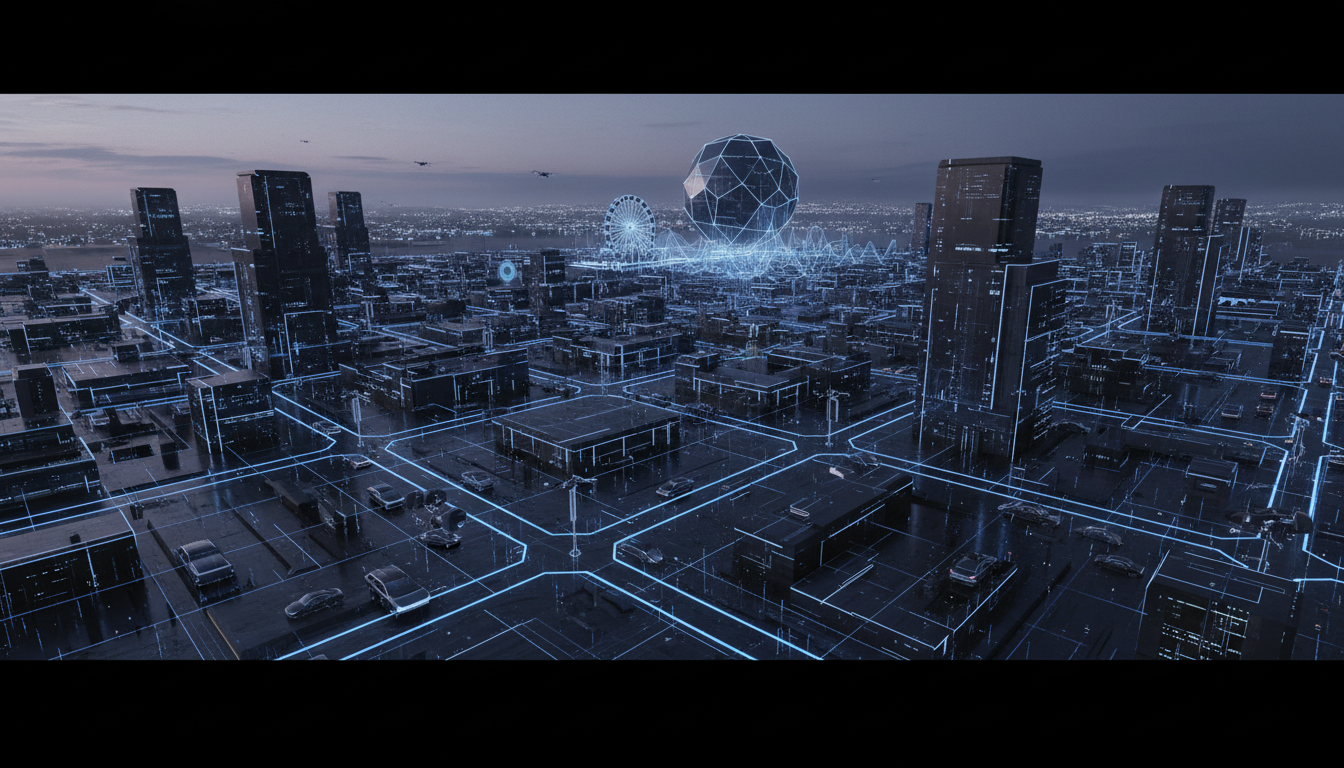
The Autonomy of Order: How Edge AI is Redefining Urban Mobility Enforcement
The digitization of municipal infrastructure has historically been a static endeavor—fixed sensors, inductive loops, and CCTV grids feeding into centralized traffic management centers. However, a paradigmatic shift is occurring in the architecture of smart cities. We are moving from passive observation to active, mobile inference. The latest deployment in Santa Monica, utilizing AI-powered vision systems mounted on municipal fleets to police bike and bus lanes, represents a critical maturation point in this trajectory. It signals the transition from cloud-dependent analysis to Edge AI inference, fundamentally altering the latency and efficacy of urban compliance.
As a technical architect analyzing the convergence of computer vision and urban policy, it is essential to look past the surface-level narrative of “parking tickets.” The real story is the deployment of mobile sensor fusion networks capable of performing complex object detection and semantic segmentation in real-time, effectively creating a digital twin of curb utilization.
The Architecture of Mobile Enforcement: From Cloud to Edge
The core challenge in automating traffic enforcement is not capturing the image; it is the contextual understanding of the scene. Traditional ALPR (Automated License Plate Recognition) systems were deterministic triggers: read a plate, check a database. The new generation of enforcement technology, as seen in the Santa Monica deployment, relies on probabilistic modeling and deep learning pipelines.
The Computer Vision Pipeline
To detect a vehicle blocking a bike lane, the system cannot simply identify a car. It must understand spatial relationships. The technical stack likely employs a variation of the YOLO (You Only Look Once) architecture or similar single-stage object detectors optimized for high inference speeds on low-power edge devices (such as NVIDIA Jetson modules or dedicated TPUs).
- Semantic Segmentation: The model must first segment the roadway, distinguishing between general traffic lanes, dedicated bus corridors, and protected bike lanes. This requires training on high-variance datasets including weathered road markings, occlusion by pedestrians, and variable lighting conditions.
- Temporal Analysis: A static image is insufficient for proving a violation. The system must utilize video analytics to establish persistence. Is the vehicle stopped? Is it actively loading? The AI must calculate dwell time, requiring a multi-frame analysis often handled by Recurrent Neural Networks (RNNs) or Transformers adapted for video vision tasks.
- ALPR Integration: Once the violation context is established, the ALPR module extracts the license plate. This is no longer simple OCR; it involves character segmentation and super-resolution techniques to handle motion blur caused by the velocity of the bus or enforcement vehicle.
Latency and Bandwidth Optimization
Streaming 4K video from hundreds of buses to a central cloud for processing is bandwidth-prohibitive and introduces unacceptable latency. The Santa Monica pilot demonstrates the necessity of Edge Computing. The heavy lifting—inference, detection, and initial validation—occurs locally on the vehicle. Only the metadata and the specific evidence package (the “clip” of the violation) are transmitted via cellular backhaul (LTE/5G) to the central server. This reduces data egress costs and ensures that the system operates efficiently even in areas with spotty network coverage.
The Santa Monica Deployment: A Node in the Smart City Mesh
Santa Monica’s initiative broadens the scope of automated enforcement beyond static intersections. By equipping Big Blue Bus vehicles and other city fleets with these camera systems, the municipality effectively turns its transit network into a roving sensor grid. This creates a higher sampling rate of curb activity than any manual patrol could achieve.
Implementation Phases and Calibration
Deploying probabilistic AI in a legal framework requires a rigorous calibration phase. The 45-day warning period currently underway serves two technical purposes:
- Model Fine-Tuning: Real-world data collection allows engineers to adjust the weights and biases of the neural networks to account for local anomalies (e.g., unique Santa Monica bike lane signage or specific lighting glares from coastal sunsets).
- False Positive Rate (FPR) Minimization: Before financial penalties are automated, the system must demonstrate an FPR approaching zero. While the AI flags potential violations, a Human-in-the-Loop (HITL) review process remains a critical architectural component to validate the machine’s inference before a citation is issued.
Privacy Engineering and Data Governance
With great surveillance capability comes the imperative for rigorous privacy engineering. In the context of AI enforcement, “Privacy by Design” is not just a policy; it is a code-level requirement.
Redaction at the Source
Advanced systems utilize real-time object obfuscation. Before data is written to permanent storage, algorithms detect and blur non-target faces and vehicles. This ensures that the dataset contains only the violator and the context, stripping away collateral PII (Personally Identifiable Information) of pedestrians or compliant drivers.
Data Retention Lifecycles
The distinction between evidence and raw feed is vital. The system discards non-violation footage almost immediately. This “retention by exception” model minimizes the attack surface for potential data breaches and aligns with modern data minimization principles (such as those found in GDPR or CCPA). The Santa Monica pilot underscores this approach: if no violation is detected, the data ceases to exist.
The Future: Predictive Compliance and Digital Twins
The long-term value of this technology extends beyond citation revenue. The data harvested by these mobile units feeds into the city’s Digital Twin. By aggregating violation heatmaps, city planners can understand where infrastructure fails. Are cars blocking a specific bike lane because the loading zone is inadequate? Is a bus lane frequently obstructed at a specific hour?
This feedback loop moves the city from reactive enforcement to predictive infrastructure planning. We are witnessing the early stages of a self-diagnosing city, where the enforcement layer provides the telemetry needed to optimize the physical layer.
Technical Deep Dive FAQ
How does the system distinguish between a stopped car and slow traffic?
The vision pipeline utilizes Optical Flow algorithms to analyze the motion vectors of surrounding pixels. If the background and adjacent lanes are moving but the target object in the bike lane has a zero-motion vector relative to the road surface for a set duration (thresholding), the system classifies it as stationary.
What happens if the AI misidentifies a vehicle type?
This is known as a classification error. To mitigate this, systems use confidence intervals. If the model is only 85% sure an object is a car, but the threshold for a ticket is 98%, the event is either discarded or flagged for manual human review. The HITL (Human-in-the-Loop) stage acts as the final firewall against algorithmic hallucinations.
Does this system require 5G?
Not necessarily. Because the heavy processing (inference) happens at the edge (on the bus), the system only uploads small evidence packages (images/short clips) and metadata. This payload is light enough for standard 4G LTE, though 5G offers lower latency for real-time fleet management.
How is license plate data protected?
Data is typically encrypted both at rest (on the device) and in transit (during upload). Access control is strictly role-based (RBAC), meaning only authorized enforcement officers can view the unmasked data, and usually only for a limited window of time for adjudication purposes.
This technical analysis was developed by our editorial intelligence unit, leveraging insights from the original briefing found at this primary resource.