The Dawn of Spatial Intelligence: World Labs and Autodesk Unite
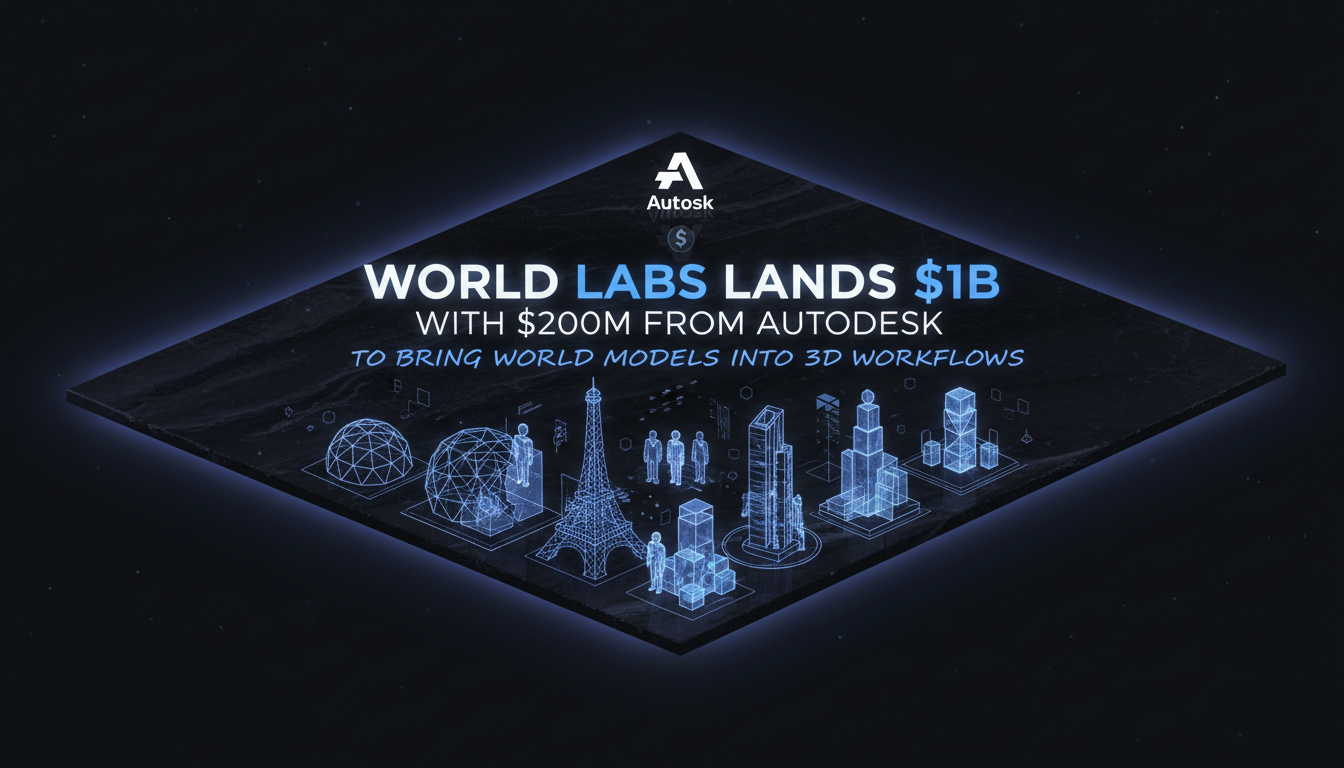
The landscape of generative artificial intelligence is undergoing a seismic shift, moving from the flat processing of text and 2D images into the complex, volumetric reality of three-dimensional space. At the forefront of this evolution is the breaking news that World Labs lands $1B, with $200M from Autodesk, to bring world models into 3D workflows. This significant capital injection and strategic partnership mark a definitive moment for the concept of “Spatial Intelligence”—the ability of AI to not just see pixels, but to understand geometry, physics, and the functional relationships between objects in the physical world.
Founded by AI pioneer Fei-Fei Li, World Labs has quickly established itself as a beacon for the next generation of foundation models. Unlike the Large Language Models (LLMs) that have dominated headlines for the past two years, World Labs is building Large World Models (LWMs). These models are designed to perceive, generate, and interact with 3D environments in a way that mimics human cognitive understanding of space. The involvement of Autodesk, the titan of Computer-Aided Design (CAD) and digital content creation, suggests that this technology is moving rapidly from research labs to industrial application.
In this analysis, we will deconstruct the implications of this funding round, explore the technical architecture of World Models, and evaluate how the convergence of generative AI and professional 3D workflows will reshape industries ranging from architecture and manufacturing to gaming and film.
Unpacking the Deal: Strategic Capital Meets Visionary Tech
The headline that World Labs lands $1B, with $200M from Autodesk, to bring world models into 3D workflows represents more than just a financial milestone; it is a validation of the thesis that 3D is the next frontier for AI utility. While the total valuation and funding structures in the AI sector are often opaque, a commitment of this magnitude specifically targeting “world models” indicates a pivot in investor sentiment away from purely text-based reasoning toward physical world simulation.
The Autodesk Factor
Autodesk’s participation with a $200M stake is particularly telling. Autodesk software—Revit, Maya, Fusion 360, and AutoCAD—forms the backbone of the global built environment. By investing heavily in World Labs, Autodesk is effectively betting that future design workflows will not start with a blank canvas or a primitive shape, but with a semantic conversation with an AI that understands structural integrity, lighting, and spatial constraints.
- Integration Potential: The goal is likely the integration of LWMs directly into the Autodesk ecosystem, allowing architects to generate editable 3D structures from prompts or partial sketches.
- Data Advantage: Autodesk possesses one of the world’s largest repositories of 3D metadata. Coupling this with World Labs’ generative capabilities could create a moat that is difficult for competitors to cross.
- Workflow Automation: This partnership targets the reduction of tedious modeling tasks, freeing engineers and artists to focus on high-level creative direction.
Defining Large World Models (LWMs)
To understand why this funding matters, we must technically distinguish World Models from the current crop of generative AI tools. Most current image generators (like Midjourney or Stable Diffusion) rely on diffusion models trained on 2D images. They do not understand that a chair has a back, or that light interacts with materials in specific ways based on geometry—they merely predict pixel correlations.
From 2D Correlates to 3D Causality
Large World Models operate on different principles. They are trained to understand the underlying physics and geometry of a scene. When an LWM generates an object, it generates a 3D representation (often using techniques like Neural Radiance Fields or Gaussian Splatting) that is consistent from all viewing angles.
Insert chart showing the architectural differences between LLMs, Image Diffusion Models, and Large World Models here
World Labs is focusing on Spatial Intelligence. This involves:
- Object Permanence: Understanding that objects exist even when occluded.
- Physics Simulation: Predicting how rigid and soft bodies interact (e.g., how a curtain folds or how a car accelerates).
- 3D Consistency: Ensuring that the generated environment remains stable as the camera moves through it.
Revolutionizing 3D Workflows in Industry
The mandate to “bring world models into 3D workflows” suggests a move away from static asset generation toward interactive scene creation. Currently, creating a 3D asset for a video game or an architectural visualization is a labor-intensive process involving modeling, texturing, rigging, and lighting. World Labs aims to compress this pipeline.
Architecture, Engineering, and Construction (AEC)
In the AEC sector, the implications are profound. An architect could theoretically describe a building’s parameters—”a 30-story residential tower with a brutalist facade and sustainable green terraces”—and have the World Model generate a structurally plausible 3D model. Unlike a 2D render, this model could be exported into Revit for further refinement, containing data about volume, materials, and potentially even load-bearing estimates.
Gaming and Virtual Production
For the entertainment industry, the ability to generate infinite, consistent 3D environments on the fly is the “Holy Grail.” Current procedural generation techniques are limited by predefined rule sets. LWMs could allow for dynamic environments that react to player actions in real-time, creating bespoke narratives and settings without the need for massive human art teams.
The Technical Stack: How It Works
While World Labs operates with proprietary technology, we can infer the probable technical stack based on the state of the art in 3D AI research. The system likely utilizes a hybrid approach combining transformer architectures with neural rendering.
Neural Radiance Fields (NeRFs) and Gaussian Splatting
To render 3D scenes from neural networks, technologies like NeRFs and, more recently, 3D Gaussian Splatting have become standard. These methods allow for photorealistic rendering of scenes from sparse data. World Labs is likely pushing these technologies further to allow for generative capabilities—creating new scenes rather than just reconstructing existing ones.
Latent Diffusion in 3D Space
Adapting diffusion models to 3D involves denoising point clouds, voxels, or implicit representations rather than 2D pixels. This requires massive compute power and specialized datasets containing 3D geometry, which is where the Autodesk partnership likely provides a critical data advantage. The ability to utilize synthetic data derived from CAD models can help train these models to understand “man-made” precision, distinct from the “organic” noisiness often found in photogrammetry scans.
Open Source Implications and the Data Moat
As a publication dedicated to open-source AI projects and trends, we must analyze how World Labs’ massive funding affects the open ecosystem. Historically, 3D data has been scarce compared to text or images. The largest open datasets, like Objaverse, are still dwarfed by the private repositories held by companies like Autodesk, Sketchfab (owned by Epic Games), and Unity.
The Risk of Proprietary Silos
With World Labs landing $1B to build proprietary models with Autodesk, there is a risk that the highest-quality “World Models” will be locked behind enterprise paywalls. This mirrors the trajectory of LLMs, where the most capable models (GPT-4, Claude 3.5) remain closed. However, this also creates a clear roadmap for the open-source community: the need for better open 3D datasets and efficient 3D training algorithms is more urgent than ever.
Standards Interoperability: OpenUSD
For World Labs to succeed in professional workflows, they must embrace open standards. Pixar’s OpenUSD (Universal Scene Description) is rapidly becoming the standard for 3D interchange. It is highly likely that World Labs will optimize their outputs for OpenUSD to ensure compatibility with NVIDIA Omniverse, Apple’s ecosystem, and Autodesk’s own tools. This reliance on open standards provides a bridge where open-source tools might still interact with these proprietary models.
Fei-Fei Li’s Vision: Beyond the Chatbot
Dr. Fei-Fei Li is renowned for creating ImageNet, the dataset that arguably sparked the deep learning revolution in computer vision. Her vision for World Labs moves beyond the “disembodied brain” of a chatbot. She argues that true intelligence requires embodiment and spatial awareness. By securing this funding, she is positioning World Labs to solve the “Moravec’s paradox” of AI—that high-level reasoning is easy, but low-level sensorimotor skills (like understanding 3D space) are hard.
This pivot toward Spatial Intelligence suggests that the next wave of AI products will not just be about generating text or code, but about generating reality. This aligns with broader AI research trends focusing on robotics and physical world interaction.
Challenges Ahead: Compute, Control, and Hallucination
Despite the massive funding, significant hurdles remain. Generating 3D content is exponentially more compute-intensive than 2D content. Furthermore, “hallucinations” in 3D are far more problematic. A hallucinated pixel in an image is a glitch; a hallucinated geometric error in a CAD model could be a structural failure.
- Precision vs. Creativity: Autodesk users require millimeter precision. Generative models are probabilistic and inherently “fuzzy.” Bridging the gap between a “dreamed” 3D object and a manufacturable STEP file is a massive technical challenge.
- Inference Costs: Running LWMs requires significant GPU resources, which may limit accessibility to high-end workstations or cloud streaming services.
- Copyright and IP: As with image generation, the training data for 3D models will face scrutiny. Does training on proprietary architectural designs infringe on IP?
Conclusion: A New Dimension for AI
The announcement that World Labs lands $1B, with $200M from Autodesk, to bring world models into 3D workflows is a watershed moment. It signals the maturation of generative AI from a novelty into a core industrial technology. We are moving from the era of “Prompt Engineering” to “World Engineering,” where the barrier between imagination and virtual manifestation is dissolved.
For developers, architects, and creators, the message is clear: the tools of the trade are about to become active collaborators. For the open-source community, the race is on to democratize spatial intelligence before it becomes the exclusive domain of a few tech giants. As World Labs deploys this capital, the boundaries of what is possible in digital 3D creation will expand, redefining the very nature of design.
Frequently Asked Questions – FAQs
What is a Large World Model (LWM)?
A Large World Model (LWM) is an AI model designed to understand and generate three-dimensional environments. Unlike Large Language Models (LLMs) that process text, LWMs are trained on 3D data, physics simulations, and visual inputs to understand geometry, spatial relationships, and object permanence.
Why is Autodesk investing in World Labs?
Autodesk is investing $200M to integrate World Labs’ spatial intelligence into its suite of design software (like AutoCAD, Revit, and Maya). This aims to automate complex 3D modeling tasks and enable users to generate functional 3D assets and environments using generative AI.
How does Spatial Intelligence differ from Generative AI?
Generative AI is a broad term for any AI that creates content (text, images, audio). Spatial Intelligence is a specific subset focused on understanding and interacting with the 3D physical world. It requires the AI to model physics, depth, and geometry, not just surface-level patterns.
Will World Labs’ technology be open source?
World Labs is a private company, and the specifics of their model licensing have not been fully disclosed. However, given the significant proprietary investment from Autodesk, the core models will likely be closed-source, though they may utilize open standards like OpenUSD for file interoperability.
Who is Fei-Fei Li?
Fei-Fei Li is a prominent computer scientist, known as the “Godmother of AI” for her work in establishing ImageNet, a massive dataset that enabled the modern deep learning boom in computer vision. She is the founder of World Labs.