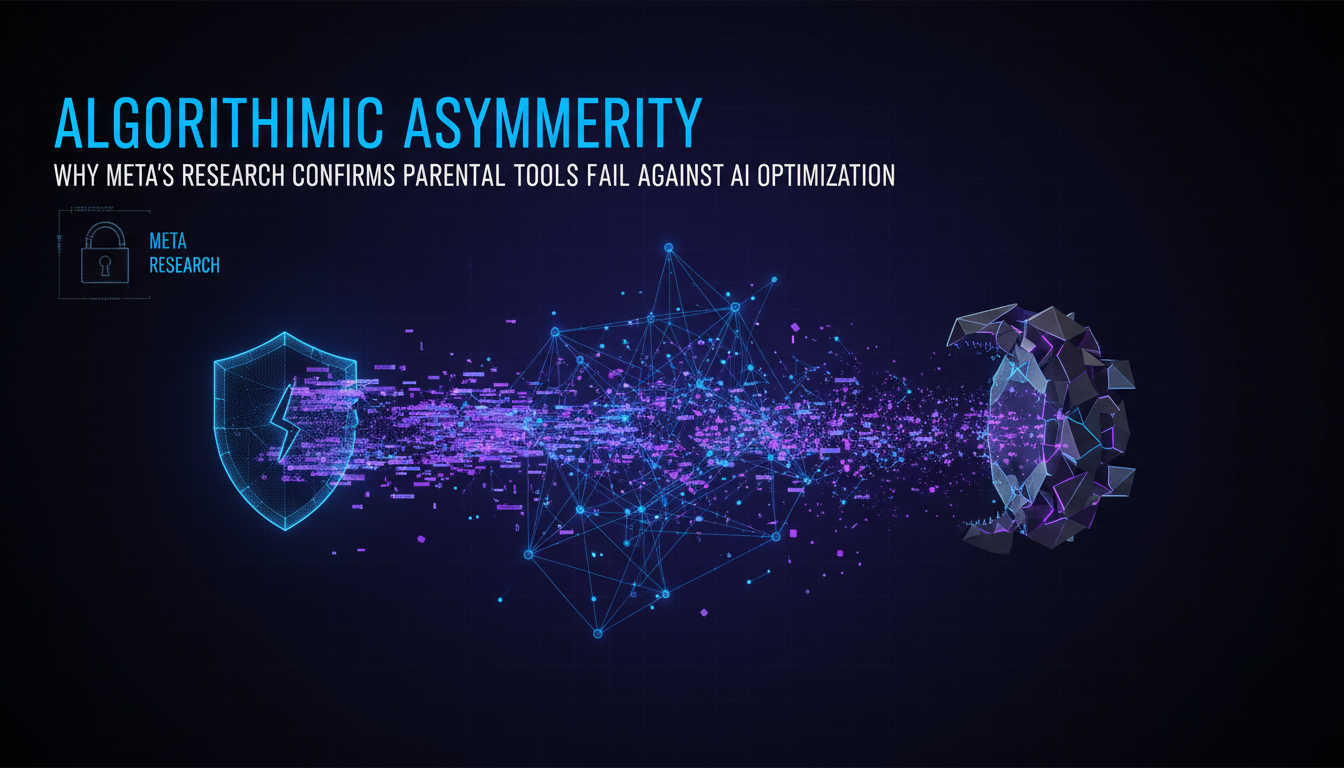
The Algorithmic Asymmetry: Why Client-Side Constraints Fail Against Server-Side Optimization
The recent revelation that Meta’s own research found parental supervision doesn’t really help curb teens’ compulsive social media use is not merely a sociological finding; it is a definitive statement on software architecture. It highlights a fundamental mismatch between client-side restrictions (parental controls, screen time limits) and server-side objective functions (engagement maximization). For the technical community, this underscores a critical reality: legacy safety tools operating at the application layer are structurally incapable of countering behavior modification models embedded deep within the inference stack of modern recommendation engines.
In the domain of open source AI and algorithmic transparency, we often discuss model weights, quantization, and inference latency. However, the architecture of engagement—specifically the Reinforcement Learning (RL) loops that power feeds on Instagram, Facebook, and TikTok—represents one of the most sophisticated deployments of predictive AI in history. When a parental control tool attempts to block access based on a timestamp, it is fighting against a neural network that has spent billions of compute cycles optimizing for session retention. This is an asymmetric warfare of code: a static boolean gate versus a dynamic, hyper-parameterized agent trained on petabytes of behavioral data.
This analysis deconstructs the engineering reality behind Meta’s findings. We will explore the technical mechanics of “compulsive use” as a derived output of reward hacking, the failure of API-based supervision tools, and why the solution likely requires a fundamental re-architecture of the inference economy itself rather than simple UI toggles.
The Architecture of Intent vs. The Architecture of Retention
To understand why supervision fails, we must first analyze the underlying architecture of the platforms themselves. Modern social media feeds are not chronological archives; they are probabilistic engines. Every scroll event triggers an inference call that ranks thousands of potential content candidates based on the probability of interaction (p(Click), p(Like), p(ViewTime > 3s)).
This is where the concept of the “Architecture of Intent” becomes critical. In systems designed for utility, such as search engines or specific AI agents, the goal is to satisfy a user’s query as efficiently as possible. We see this in the analysis of Pinterest Vs Chatgpt 80 Billion Queries The Architecture Of Intent, where the engineering focus is on aligning the model’s output with the user’s specific goal. However, in social media recommendation systems, the intent is inverted. The system does not serve the user’s conscious intent; it exploits the user’s subconscious vulnerabilities to maximize the system’s own objective function: Time Spent.
The Dopamine Loop as a Reward Function
Technically, compulsive use is a manifestation of a highly efficient Reinforcement Learning loop. The model observes a state (the user’s history, current context, time of day), takes an action (serves a specific video), and receives a reward (view duration). Over time, the model learns to exploit patterns that human psychology struggles to resist—specifically, variable ratio reinforcement schedules (the “slot machine” effect).
Parental supervision tools, by contrast, act as crude high-level interrupts. They do not alter the reward function of the underlying model. They essentially place a “closed” sign on the casino door after the user is already inside. Meta’s research indicates that once the behavioral loop is established—once the model has successfully optimized for compulsion—external friction is largely ineffective. The engagement metrics are optimized at the millisecond level of the user experience, far below the granularity of parental dashboards.
Systemic Failure of Client-Side Heuristics
The failure of supervision tools is also a failure of heuristics. Most parental controls rely on basic metadata: total screen time, app open counts, or keyword filtering. These are scalar values that fail to capture the vector space of addiction. The AI models driving engagement operate in high-dimensional space, analyzing semantic relationships between content and user sentiment that are invisible to simple time-tracking APIs.
- Latency of Intervention: Supervision reports are often retrospective (weekly summaries) or delayed. The AI’s intervention (serving the next hook) is real-time, operating with sub-100ms inference latency.
- Granularity Mismatch: Parents can limit “Instagram” as an app, but they cannot effectively limit specific patterns of algorithmic delivery, such as “doomscrolling” vs. “messaging friends.”
- Adversarial Adaptation: Just as we see in cybersecurity, users (teens) adapt faster than the security protocols. However, the more significant adaptation is by the AI itself, which learns to serve content that maximizes engagement within the shrinking window of allowed time, potentially intensifying the compulsive behavior per minute of usage.
This creates a scenario where the supervision tools provide a false sense of security while the underlying mechanics remain unchecked. It mirrors the challenges we see in securing Large Language Models (LLMs). As discussed in Introducing Lockdown Mode Elevated Risk Labels Chatgpt, bolt-on safety features are often bypassed if the core model is not aligned with safety at the training layer. If the base model is optimized for maximum engagement, a UI layer trying to curb engagement is structurally destined to fail.
The Economic Imperative: Why the Model Won’t Change
Why do these architectures persist despite the known harms? The answer lies in the “Inference Economy.” The computational cost of running massive recommendation models is staggering. Every inference cycle costs electricity and hardware depreciation. To justify this OpEx, the model must generate revenue, which in the current paradigm means ad impressions.
We have analyzed this economic pressure in The Inference Economy Inside Openai S Chatgpt Ad Architecture. The drive for monetization forces engineering teams to tune hyperparameters for retention above all else. Even if a company wants to implement safety, the fundamental business logic—and the automated training pipelines—are biased toward engagement. A parental supervision tool is essentially asking the algorithm to lose money. Without a change in the underlying objective function, the algorithm will always find a path of least resistance to the user’s attention.
Metric Fixation and Goodhart’s Law
Goodhart’s Law states that “when a measure becomes a target, it ceases to be a good measure.” In social media engineering, “Time Spent” was the proxy for “User Satisfaction.” However, the AI optimized this metric so ruthlessly that it decoupled satisfaction from usage. Users can be miserable yet fully engaged—a state technically described as compulsive use. Meta’s research confirms that supervision tools cannot fix this metric fixation because they do not redefine the target; they only attempt to cap the volume of the output.
Comparing Social Algorithms to AI Safety Protocols
The industry is currently obsessed with “AI Safety” regarding AGI and LLMs, yet we largely ignore the massive scale of behavioral manipulation occurring in deployed social algorithms. When we look at advanced safety protocols, such as those detailed in Architecting Agi Safety Deconstructing The Deepmind Uk Aisi Strategic Protocol, we see a rigor that is absent in consumer social apps. AGI safety protocols demand interpretability, steerability, and alignment.
Social media algorithms, conversely, are often “Black Boxes” even to their creators. The neural networks evolve weights that maximize the reward function in ways that are non-interpretable. A teen’s feed is a unique, ephemeral construct generated by a model reacting to thousands of micro-signals. This lack of interpretability makes “supervision” practically impossible because the parent cannot see or understand the personalized reality the teen is experiencing. It is a Meta Smart Glasses Facial Recognition Edge Biometric Architecture Analysis situation applied to psychology: the system sees and analyzes the user with biometric precision, while the user (and their guardian) sees only the interface.
The Role of Hardware and Edge Computing
The problem is further complicated by the shift toward edge computing and immersive hardware. As AI moves from cloud-based inference to local processing on devices, the feedback loop tightens. We are seeing this trend with Apple’s ecosystem, where local processing allows for deeper integration. In the context of Apple Trio Ai Wearables Smart Glasses Airpods Ring, the potential for continuous, ambient algorithmic influence grows. If parental supervision fails on a smartphone screen, it will be exponentially less effective in an augmented reality environment where the digital overlay is persistent and pervasive.
Furthermore, the push for “Natively Adaptive Interfaces” suggests that future UIs will mutate in real-time to suit the user’s cognitive state. As explored in Natively Adaptive Interfaces Engineering The Future Of Ai Accessibility, while this tech has massive potential for accessibility, it also provides the platform with more vectors to bypass static defense mechanisms like parental controls. The interface itself becomes a fluid agent of persuasion.
Methodological Challenges in Researching Algorithmic Harm
One of the reasons Meta’s internal research is so significant is that external auditing of these systems is notoriously difficult. Social science research has historically struggled to keep pace with the velocity of AI development. Traditional longitudinal studies take years; AI models update weekly.
However, new methodologies are emerging. The concept of Scaling Social Science Research Generative Ai proposes using AI agents to simulate social dynamics and predict harms before they manifest in the real world. If Meta and other platforms were to employ agent-based modeling to test the efficacy of supervision tools against their own engagement algorithms, they would likely find—in simulation—exactly what they found in reality: the algorithms win. This simulation-first approach is crucial for designing future regulations that are technical rather than just legislative.
Toward a Solution: Agentic Defense and Middleware
If server-side optimization is the problem, and simple client-side blocking is ineffective, what is the architectural solution? The answer likely lies in “Agentic Defense”—deploying local, user-aligned AI agents that filter and sanitize the incoming feed before it reaches the user’s perception.
Imagine a local LLM or small action model running on the user’s device (neural processing unit). This agent acts as a middleware layer. It doesn’t just block apps; it actively parses the content stream, identifying manipulative patterns, dark patterns, and dopamine triggers, and sanitizes them in real-time. This aligns with the concepts seen in Runtime Sovereignty Zero Dependency Ai Firewalls Saferun Guard, where the user retains sovereignty over their runtime environment.
The Rise of the “Sovereign User Stack”
We are entering an era where users will need their own AI to protect them from corporate AI. This “Sovereign User Stack” would function similarly to how ad-blockers work today but for cognitive protection. It would require hardware capable of running efficient local models—a topic we cover often, from the M5 Macbook Air Release Date Features And Performance Predictions to dedicated AI accelerators. By moving the control logic from the server (where the company controls it) to the edge (where the user controls it), we can potentially curb compulsive use by breaking the feedback loop at the point of inference.
Moreover, comparing the capabilities of open models, like those discussed in the Deepseek R1 Vs Openai O1 Benchmark, shows that open-source, locally run models are becoming powerful enough to handle this task. An open-source “Guard Dog” agent could be trained specifically to detect and neutralize engagement hacks, restoring agency to the user (or the parent).
Conclusion: The Necessity of Structural Change
Meta’s research finding that parental supervision doesn’t really help curb teens’ compulsive social media use is a damning indictment of the current technological paradigm. It proves that you cannot solve a problem caused by deep learning with a settings toggle. The compulsion is an emergent property of the system’s architecture, driven by economic incentives and realized through maximizing objective functions.
For the open source and engineering community, the path forward is clear. We cannot rely on the platforms to self-regulate effectively, as their architecture is antithetical to disengagement. Instead, we must build better tools: sovereign AI agents, transparent algorithms, and defensive middleware that prioritize human cognitive liberty over server-side retention metrics. Until the architecture changes, the addiction will remain feature, not a bug.
Frequently Asked Questions (FAQs)
Why do parental controls fail against AI algorithms?
Parental controls typically operate on a binary basis (allow/block) or a time basis (limit hours). AI algorithms, however, operate on a probabilistic basis, optimizing content in real-time to maximize engagement intensity. The algorithm can adapt its strategy to make the limited time a user has more addictive, bypassing the intent of the restriction.
What is the “Architecture of Intent”?
The Architecture of Intent refers to how a system is designed to fulfill a user’s goals. In social media, this architecture is often inverted; instead of fulfilling the user’s intent, the system manipulates the user to fulfill the platform’s intent (maximizing ad views and time on site).
Can AI agents help parents better than current tools?
Yes. A “defensive” AI agent running locally on a device could analyze content in real-time, detecting manipulative patterns or “doomscrolling” triggers and intervening contextually—perhaps by altering the feed or alerting the user—offering a much more sophisticated defense than a simple timer.
How does the “Inference Economy” drive compulsive use?
Running AI models is expensive. To pay for the compute costs, platforms must generate revenue, usually through ads. This creates a direct economic incentive to maximize the time users spend viewing the feed, driving engineering teams to optimize algorithms for compulsion rather than user well-being.
Is this problem unique to Meta?
No. While Meta’s research is the focus here, the same reinforcement learning dynamics apply to TikTok, YouTube Shorts, and any other platform that uses algorithmic feeds to maximize retention. It is an industry-wide architectural standard.