The DevOps Paradigm Shift: Why Railway’s Series B Matters
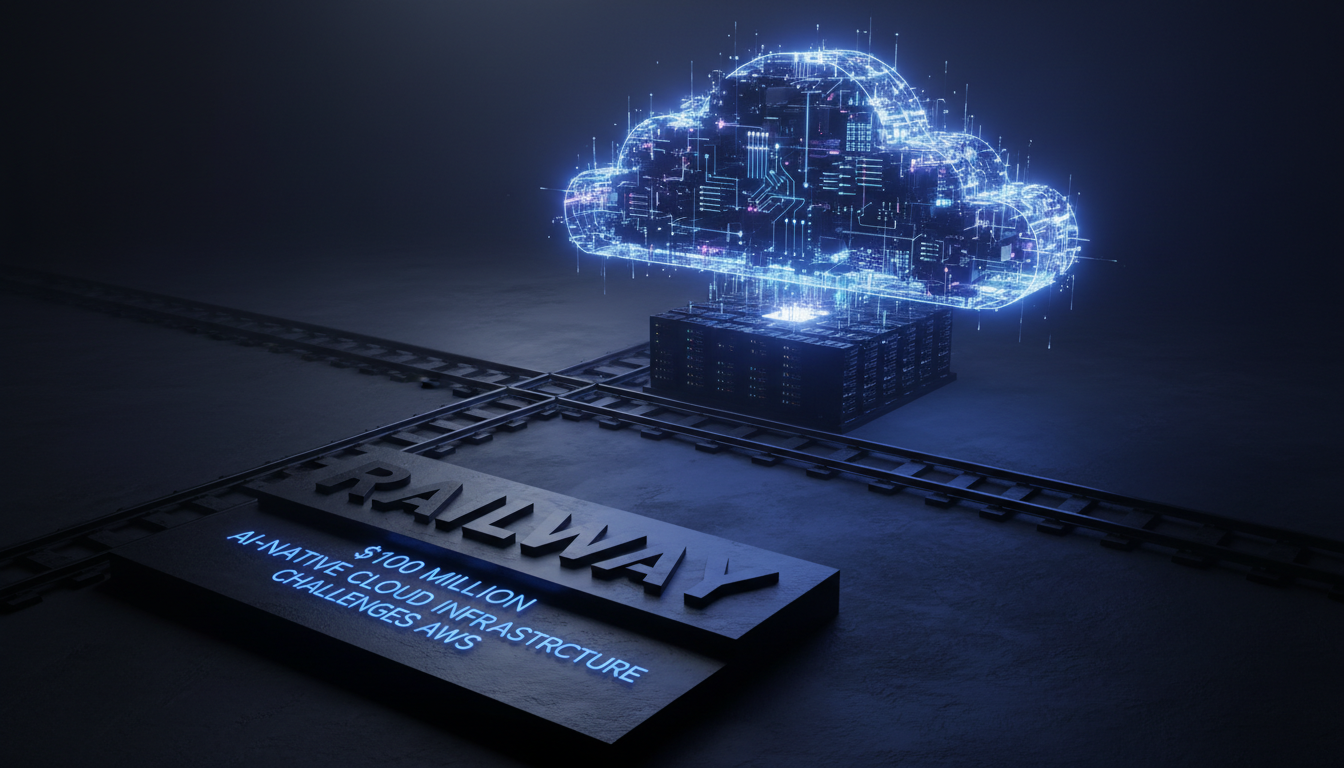
The landscape of cloud computing is undergoing a seismic shift, moving away from the granular, often overwhelming complexity of hyperscalers toward intuitive, developer-first platforms. This transition was solidified recently as Railway secures $100 million to challenge AWS with AI-native cloud infrastructure. The Series B funding round, led by Lead Edge Capital with participation from heavyweights like Iconiq Growth and Redpoint Ventures, is not merely a financial milestone; it is a validation of the "No-Ops" philosophy in an era dominated by artificial intelligence.
For decades, Amazon Web Services (AWS), Google Cloud Platform (GCP), and Microsoft Azure have acted as the gatekeepers of the internet. While they offer unparalleled power, they exact a heavy "complexity tax." Developers often spend more time configuring IAM roles, managing Kubernetes clusters, and debugging VPC peering connections than they do writing shipping code. Railway’s rapid ascent suggests that the market is desperate for an alternative—a platform that abstracts the infrastructure layer entirely, allowing engineers to focus on product logic.
This $100 million injection is earmarked to expand Railway’s capabilities, specifically targeting the growing needs of AI engineering teams. As AI research trends accelerate, the engineers building the next generation of Large Language Model (LLM) applications require infrastructure that is as dynamic and intelligent as the code they are deploying. This article dissects the strategic implications of Railway’s funding, the technical architecture that differentiates it from AWS, and why it is positioned to become the default operating system for open-source AI.
The $100 Million War Chest: Unpacking the Series B
The sheer size of this Series B round serves as a signal to the broader tech ecosystem. In a venture capital climate that has been notoriously conservative following the post-pandemic correction, a nine-figure check indicates exceptional confidence in Railway’s growth metrics and retention rates. Lead Edge Capital, known for backing enduring software companies, sees Railway not just as a hosting provider, but as a fundamental layer of the modern internet stack.
Capital Allocation Strategy
With $100 million in fresh capital, Railway is poised to aggressively scale its engineering workforce and infrastructure footprint. The primary areas of investment include:
- Global Edge Network Expansion: To compete with AWS, Railway must ensure low-latency delivery worldwide. This involves expanding points of presence (PoPs) to bring compute closer to users, a critical factor for real-time AI inference.
- Enterprise Reliability: Moving upmarket requires Service Level Agreements (SLAs) and compliance certifications (SOC2, HIPAA) that enterprise clients demand. This funding provides the runway to build the rigid governance structures required by Fortune 500 adopters.
- AI-Native Primitives: Perhaps most importantly, Railway is building features specifically for AI workloads. This includes optimized support for vector databases, GPU scheduling, and seamless integration with open-source AI projects.
Insert chart showing the comparative growth of PaaS vs. IaaS adoption over the last 5 years here
The Anti-AWS: Solving the Complexity Crisis
To understand why Railway is gaining traction, one must first analyze the friction inherent in incumbent cloud providers. AWS currently offers over 200 distinct services. For a startup trying to deploy a simple RAG (Retrieval-Augmented Generation) pipeline, the cognitive overhead of choosing between EC2, ECS, Fargate, Lambda, and App Runner is paralyzing.
The Canvas Interface
Railway disrupts this with a visual "Canvas" approach. Instead of a list of disconnected services, users interact with a graph-based interface where services (databases, workers, APIs) are visually linked. This mimics the mental model of a system architect. If you need a Redis cache connected to a Python backend, you simply drag and connect them. Railway handles the networking, environment variable injection, and security groups automatically.
Nixpacks: The Build Engine
At the core of Railway’s technical superiority is Nixpacks, an open-source tool that reads source code and generates a container image compatible with OCI standards. Unlike Heroku buildpacks, which can be opaque and slow, Nixpacks leverages the Nix package manager to create reproducible, layered builds. This means that whether a developer is deploying a Rust API, a Python AI agent, or a Node.js frontend, Railway identifies the language, installs dependencies, and builds the artifact with zero configuration.
AI-Native Infrastructure: The New Frontier
The term "AI-native" is central to Railway’s new mandate. Traditional DevOps was built for deterministic code—stateless microservices that scale based on CPU usage. AI workloads are different; they are often stateful, GPU-hungry, and require massive bandwidth for fetching model weights.
Hosting the Open Source AI Stack
The explosion of open-source models like Llama 3, Mistral, and Stable Diffusion has created a new class of developer: the AI Engineer. These individuals are often data scientists or researchers who may not possess deep Kubernetes expertise. Railway bridges this gap by offering one-click templates for complex stacks.
- Vector Database Management: AI apps depend on vector search. Railway simplifies the deployment of PGVector (PostgreSQL with vector extensions), Qdrant, or Chroma, managing the persistence layer so developers don’t have to.
- Inference at the Edge: For AI agents to feel responsive, latency must be minimized. Railway’s infrastructure allows inference servers to spin up near the user, reducing the time-to-first-token.
- GPU Orchestration: While Railway started with CPU-bound workloads, the roadmap implies a move toward GPU accessibility, challenging AWS SageMaker by offering a more developer-friendly interface for fine-tuning and inference.
The Strategic Pivot from Heroku and Vercel
Railway is frequently compared to Heroku and Vercel, but its strategic positioning is distinct. Heroku, long the darling of developers, stagnated under Salesforce ownership, failing to innovate on pricing or modern language support. Vercel, while dominant in the frontend space (Next.js), often struggles with long-running backend processes and heavy compute jobs—areas where AI excels.
Railway positions itself as the backend-agnostic platform. It does not care if you use React, Svelte, or HTMX. Its primary concern is the execution of backend logic, databases, and message queues. This makes it the ideal home for the "heavy lifting" required by multimedia news strategy algorithms and generative AI processors.
Pricing Transparency as a Feature
One of the biggest criticisms of AWS is the "billing shock." Railway counters this with a transparent, resource-based pricing model. Users pay for what they use (RAM and CPU execution time) without hidden fees for API gateway hits or obscure data transfer costs. For startups operating on thin margins, this predictability is a massive competitive advantage.
Technical Deep Dive: How Railway Scales
Scaling on Railway is fundamentally different from scaling on EC2. In an AWS environment, autoscaling requires defining launch configurations, load balancers, and health checks. Railway abstracts this into a simple slider or an autoscaling rule based on request volume.
Private Networking and Service Mesh
Under the hood, Railway creates a private mesh network for every project. Services within a project can communicate over a private network without exposing ports to the public internet. This "secure by default" posture removes a massive vector for cyberattacks. For AI applications handling sensitive user data or proprietary datasets, this isolation is non-negotiable.
The Role of Observability
As Railway secures $100 million to challenge AWS with AI-native cloud infrastructure, a portion of that capital is flowing into observability. Debugging distributed AI systems is notoriously difficult. Railway provides built-in logs, metrics, and traces that require no setup. This contrasts sharply with AWS CloudWatch, which often requires significant configuration to yield actionable insights.
The Future of Platform Engineering
Railway’s rise signals the commoditization of Platform Engineering. In the past, companies hired teams of DevOps engineers to build internal developer platforms (IDPs). Railway essentially sells an IDP as a service. This democratization means that a two-person startup can have the same deployment sophistication as a post-IPO tech giant.
This shift is particularly vital for the open-source AI community. Projects that were once difficult to self-host due to infrastructure complexity can now be deployed via a "Deploy to Railway" button on a GitHub README. This lowers the barrier to entry for experimenting with new models and contributes to a more vibrant, decentralized AI ecosystem.
Challenges and the Road Ahead
Despite the $100 million war chest, toppling AWS is a Herculean task. AWS has entrenched enterprise contracts, a marketplace of thousands of integrations, and physical data centers in every corner of the globe. Railway’s challenge will be to maintain its simplicity while adding the features enterprise customers demand.
Furthermore, the cost of compute is dropping, but the cost of *specialized* compute (GPUs) is rising. Railway must navigate the economics of reselling compute while maintaining healthy margins. If they can solve the GPU availability puzzle for developers, they may well become the standard infrastructure for the AI era.
Conclusion: A New Standard for Deployment
The news that Railway secures $100 million to challenge AWS with AI-native cloud infrastructure is more than a funding announcement; it is a manifesto for the future of software development. It champions a world where infrastructure is invisible, where complexity is managed by the platform, and where AI applications can be shipped with the same ease as a static HTML page. For the readers of OpenSourceAI News, this development underscores the importance of choosing the right tools—tools that empower innovation rather than stifle it with configuration.
Frequently Asked Questions – FAQs
What makes Railway different from AWS?
Railway focuses on Developer Experience (DX) by abstracting the complexity of infrastructure management. Unlike AWS, which requires manual configuration of servers, networking, and security, Railway automates the build and deployment process, allowing developers to focus solely on their code.
Is Railway suitable for hosting AI models?
Yes. Railway is increasingly positioning itself as an AI-native platform. Its support for Docker containers, Nixpacks, and heavy compute workloads makes it an excellent choice for hosting Large Language Models (LLMs), vector databases, and Python-based AI agents.
What does the $100 million funding mean for current users?
The funding ensures long-term stability and accelerating feature development. Users can expect improved reliability, global edge network expansion, and new features specifically designed for scaling AI and enterprise workloads.
Can I migrate from Heroku to Railway?
Migration is generally seamless. Railway supports many of the same workflows as Heroku but offers more flexible configuration and lower costs. Many developers have migrated to avoid Heroku’s pricing changes and to leverage Railway’s modern feature set.
Does Railway support GPU instances?
While Railway primarily focuses on CPU and memory-based autoscaling, the roadmap following this Series B funding heavily implies deeper support for GPU-accelerated workloads to cater to the booming demand for AI inference and fine-tuning.