The Dawn of Steering-Wheel-Less Autonomy
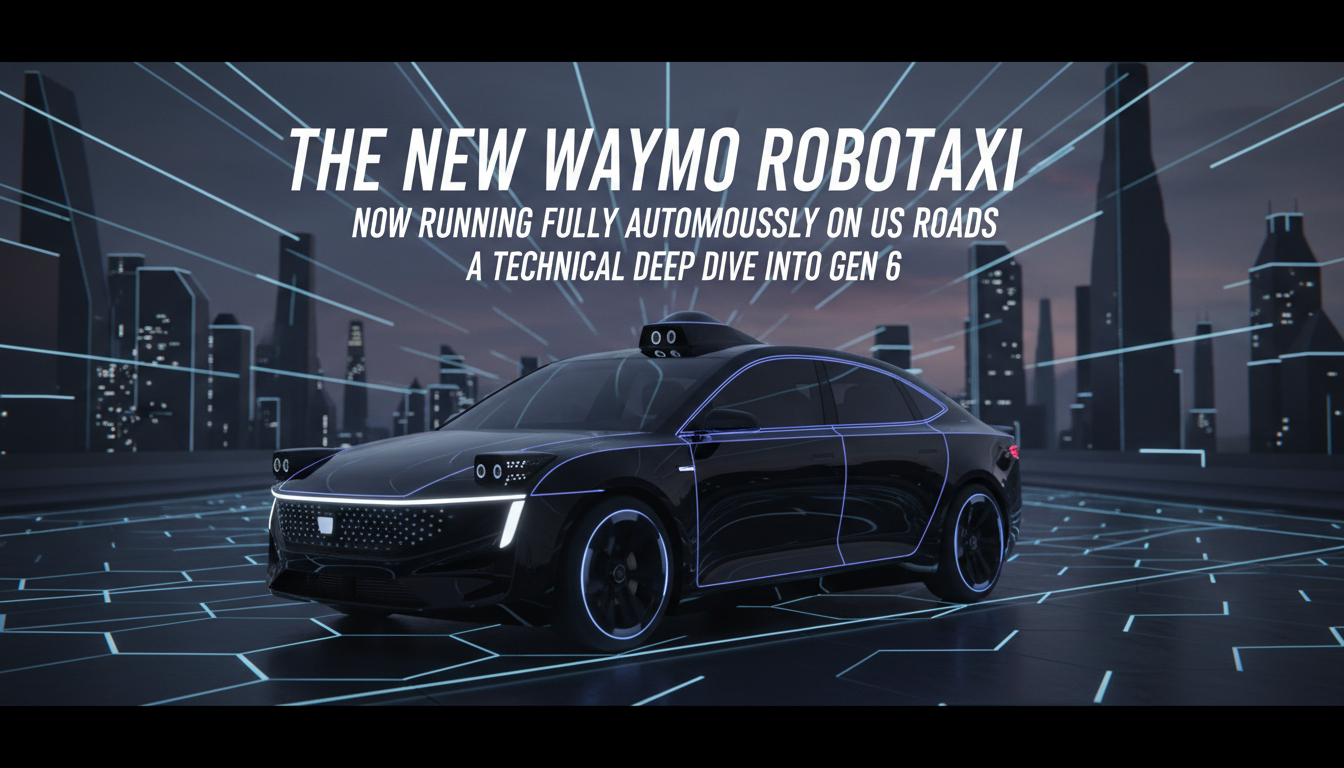
The landscape of autonomous mobility has shifted dramatically with the confirmation that the New Waymo Robotaxi now Running Fully Autonomously on US Roads is no longer just a concept, but an operational reality. For years, the industry has operated in a transitional phase, utilizing retrofitted consumer vehicles—specifically the Jaguar I-PACE and the Chrysler Pacifica—laden with external sensor rigs and retaining traditional manual controls. This era is drawing to a close as Waymo begins public testing of its 6th-generation hardware integrated into a purpose-built Zeekr platform.
This development represents more than a mere fleet update; it is a fundamental architectural pivot in how autonomous vehicles (AVs) are engineered, manufactured, and deployed. By removing the steering wheel and pedals, Waymo is asserting a level of confidence in its AI stack that challenges current regulatory frameworks and sets a new benchmark for competitors like Tesla and Zoox. For the open-source AI community and tech observers, this transition offers a rich case study in hardware-software integration, redundancy planning, and the scaling of deep learning models in safety-critical environments.
The significance of seeing the New Waymo Robotaxi now Running Fully Autonomously on US Roads lies in the verification of the “Driver” system’s maturity. Unlike previous iterations where a safety driver could theoretically intervene, or a remote operator could guide the vehicle through edge cases, the removal of manual controls signals that the AI perception and planning modules have reached a threshold of reliability necessary for mass commercialization. This article dissects the technical specifications, the sensor fusion strategy, and the broader implications for the AI ecosystem.
Deconstructing the 6th Generation Waymo Driver
To understand why this specific vehicle is a milestone, one must look “under the hood” at the 6th Generation Waymo Driver. The previous generation was a marvel of engineering, but it was expensive and complex. The new system focuses on cost optimization without sacrificing safety—a critical step for unit economics in the Robotaxi sector.
Sensor Architecture and Fusion
The 6th-generation suite is optimized for performance in diverse weather conditions and complex urban geometries. It employs a sophisticated sensor fusion approach combining LiDAR, cameras, and radar to create a overlapping, redundant view of the world.
- 13 Cameras: High-resolution sensors provide 360-degree coverage, essential for reading traffic lights, construction signs, and detecting brake lights at long distances. The computer vision algorithms processing this feed must handle high dynamic range lighting, such as exiting a dark tunnel into bright sunlight.
- 4 LiDAR Units: Unlike the previous generation’s reliance on a massive, expensive top-dome spinner, the new configuration integrates LiDAR more seamlessly into the vehicle’s body. These active sensors provide precise depth mapping, crucial for distinguishing 3D geometry from 2D visual noise.
- 6 Radar Sensors: Radar remains the backbone for detecting speed and velocity, particularly in adverse weather where optical sensors might be compromised by fog or heavy rain.
- External Audio Receivers: A less discussed but vital component is the array of microphones designed to detect emergency sirens, giving the AI the ability to yield to first responders before they are visually identified.
Insert diagram comparing 5th Gen vs. 6th Gen sensor placement and field of view here.
This hardware stack feeds into a centralized compute module running highly optimized inference models. For developers following AI research trends, the shift here is towards “early fusion,” where raw data from different sensor modalities is combined earlier in the processing pipeline, allowing the neural networks to make more informed decisions based on holistic data rather than disparate inputs.
From Retrofit to Purpose-Built: The Zeekr Advantage
The transition from the Jaguar I-PACE to the Geely-manufactured Zeekr platform is not merely aesthetic. Retrofitting existing cars involves significant engineering compromises. The power distribution, thermal management, and chassis dynamics of a consumer car are rarely optimized for the continuous, high-compute load of an autonomous system. The New Waymo Robotaxi now Running Fully Autonomously on US Roads utilizes a “ground-up” design philosophy.
Ergonomics and Passenger Experience
Without the need for a driver’s seat, steering column, or pedals, the interior volume is maximized for passenger comfort. The vehicle features a flat floor, low step-in height, and wide sliding doors, making it significantly more accessible for individuals with disabilities—a key demographic for Mobility-as-a-Service (MaaS). The removal of the B-pillar allows for easier ingress and egress, a design choice that requires advanced structural reinforcement elsewhere in the chassis to meet crash safety standards.
Hardware-Software Integration
In a purpose-built vehicle, the integration of the AI system is native. The cooling loops for the compute stack are integrated with the vehicle’s thermal management system. The power draw of the sensors is accounted for in the battery management system (BMS) design. This integration results in higher efficiency and range, addressing one of the hidden costs of autonomous driving: the energy penalty of the computer itself.
The AI Stack: Perception, Prediction, and Planning
The hardware is only the vessel; the intelligence lies in the software. Waymo’s approach relies heavily on advanced machine learning techniques, moving beyond simple rule-based heuristics.
Deep Learning and Behavioral Prediction
One of the hardest challenges in autonomous driving is not seeing the world, but understanding it. The AI must predict the behavior of irrational actors—human drivers, jaywalking pedestrians, and cyclists. Waymo utilizes massive datasets gathered from millions of miles of real-world driving and billions of miles of simulation to train these prediction models. The system employs transformer-based architectures, similar to those used in Large Language Models (LLMs), to predict sequences of future events based on current context.
The Role of Simulation in Validation
Before the New Waymo Robotaxi now Running Fully Autonomously on US Roads ever turned a wheel, it drove millions of virtual miles. Waymo’s simulation environment allows them to test the 6th-gen hardware against edge cases that occur rarely in the real world—such as a person jumping out of a cardboard box or a pile of debris on a highway. This “Matrix-style” testing ensures that the software is robust against the unexpected.
For the open-source community, this highlights the importance of simulation tools like CARLA or LGSVL in developing open-source AI projects for autonomy. While Waymo’s tools are proprietary, the methodology validates the simulation-first approach to safety.
The Regulatory Landscape and Safety Verification
Deploying a vehicle without a steering wheel brings Waymo into direct dialogue with the National Highway Traffic Safety Administration (NHTSA) and local regulatory bodies. The Federal Motor Vehicle Safety Standards (FMVSS) historically assumed the presence of a human driver. Waymo has had to demonstrate that their automated driving system (ADS) provides a level of safety equivalent to, or greater than, a human driver.
This involves rigorous statistical validation. Waymo publishes safety methodologies detailing how they benchmark their performance against human crash rates. The deployment of the Zeekr platform suggests that regulators are becoming more comfortable with the data provided by AV companies, moving away from theoretical safety arguments to empirical evidence based on actual road performance.
Competitive Analysis: Waymo vs. Tesla vs. Zoox
The deployment of the Zeekr robotaxi places immense pressure on the competition.
- Tesla: Tesla’s approach relies heavily on vision-only systems and end-to-end neural networks deployed on consumer vehicles. While Tesla has a massive data advantage, they have yet to deploy a fully driverless, purpose-built vehicle without a steering wheel at scale. Waymo’s redundancy (Lidar + Radar + Vision) is generally viewed by safety experts as a more robust, albeit expensive, approach.
- Zoox: The Amazon-backed Zoox has also developed a carriage-style, bidirectional robotaxi. However, Waymo’s advantage lies in its operational history. Waymo has been running commercial services in Phoenix, San Francisco, and Los Angeles for years. The New Waymo Robotaxi now Running Fully Autonomously on US Roads benefits from this institutional operational knowledge.
- Cruise: After significant setbacks and safety incidents, Cruise is in a rebuilding phase. Waymo’s ability to launch a new platform while its main competitor is retrenching solidifies its leadership position.
Insert chart comparing autonomous miles driven per disengagement across major AV players.
Implications for the Open Source Ecosystem
While Waymo is a closed ecosystem, its progress fuels the broader AI industry. It proves that Level 4/5 autonomy is solvable with current deep learning architectures and sensor hardware. This validates the efforts of open-source projects like Autoware and Comma.ai, which aim to democratize driver assistance technologies.
Furthermore, Waymo’s occasional release of open datasets (like the Waymo Open Dataset) provides researchers with the high-fidelity ground truth data needed to train academic models. As the 6th-gen hardware collects more data, there is hope that snippets of this advanced sensor data will eventually filter down to the research community, accelerating multimedia news strategy and computer vision breakthroughs globally.
Economic Impact and Mobility as a Service (MaaS)
The ultimate goal of the New Waymo Robotaxi now Running Fully Autonomously on US Roads is to drive the cost per mile down to a point where it competes with personal car ownership. By removing the driver (the highest operating cost) and utilizing a durable, purpose-built EV (lower maintenance and energy costs), Waymo is targeting positive unit economics.
This shift has profound implications for urban planning. If MaaS becomes cheaper than ownership, the demand for parking in city centers drops. The integration of these vehicles into public transit networks could solve the “last mile” problem, creating a hybrid transit ecosystem that is efficient and sustainable.
The Path Forward: Scaling and Winter Testing
Currently, testing is concentrated in areas with favorable weather and mapped environments. The next frontier for the 6th-generation platform is winter testing. The inclusion of sensor cleaning systems and advanced radar suggests Waymo is preparing for expansion into markets like New York or Chicago, where snow and ice pose significant challenges to perception systems.
As these vehicles populate US roads, they will serve as rolling laboratories. Every mile driven refines the neural networks, creating a flywheel effect where the leader in the space accelerates away from the pack based on data accumulation. The New Waymo Robotaxi now Running Fully Autonomously on US Roads is not just a car; it is the physical manifestation of a decade of AI advancement.
Frequently Asked Questions – FAQs
What makes the 6th Generation Waymo Driver different from previous versions?
The 6th Generation system is designed for cost-efficiency and performance in a wider range of weather conditions. It features a simplified sensor suite with 13 cameras, 4 LiDARs, and 6 radars, all integrated directly into the vehicle’s body rather than mounted on external racks. This generation also utilizes the purpose-built Zeekr platform rather than retrofitting consumer cars.
Is it legal to drive a car without a steering wheel in the US?
Yes, but with specific regulatory exemptions. Waymo works closely with the NHTSA and state DMVs to obtain permits for deploying vehicles without manual controls. These vehicles must meet rigorous safety standards and are usually restricted to specific geofenced operational design domains (ODDs) during initial rollout.
How does the Waymo Robotaxi handle emergency situations?
The vehicle is equipped with redundant braking, steering, and power systems. If a critical failure occurs, the system is designed to execute a “minimal risk condition” maneuver, such as safely pulling over to the side of the road. Additionally, remote assistance teams can monitor the vehicle and provide high-level guidance (though not direct steering control) if the AI encounters a confusing situation.
Can I ride in the new Zeekr Waymo Robotaxi yet?
As of now, the Zeekr platforms are primarily in the testing phase on US roads. Waymo is gradually integrating them into their commercial Waymo One fleet. Availability depends on the specific service region (e.g., San Francisco, Phoenix, Los Angeles, Austin) and the current stage of fleet rotation.
How does this impact the job market for drivers?
The shift to fully autonomous robotaxis is a gradual process that will reshape the transportation labor market. While it aims to reduce the need for human drivers in ride-hailing, it creates new technical roles in fleet management, remote monitoring, vehicle maintenance, and AI system supervision.