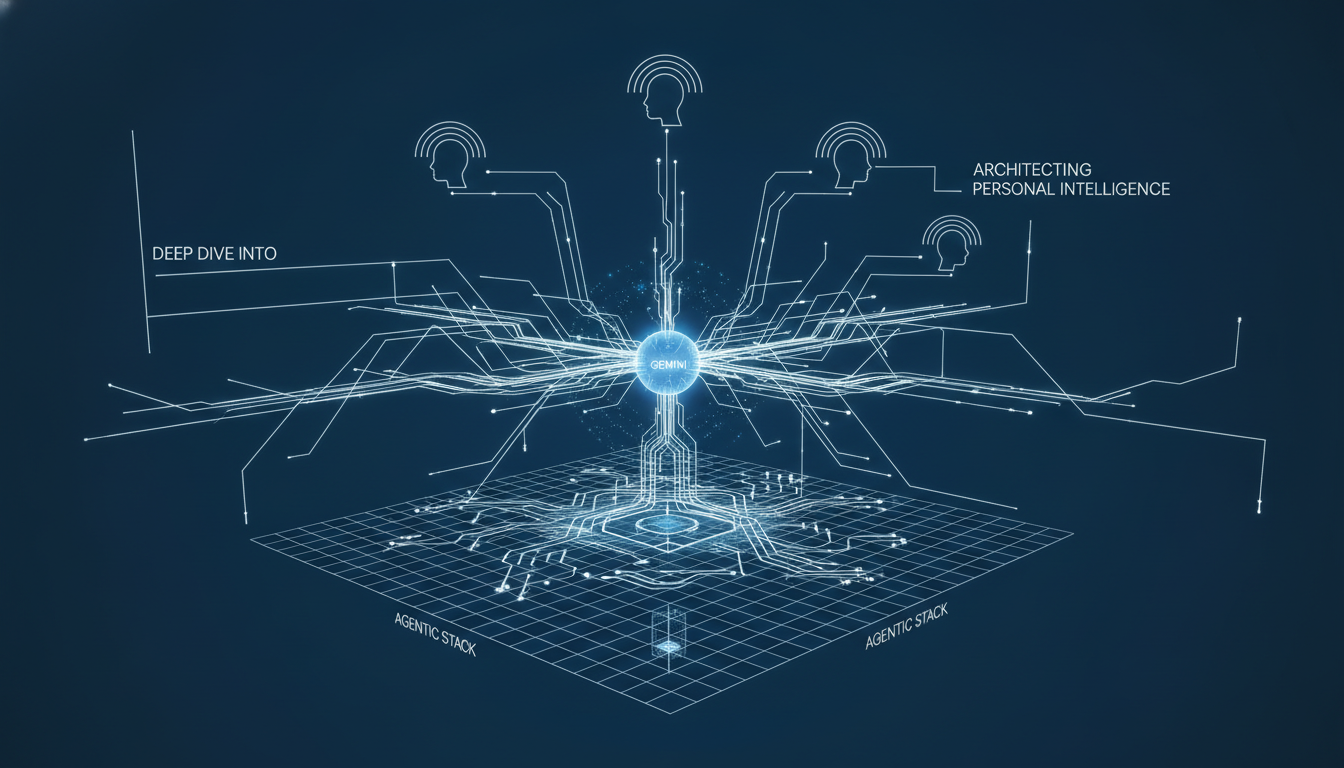
The trajectory of Artificial Intelligence has arguably reached its most critical inflection point since the introduction of the Transformer architecture. With the announcements made in January 2026, the industry is witnessing a definitive pivot from generic Large Language Models (LLMs) to highly individualized Personal Intelligence (PI) systems. This shift represents not merely an improvement in conversational fluency, but a fundamental re-architecture of how neural networks ingest, retain, and utilize user-specific context over extended temporal horizons.
This analysis decomposes the technical advancements underpinning Google’s latest Gemini iterations, focusing specifically on the transition toward agentic workflows, persistent memory structures, and hybrid inference stacks that define the new era of Personal Intelligence.
The Paradigm Shift: From Generative Pre-training to Personal Contextualization
Historically, the utility of LLMs was bounded by the dichotomy between pre-training data (general world knowledge) and the prompt context window (immediate, ephemeral input). The concept of Personal Intelligence bridges this gap by introducing a third state of knowledge: Persistent Personal State (PPS).
The January updates introduce architectural patterns that allow Gemini to maintain a dynamic, evolving graph of the user’s life. Unlike standard Retrieval-Augmented Generation (RAG), which fetches static documents based on vector similarity, the new PI architecture employs Dynamic Context Integration (DCI). DCI does not simply retrieve data; it continuously updates a latent representation of the user’s intent and preferences, effectively fine-tuning the model’s routing logic in real-time without the computational overhead of full weight updates.
Defining the Personal Intelligence Stack
The PI stack differs from traditional AI stacks in its handling of state. While a stateless REST API model serves a request and forgets, the PI stack is stateful by design. It requires:
- Episodic Memory: The ability to recall specific past interactions or events.
- Semantic Memory: The abstraction of facts and preferences derived from episodic data.
- Procedural Memory: Learned behaviors and workflows unique to the user’s operational habits.
Architectural Deep Dive into Gemini’s PI Engine
The core of the recent announcements lies in the modifications to the underlying Transformer blocks to support infinite-context approximations and efficient memory retrieval.
1. Long-Term Memory (LTM) via Vectorized Knowledge Graphs
To achieve true Personal Intelligence, the model must transcend the token limits of the context window. The solution implemented involves a hybrid approach combining Vector Databases with Knowledge Graphs.
When a user interacts with the system, the input is tokenized and embedded. However, instead of a simple cosine similarity search against a flat vector index, the system queries a personalized Knowledge Graph. This graph links entities (e.g., “Project Alpha”, “Jane Doe”, “Q1 Budget”) with semantic relationships. The retrieval process traverses these edges to fetch context that is conceptually relevant, not just linguistically similar.
This allows for complex reasoning chains. If a user asks, “Draft an email to the project lead about the budget delay,” the system identifies the specific project, retrieves the lead’s identity from the graph, and pulls the latest context regarding budget constraints—all without explicit prompting.
2. Dynamic Context Integration (DCI)
Standard RAG appends retrieved text to the prompt, consuming valuable tokens. DCI, however, utilizes Soft Prompt Tuning techniques. The retrieved personal context is compressed into dense vectors that act as “soft prompts,” modifying the activation patterns of the frozen LLM layers. This effectively steers the model’s behavior based on personal context without re-training the base model or flooding the context window with raw text.
Sparse Attention Mechanisms
To handle the massive influx of personal data, the architecture employs sparse attention patterns. Instead of the quadratic complexity of global attention ($O(n^2)$), the model uses Sliding Window Attention combined with Global Memory Tokens. This reduces computational complexity to $O(n)$, allowing the model to attend to relevant personal history (represented by global tokens) while processing current inputs efficiently.
Agentic Workflows: The Move to Large Action Models (LAMs)
The January 2026 updates signify the maturation of Large Action Models (LAMs). While LLMs excel at generating text, LAMs are engineered to execute tasks. This transition requires a robust planning engine capable of breaking down high-level intent into executable steps.
Chain-of-Thought (CoT) Planning and Reasoning
For an AI to act as a personal agent, it must possess superior reasoning capabilities. The architecture utilizes recursive Chain-of-Thought prompting, where the model generates an internal monologue to plan its actions.
For example, a request to “Plan a business trip to Tokyo” triggers a decomposition process:
- Intent Analysis: Identify dates, budget, and constraints.
- Information Retrieval: Query flight APIs, hotel availability, and calendar slots.
- Logic Synthesis: Cross-reference flight durations with meeting times.
- Execution: Draft booking requests and calendar invites.
This process is governed by a Verifier Module, a smaller, specialized model that validates each step of the plan against safety constraints and user preferences before execution proceeds.
API Chaining and Interoperability
LAMs rely on the ability to interface with external software. The new architecture introduces a standardized Tool Use Protocol. The model is fine-tuned to output structured calls (JSON or function pointers) that trigger external APIs.
Crucially, the system supports Multi-Step Tool Use. If an API call fails or returns ambiguous data, the model can interpret the error code, adjust its parameters, and retry—mimicking the debugging process of a human developer. This resilience is key to autonomous agentic behavior.
The Hybrid Inference Stack: Edge vs. Cloud
Personal Intelligence demands low latency and high privacy. Relying solely on cloud inference is insufficient due to bandwidth constraints and data sovereignty concerns. The January updates showcase a sophisticated Hybrid Inference strategy.
On-Device Quantization and Gemini Nano
The pixel-level integration of Gemini Nano utilizes advanced quantization techniques (e.g., 4-bit or even 2-bit quantization) to run LLMs directly on mobile NPUs (Neural Processing Units).
To maintain performance despite reduced precision, the system uses Speculative Decoding. A small, on-device draft model generates potential tokens rapidly, which are then verified in batches by a slightly larger, more capable model (either on-device or edge-cloud). This creates a user experience that feels instantaneous while maintaining high fidelity.
LoRA Adapters for Personalization
Fine-tuning a massive model for every user is computationally infeasible. Instead, the architecture leverages Low-Rank Adaptation (LoRA). The base weights of the model remain frozen. User-specific patterns—such as writing style, coding conventions, or vocabulary—are learned and stored in small, low-rank matrices.
These LoRA adapters are lightweight (often just a few megabytes) and can be hot-swapped instantly. When a user switches contexts (e.g., from “Work Mode” to “Creative Mode”), the system swaps the active LoRA adapter, effectively changing the model’s personality and expertise without reloading the base model.
Federated Learning and Privacy-Preserving Compute
With the ingestion of deeply personal data, security architecture becomes paramount. The updates emphasize the use of Federated Learning. In this paradigm, the model is trained across decentralized edge devices holding local data samples, without exchanging them.
Gradients (updates to the model’s learning) are calculated locally on the user’s device. Only these gradients—encrypted and aggregated—are sent to the central server to update the global model. Differential privacy noise is injected into the gradients to prevent the reverse-engineering of specific user data.
Secure Enclaves and Trusted Execution Environments (TEEs)
For cloud-based processing of highly sensitive tasks, the architecture utilizes Trusted Execution Environments (TEEs). TEEs are hardware-isolated areas of the main processor that ensure data is encrypted in memory during processing. Even the cloud provider (Google) cannot access the raw data while it is being processed by the AI models within the enclave.
Multimodal Reasoning: Beyond Text
Personal Intelligence is inherently multimodal. Users interact with the world through vision and sound, not just text. The updated Gemini models feature native multimodal support, processing audio, video, and image inputs in the same embedding space as text.
Latent Space Alignment
The architecture aligns the latent spaces of different modalities. A video frame of a user’s kitchen, an audio recording of a timer, and the text “bake for 20 minutes” are mapped to proximal vectors in the high-dimensional space. This allows the agent to reason across modalities—understanding that the visual state of the oven, the audio alarm, and the textual recipe are all related to the same “cooking” event.
Real-Time Video Contextualization
Advanced Video Vision Transformers (ViViT) allow the model to process streaming video input in real-time. By utilizing temporal attention mechanisms, the model can understand the sequence of actions. For instance, it can observe a user assembling furniture and offer guidance based on the visual step currently being attempted, referencing the instruction manual stored in its knowledge base.
Future Projections: The Road to Autonomy
The convergence of memory, agentic capabilities, and multimodal understanding paves the way for semi-autonomous digital twins. We are moving toward systems that do not just respond to commands but proactively manage aspects of the user’s digital life.
Future iterations will likely focus on Self-Correction and Meta-Cognition—the ability of the model to evaluate the quality of its own reasoning and recognize when it lacks sufficient information to act safely. As these architectures mature, the distinction between a software tool and a digital collaborator will vanish.
Technical FAQs
1. How does Dynamic Context Integration differ from standard Context Window expansion?
Standard expansion simply increases the token limit (e.g., 1M tokens), which increases inference cost and latency quadratically (or linearly with optimizations). Dynamic Context Integration (DCI) uses vector retrieval and soft-prompt tuning to inject relevant information into the model’s active state without filling the context window with irrelevant data, ensuring lower latency and higher relevance.
2. What is the role of quantization in Gemini’s on-device architecture?
Quantization reduces the precision of the model’s weights (e.g., from FP16 to INT4), significantly shrinking the model size and memory footprint. This allows powerful models like Gemini Nano to run on mobile NPUs. Post-training quantization and quantization-aware training ensure that this compression has minimal impact on the model’s reasoning capabilities.
3. How does the system prevent hallucinations when dealing with personal data?
The system employs RAG-based grounding. Every claim or action generated by the model is cross-referenced against the retrieved evidence from the user’s Personal Knowledge Graph. If the evidence does not support the generation, the Verifier Module suppresses the output, favoring a “I don’t know” response over a hallucination.
4. Can LoRA adapters be combined for multiple contexts?
Yes, the architecture supports LoRA Merging. Multiple low-rank adapters (e.g., one for “Python Coding” and one for “French Language”) can be mathematically merged into the base model weights at runtime, or run in parallel, allowing the model to exhibit expertise in intersecting domains simultaneously.
5. What security mechanisms protect the Vectorized Knowledge Graph?
The vector database containing user history is encrypted at rest and in transit. Furthermore, access is governed by a strict RBAC (Role-Based Access Control) system managed by the local device’s Secure Enclave. Cloud retrieval only occurs for data explicitly synchronized by the user, and is processed within TEEs to ensure data isolation.
Original Resource: https://blog.google/innovation-and-ai/products/google-ai-updates-january-2026/