The Platform Paradigm: Why Uber is Pivoting to Aggregation
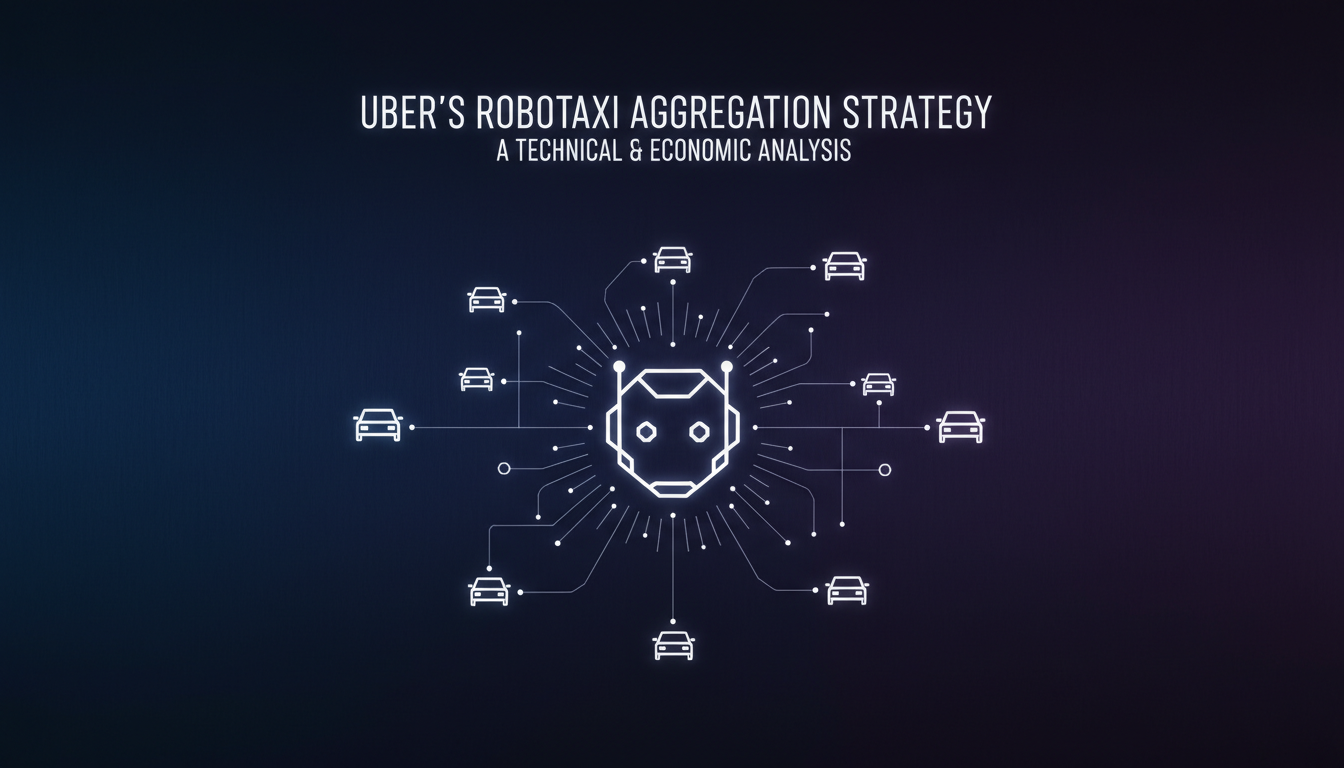
The narrative of autonomous mobility has shifted from a race for vertical integration to a battle for network utilization. Uber’s strategic pivot—often described by CEO Dara Khosrowshahi as becoming the “Swiss Army Knife” for robotaxis—represents a fundamental architectural change in how autonomous vehicles (AVs) are deployed, managed, and monetized. Rather than competing solely on the hardware or the autonomous driving system (ADS) layer, Uber is positioning itself as the critical orchestration layer that connects disparate AV fleets to a global demand network.
This strategy addresses the single biggest bottleneck for AV scalability: utilization rates. An autonomous vehicle that sits idle destroys unit economics. By aggregating demand across ride-hailing, food delivery, and freight, Uber offers AV partners—from Waymo to Cruise and international players like WeRide—access to a high-density, liquid marketplace that ensures vehicles remain in motion. This approach allows Uber to transition to a capital-light model while solving the “cold start” problem for AV manufacturers.
Deconstructing Uber Autonomous Solutions (UAS)
To execute this aggregation strategy, Uber has built a suite of technical capabilities known as Uber Autonomous Solutions (UAS). This is not merely a partnership agreement but a full-stack integration platform designed to normalize the complexities of operating mixed fleets. The UAS architecture can be broken down into three critical technical pillars:
1. Universal Dispatch and Hybrid Network Logic
The core of Uber’s technical advantage lies in its dispatching algorithms. In a pure AV network, dispatch is relatively binary. In a hybrid network (humans + robots), the logic becomes exponentially more complex. Uber’s “Universal Dispatch” system functions as a real-time arbitrage engine that evaluates route suitability against vehicle capabilities.
- Operational Design Domain (ODD) Matching: The system ingests the ODD constraints of every partner fleet (e.g., “Waymo vehicles in Phoenix, avoiding unprotected left turns at specific intersections during rain”). When a trip request comes in, the algorithm instantly filters eligible vehicles.
- Route Complexity Scoring: Uber assigns a complexity score to every potential route based on historical data. High-complexity routes are routed to human drivers, while predictable, well-mapped routes are offered to AVs. This ensures safety while maximizing AV successful trip completion rates (STCR).
- Supply Rebalancing: The algorithm predicts demand hotspots and proactively positions AVs in high-density areas, minimizing deadheading (driving empty) which is critical for the tight margins of robotaxi economics.
2. The AV Mission Control Interface
For fleet operators, blind deployment is a liability. Uber provides an AV Mission Control layer that gives partners deep visibility into their assets while they are active on the Uber network. This is an API-first interface that enables:
- Real-Time State Synchronization: Constant telemetry sync regarding vehicle battery/charge status, sensor health, and passenger occupancy.
- Remote Assistance Integration: If an AV encounters an edge case (e.g., a construction zone not on the map), the UAS platform facilitates a handoff to the fleet operator’s remote assistance center, rather than Uber attempting to control the vehicle directly.
- Incident Response protocols: Automated workflows for accident reporting, rider support tickets, and lost item retrieval, standardized across different AV providers.
3. The Demand Generation API
Uber has exposed its marketplace via standardized APIs that allow AV partners to “plug in” their supply. This abstraction layer means that a Cruise vehicle and a Waymo vehicle effectively look the same to the demand matching engine, differing only by their ODD and capacity constraints. This standardization reduces integration time from months to weeks.
The Economics of Aggregation: A Comparative Analysis
The “Swiss Army Knife” model fundamentally alters the unit economics for both Uber and its partners. Understanding this financial framework is key to grasping why the industry is consolidating around this model.
For the AV Partner (Supply Side)
Building a consumer-facing ride-hailing app is expensive. Customer acquisition costs (CAC) in a competitive market can exceed $50 per user. By partnering with Uber, AV companies:
- Eliminate CAC: They instantly access 150 million+ monthly active platform consumers.
- Increase Utilization: Uber can interleave ride-hailing trips with Uber Eats deliveries during off-peak hours, flattening the demand curve and ensuring the asset generates revenue 24/7.
- Reduce Operational Overhead: Uber handles payment processing, customer support (Tier 1), and insurance transaction layers.
For Uber (Demand Side)
Uber shifts from a variable cost model (paying human drivers) to a potentially higher-margin model where they take a take-rate on AV rides without the volatility of driver incentives. However, the real long-term gain is the hybrid network effect. As Uber adds more AV partners, reliability increases, which drives more demand, which in turn attracts more AV partners. This flywheel creates a defensive moat against vertical players like Tesla who may attempt to launch closed networks.
Strategic Partnerships & The Global Ecosystem
Uber’s execution of this strategy is visible in its rapidly expanding partner ecosystem. The “Swiss Army Knife” implies versatility, and Uber is diversifying across geography and vehicle form factor.
- Waymo (The Premium Anchor): The partnership with Waymo in Phoenix, Atlanta, and Austin serves as the proof-of-concept. It validates that the hybrid dispatch logic works at scale with Level 4 autonomous vehicles.
- Cruise (The Comeback Play): Despite Cruise’s regulatory setbacks, Uber’s scheduled integration for 2025 demonstrates a commitment to a multi-vendor future. This commoditizes the AV layer—Uber doesn’t care whose robotaxi picks you up, as long as the ride is fulfilled.
- International Expansion (WeRide, Pony.ai): The strategy extends beyond the US. By partnering with Chinese AV leaders in markets like the UAE (Abu Dhabi and Dubai), Uber is hedging against geopolitical tech bifurcation. They are positioning themselves to be the global interface for AVs, regardless of the underlying hardware origin.
- Freight and Logistics (Waabi, Aurora): The same aggregation logic applies to Uber Freight, where “driver-as-a-service” models allow autonomous trucks to handle long-haul highway segments while human drivers handle complex last-mile urban docking.
Future Outlook: The Operating System for Autonomy
Uber’s end game is not just to be a marketplace, but to become the Operating System for Autonomy. By controlling the data layer—knowing where every person and package needs to go in every major city—Uber holds the keys to efficiency. As AV hardware becomes commoditized and prices drop, the value captures shifts to the network that can route those assets most efficiently.
The “Swiss Army Knife” is an apt metaphor not just for utility, but for indispensability. In a future where robotaxis are ubiquitous, Uber aims to be the hand that holds the tool, ensuring that no matter which blade (AV provider) is used, the user interface remains Uber.
Frequently Asked Questions
What is Uber’s “Swiss Army Knife” strategy for robotaxis?
It is a partnership-driven approach where Uber acts as a platform aggregator for multiple autonomous vehicle companies (like Waymo, Cruise, and WeRide) rather than building its own self-driving cars. Uber provides the demand, dispatch technology, and rider interface, while partners provide the physical robotaxi fleets.
How does Uber’s dispatch algorithm handle autonomous vehicles?
Uber uses a “Universal Dispatch” system that filters trip requests based on an AV’s specific Operational Design Domain (ODD). It analyzes route complexity, weather, and traffic data to decide whether to dispatch a human driver or a robotaxi, ensuring safety and optimizing fleet utilization.
What is Uber Autonomous Solutions (UAS)?
UAS is a suite of technical tools and services Uber offers to AV partners. It includes demand generation APIs, fleet management software (AV Mission Control), remote assistance integrations, and infrastructure support like mapping and routing intelligence.
Why is Uber partnering with competitors like Waymo?
Uber believes that a hybrid network (humans + AVs) offers better economics and reliability than a standalone AV network. For Waymo, partnering with Uber provides immediate access to millions of riders without spending billions on customer acquisition and app development.