The Kinetic Collision of Compute and Chemistry
The artificial intelligence industry has hit a physical wall. For the past three years, the narrative has been dominated by parameter counts, context windows, and transformer architectures. But in early 2026, the bottleneck shifted from silicon to electrons. The deployment of H100, Blackwell, and next-generation tensor clusters has outpaced the capacity of the global power grid, creating a “stranding asset” risk where billions in GPUs sit idle, waiting for utility interconnects that are years away.
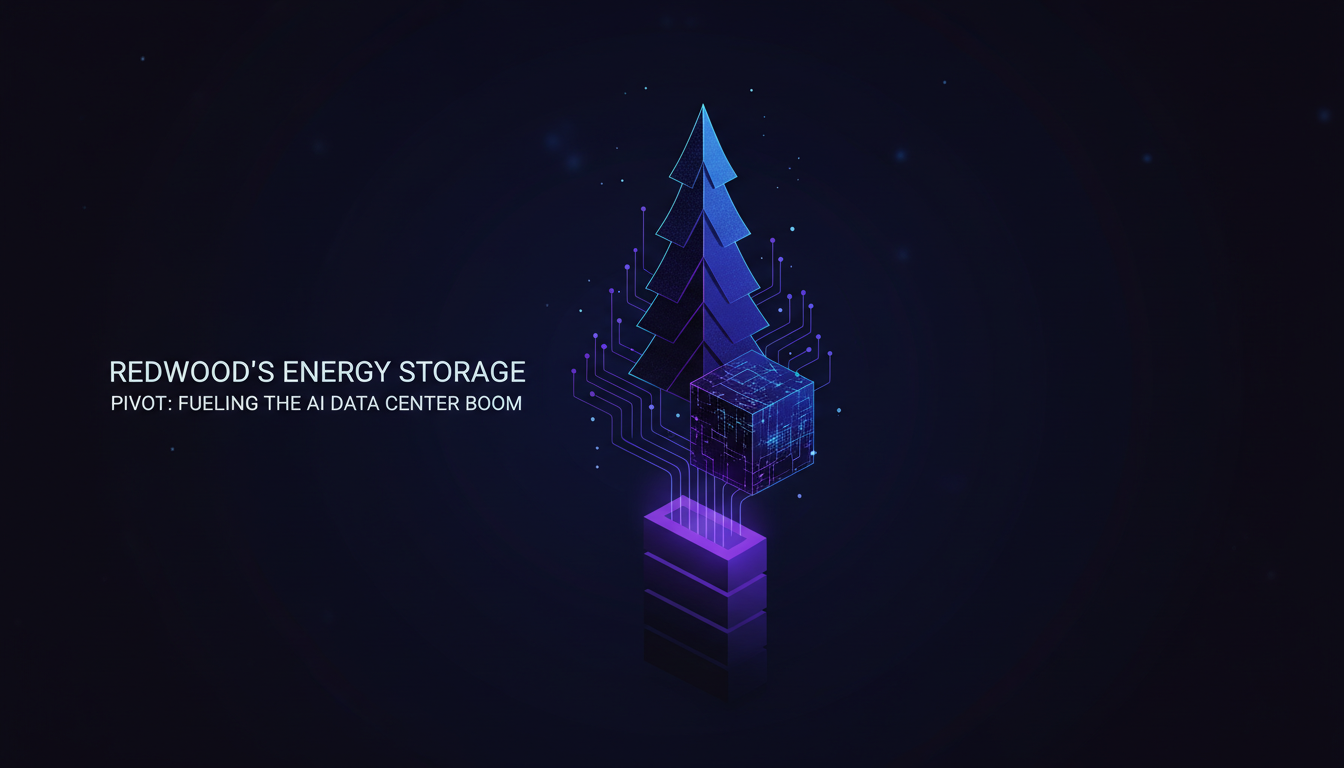
Enter Redwood Materials. Long known as the leader in closed-loop battery recycling, the company founded by former Tesla CTO JB Straubel has executed a strategic pivot that redefines its role in the AI stack. As of February 2026, Redwood’s energy storage division—Redwood Energy—has become its fastest-growing business unit. This isn’t just about recycling; it is about rapid infrastructure deployment. By repurposing “second-life” EV batteries into modular, utility-scale storage systems, Redwood is providing the backup power and peak-shaving capabilities that hyperscalers like Google and specialized compute providers like Crusoe Energy desperately need.
This pivot highlights a critical convergence: the circular economy is no longer just a sustainability play; it is a latency play. In the race to AGI, the speed of power deployment is the new competitive moat. This analysis deconstructs Redwood’s technical architecture, the economics of its Series E funding led by Google, and the engineering reality of powering the 100kW+ densities of modern AI racks.
Deconstructing the AI Power Crisis
To understand why a battery recycling company is suddenly a critical player in AI infrastructure, one must understand the thermodynamics of modern inference and training. The transition from CPU-centric workloads to dense GPU clusters has fundamentally altered the thermal and electrical profile of data centers.
- Rack Density: Traditional enterprise racks consume 5-10kW. An NVIDIA GB200 NVL72 rack can demand upwards of 120kW. This requires entirely new power delivery networks (PDN).
- Transient Spikes: Large Language Model (LLM) training and high-concurrency inference create massive transient load spikes that can destabilize local grids.
- Interconnect Latency: In markets like Northern Virginia or Silicon Valley, utility queue times for new transmission capacity can exceed 3-5 years. AI innovation cycles occur in 6-month increments.
The disparity between “Grid Time” (years) and “AI Time” (months) creates a vacuum for off-grid or microgrid solutions. Hyperscalers cannot afford to wait. This is where architecting hyper-scale inference requires not just software optimization, but sovereign power resilience.
The Buffer Solution
Battery Energy Storage Systems (BESS) act as the necessary buffer. They allow data centers to engage in “peak shaving” (drawing from batteries during high-demand windows to avoid demand charges) and provide Uninterruptible Power Supply (UPS) at a scale that traditional lead-acid systems cannot match. Redwood’s entry into this market essentially turns waste streams (old EVs) into active infrastructure assets.
Redwood Energy: The Architecture of Second-Life Storage
Redwood’s technical innovation lies in its ability to industrialize the “repurposing” phase of the battery lifecycle. Before a battery is shredded for hydrometallurgical recycling, it often retains 70-80% of its original capacity. While this SOH (State of Health) is insufficient for the high-amperage discharge requirements of an electric vehicle accelerating from 0-60, it is perfectly adequate for stationary storage applications where energy density (Wh/kg) is less critical than cost ($/kWh) and availability.
1. Module Characterization and Binning
The engineering challenge in second-life storage is heterogeneity. EV packs come from different manufacturers (Panasonic, LG, CATL), with different chemistries (NMC, NCA, LFP) and form factors (cylindrical, prismatic, pouch). Redwood has developed an automated diagnostic stack that:
- Ingests: Received packs are dismantled to the module level.
- Characterizes: Electrochemical Impedance Spectroscopy (EIS) is used to determine internal resistance and remaining useful life (RUL).
- Bins: Modules are sorted into matched sets based on voltage curves and degradation capability.
2. The Integration Layer
Redwood doesn’t just resell used cells; they package them into turnkey BESS containers. This involves a proprietary Battery Management System (BMS) capable of balancing cells that may have slightly divergent aging profiles. This is a non-trivial control theory problem. If one weak cell hits its voltage floor early, it limits the capacity of the entire string. Redwood’s active balancing architecture allows them to extract maximum utility from heterogeneous packs.
This approach mirrors the modular design seen in wafer-scale computing architectures, where redundancy and fault tolerance are built into the hardware layer to handle component variability.
The Google Series E: A Strategic CAPEX Hedge
In January 2026, Redwood Materials closed a $425 million Series E round, with Google and Nvidia participating. This investment should not be viewed solely through an ESG (Environmental, Social, and Governance) lens. It is a strategic infrastructure hedge.
Google, like Microsoft and Amazon, has committed to running its data centers on 24/7 carbon-free energy (CFE). However, the architectural shifts in AI models toward massive training runs make this incredibly difficult. Solar and wind are intermittent. To achieve true 24/7 CFE without relying on gas peaker plants, massive storage is required.
By investing in Redwood, Google secures a domestic supply chain for storage. It is a vertical integration play. Google is essentially buying an option on future battery capacity that is immune to Asian supply chain disruptions. This aligns with the broader sovereign compute shift, where capital is flowing into assets that guarantee operational independence.
The Cost Delta
New LFP (Lithium Iron Phosphate) stationary storage costs have fallen, but second-life batteries maintain a structural cost advantage. Since the sunk cost of the cell manufacturing was borne by the original EV buyer, Redwood’s cost basis is primarily logistics, diagnostics, and repackaging. This allows them to deploy megawatt-hour scale systems at a lower Levelized Cost of Storage (LCOS) than competitors using virgin cells. For a data center operator looking to shave 15% off their energy bill, this CAPEX difference is material.
Case Study: The Crusoe Energy Partnership
The proof of concept for Redwood’s pivot is their partnership with Crusoe Energy. Crusoe specializes in “digital flare mitigation” and off-grid computing, locating modular data centers directly at energy sources (often stranded renewables or flared gas).
Redwood deployed a 12MW / 63MWh storage system at its Nevada campus to support a Crusoe AI data center. This installation:
- Scale: 63MWh is significant—enough to power thousands of homes, or sustain a massive H100 cluster through peak pricing windows.
- Composition: The system utilizes mixed assets, proving the viability of the second-life control logic at scale.
- Speed: The system was deployed in a fraction of the time required for a traditional utility substation upgrade.
This deployment serves as a reference architecture for the industry. It demonstrates that designing hardware clusters now requires designing the power plant that sits next to them.
Supply Chain Velocity: The New Metric
The most critical metric in the AI arms race today is “Time to Tokens”—how fast can you go from breaking ground on a data center to serving inference? The limiting factor is usually the transformer (the electrical kind, not the architecture) and the backup power system.
Redwood’s model accelerates this velocity. By sourcing feedstock domestically (from retired US EVs and production scrap), they bypass the 6-12 month shipping and customs delays associated with importing mega-packs from China. This domestic velocity is crucial for sovereign AI infrastructure projects that cannot rely on geopolitical stability for their power security.
Furthermore, the silicon thermodynamics of modern chips demand aggressive cooling, which itself is a massive power draw. Redwood’s systems provide the resilience needed to ensure that cooling systems never fail, even during grid brownouts—a catastrophic scenario that could destroy millions of dollars in silicon.
The Consumer Parallel: Anker and the Edge
While Redwood targets the industrial hyperscale market, a parallel trend is occurring at the edge. Devices like the Anker Solix C2000 are bringing LFP storage to the consumer/prosumer level, allowing for decentralized run-times for local inference machines. The physics remains the same: whether it is a data center in Nevada or a workstation in a garage, AI compute requires stable, buffered electrons.
Future Outlook: 20GWh and Beyond
Redwood has stated ambitions to deploy 20GWh of grid-scale storage by 2028. To put this in perspective, that is roughly equivalent to the annual output of a medium-sized Gigafactory, generated entirely from waste. This scale is necessary to support the projected doubling of data center power consumption by 2030.
We are also likely to see a tightening integration between the 2M token context window paradigms and power scheduling. Future AI schedulers might be “carbon-aware,” pushing non-urgent training jobs to time windows where Redwood’s batteries are fully charged with solar, optimizing for both cost and carbon automatically.
Ultimately, Redwood’s pivot signals that the “AI Boom” is actually an “Infrastructure Boom.” The companies that control the physical layer—power, cooling, and space—are becoming the new kingmakers of the digital age.
Frequently Asked Questions
What is Redwood Materials’ “Redwood Energy” division?
Redwood Energy is a business unit of Redwood Materials dedicated to repurposing used electric vehicle batteries into stationary energy storage systems. Instead of immediately recycling (shredding) batteries, they qualify them for “second-life” use in data centers and grid storage.
Why are AI data centers driving demand for battery storage?
AI data centers have extremely high power densities (100kW+ per rack) and fluctuating loads. The electrical grid is often too slow to upgrade connection capacity. Battery storage provides immediate backup power, peak shaving capability, and grid stabilization, allowing data centers to come online faster.
How does Google’s investment affect Redwood?
Google led Redwood’s 5 million Series E round in early 2026. This capital is specifically earmarked to expand the energy storage business. For Google, it secures a supply chain for green backup power to meet its 24/7 carbon-free energy goals for its AI data centers.
Is a “second-life” battery reliable enough for a data center?
Yes. While an EV battery might degrade to 80% capacity (limiting range), it is perfectly functional for stationary storage where weight and volume are less constrained. Redwood uses advanced testing and BMS (Battery Management Systems) to ensure these repurposed packs meet industrial reliability standards.
What is the difference between Redwood’s recycling and repurposing?
Recycling involves breaking the battery down into raw materials (lithium, nickel, cobalt) to make new cathode material. Repurposing involves taking the existing battery module, testing it, and installing it into a storage array without destroying the cell structure. Repurposing is generally cheaper and less energy-intensive.