The Strategic Shift: OpenAI Enters the Pentagon’s Classified Networks
In a definitive move that reshapes the landscape of defense technology, OpenAI has revealed granular details regarding its new agreement with the United States Department of Defense (recently rebranded by the current administration as the Department of War). This partnership marks a critical pivot from the company’s historical distance from military applications, authorizing the deployment of its frontier models within classified government networks. The agreement comes less than 24 hours after the administration severed ties with rival Anthropic, citing irreconcilable differences over security protocols and operational guardrails.
For technical stakeholders and defense analysts, this is not merely a procurement update; it is a fundamental alteration of the AI safety architecture governing national security. The deal allows the Pentagon to leverage OpenAI’s large language models (LLMs) for administrative efficiency, cybersecurity defense, and logistics planning, while establishing a rigid "cloud-only" deployment architecture designed to prevent the technology from being integrated into autonomous lethal systems.
This article provides a technical deep-dive into the agreement’s structural safeguards, the engineering behind the "Safety Stack," and the geopolitical ramifications of this alliance.
The Architecture of Deployment: Cloud vs. Edge
The core of OpenAI’s agreement rests on a specific technical constraint: Cloud-Only Deployment. Understanding the distinction between cloud and edge deployment is vital to grasping the safety mechanisms OpenAI claims to have enforced.
Cloud-Air Gapped Integration
Unlike traditional software procurement where code is installed locally on military hardware (edge devices), OpenAI’s models will remain hosted on secure, air-gapped cloud infrastructure. This architecture ensures that:
- Latency as a Safety Feature: By keeping the model in the cloud, network latency is introduced by design. This acts as a physical barrier against using the AI for real-time engagement in autonomous weaponry, which requires millisecond-level reaction times available only via edge computing.
- Centralized Kill Switches: OpenAI retains the ability to suspend access or modify model behavior centrally. If a model is detected attempting to violate safety parameters, access can be revoked instantly across the network.
- Auditability: Every prompt and completion generated within the classified environment is logged (within the constraints of classification levels), allowing for post-incident forensics that would be impossible with decentralized edge deployment.
The "No-Edge" Mandate
The contract explicitly forbids the installation of OpenAI’s model weights onto drones, missiles, or battlefield sensors. This "No-Edge" mandate is the primary technical firewall preventing the AI from becoming the "brain" of an autonomous weapon. In AI Safety Protocols, the risk of "model theft" or "drift" increases exponentially when weights are exported to insecure hardware; this agreement mitigates that vector by keeping the weights under OpenAI’s cryptographic control.
The Three "Red Lines": Contractual Safeguards
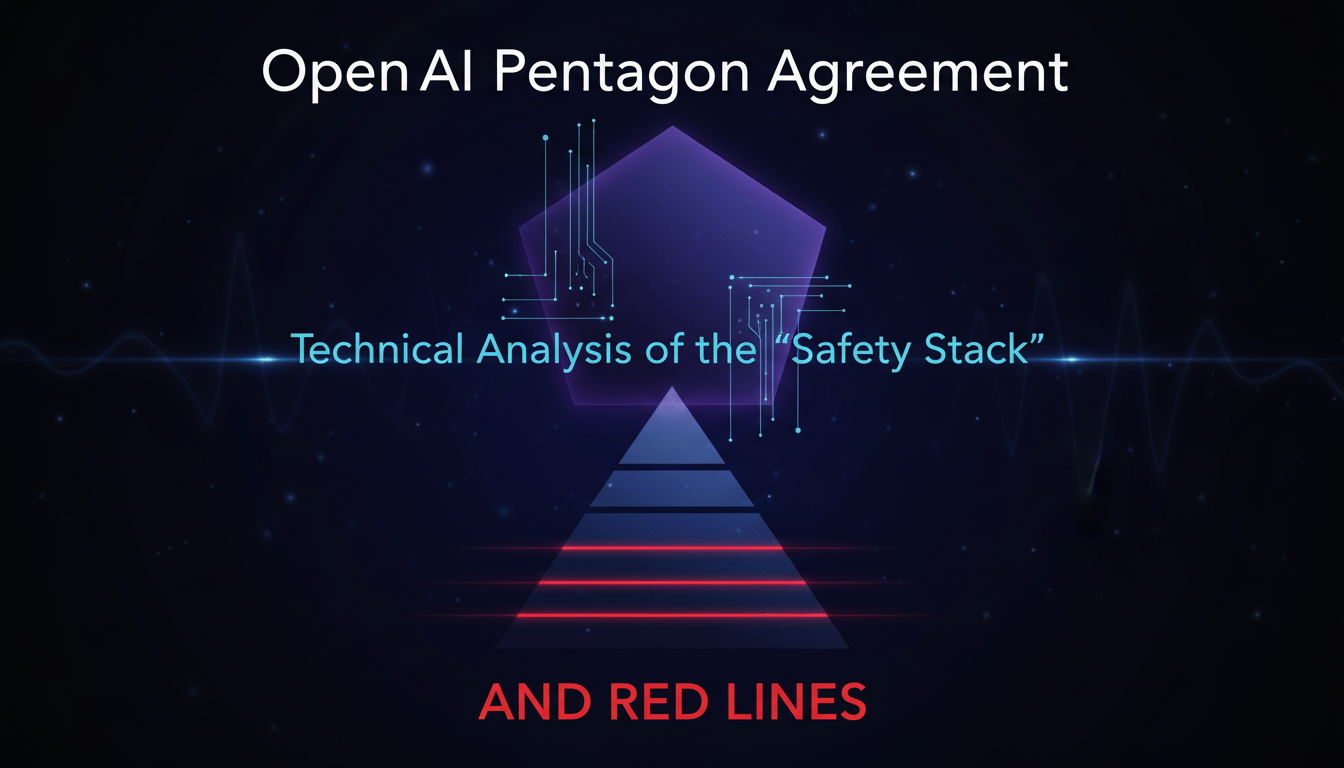
OpenAI has publicized three non-negotiable "Red Lines" that govern the Pentagon’s use of their technology. While critics argue that contractual language is malleable, the technical enforcement of these lines warrants analysis.
1. Prohibition on Mass Domestic Surveillance
The agreement bars the use of OpenAI models for the bulk collection or processing of domestic surveillance data. Technically, this is enforced through Pattern Matching Filters in the safety stack that flag high-volume ingestion of PII (Personally Identifiable Information) or domestic communication metadata. However, the definition of "mass" vs. "targeted" surveillance remains a point of contention among privacy advocates.
2. No Directing of Autonomous Weapons
As detailed in the architecture section, the prohibition on weapon direction is enforced physically via the cloud-only structure. The AI generates text, code, or analysis—it does not generate executable firing commands. The "Human-in-the-Loop" (HITL) requirement is not just policy; it is a necessity of the API’s input/output format, which delivers information to an operator rather than a guidance system.
3. No High-Stakes Automated Decisions
This red line prohibits the use of the AI for "social credit" scoring or automated judicial sentencing. This is the most abstract of the three and likely relies heavily on Policy-Based Access Control (PBAC) mechanisms within the API layer to detect and block queries related to citizen scoring or automated adjudication.
The "Safety Stack": A Technical Breakdown
OpenAI’s "Safety Stack" is the middleware layer sitting between the user (the Pentagon) and the model (GPT-5/6 class systems). In a classified environment, this stack undergoes rigorous modification.
- Input Filtering: Before a prompt reaches the model, it passes through classifiers trained to detect intent related to torture, biological weapons manufacturing, or unauthorized cyber-offensives.
- Output Interception: The model’s raw output is scanned for policy violations before being returned to the user. For the Pentagon, this filter is tuned to allow "lawful" combat-related queries (e.g., tactical analysis) while blocking "unlawful" ones (e.g., war crimes or indiscriminate targeting).
- Cleared Personnel Oversight: A unique aspect of this deal is the requirement for OpenAI employees with Top Secret/SCI clearances to oversee the deployment. These engineers act as "embedded ethicists," monitoring system health and usage patterns from within the classified bubble, bridging the gap between Silicon Valley culture and military necessity.
The Anthropic Divergence: Why OpenAI Won
To understand this agreement, one must analyze the failure of the Pentagon’s negotiations with Anthropic. The divergence highlights a split in the Generative AI Ethics community regarding cooperation with state actors.
Anthropic, known for its "Constitutional AI" approach, reportedly refused to modify its refusal of service for any lethal application, regardless of legality. They also demanded strict liability clauses that the Pentagon deemed incompatible with national sovereignty.
OpenAI’s strategy was to pivot from "No Military Use" to "Responsible National Security Alignment." By agreeing that the U.S. government should have access to the "best tools" to defend democratic values, OpenAI effectively positioned itself as a pragmatic partner. They argued that refusal to engage creates a vacuum filled by less scrupulous actors or adversaries, whereas engagement allows for the imposition of technical guardrails (the "Safety Stack") that would otherwise not exist.
Strategic Implications: The AI Arms Race
This agreement signals the formal entry of Large Language Models into the Great Power competition. The Department of Defense has long sought to integrate "Third Wave" AI (contextual adaptation) into its decision-making loops (OODA loops).
Accelerating Administrative OODA Loops
The immediate value of this partnership is not on the battlefield, but in the bureaucracy. The Pentagon processes petabytes of logistics data, maintenance reports, and acquisition contracts daily. OpenAI’s models can parse this unstructured data instantly, reducing procurement timelines from months to days. This "Logistics Superiority" is a critical, albeit unglamorous, component of modern warfare.
Cybersecurity and Code Auditing
A major component of the deal involves the Cybersecurity AI Tools developed under the DARPA AI Cyber Challenge context. OpenAI’s models will be used to automatically patch vulnerabilities in open-source software used by critical infrastructure. This defensive application aligns perfectly with the "do no harm" ethos while serving vital national security interests.
Ethical Controversies and Loophole Concerns
Despite the guardrails, the agreement has drawn sharp criticism. The phrase "lawful purposes" in the contract allows for a wide interpretation of military action. If a drone strike is deemed "lawful" by military lawyers, does using AI to plan the logistics of that strike violate OpenAI’s mission? The company argues that as long as the AI is not pulling the trigger (directing the weapon), it remains a tool for decision support.
Furthermore, the "Department of War" rebranding context adds a layer of aggressive posture to the partnership. Critics argue that by integrating with a department explicitly refocused on war-making rather than "defense," OpenAI has effectively abandoned its founding neutrality.
Conclusion
OpenAI’s agreement with the Pentagon is a watershed moment in the history of artificial intelligence. It represents the transition of AI from a theoretical research artifact to a critical component of national power. By betting on a "Cloud-Only, Human-in-the-Loop" architecture, OpenAI attempts to thread the needle between patriotism and pacifism. Whether technical safeguards can truly contain the unpredictable nature of generative AI in high-stakes environments remains the defining question of the next decade.
Frequently Asked Questions
Q: Will OpenAI’s models control drones or missiles directly?
No. The agreement strictly prohibits the use of OpenAI models to direct autonomous weapons systems. The "cloud-only" architecture creates a latency barrier that makes real-time weapon control technically unfeasible.
Q: Can the government use ChatGPT to spy on citizens?
The contract includes a "Red Line" prohibiting mass domestic surveillance. The system is designed to flag and block bulk ingestion of private citizen data, though targeted analysis for "lawful" investigations remains a grey area debated by privacy experts.
Q: Why did the Pentagon choose OpenAI over Anthropic?
Anthropic refused to compromise on strict prohibitions against any lethal application and demanded liability terms the government rejected. OpenAI offered a framework that allows for "lawful" military use (like logistics and cyber defense) while maintaining technical control over the model’s weights.
Q: What is the "Safety Stack"?
The Safety Stack is a layer of software filters that sits between the user and the AI. It detects and blocks prohibited queries (e.g., "how to build a bioweapon") and ensures that the model’s outputs adhere to safety guidelines, even within a classified network.
Q: Is the model running on government computers?
No. The model runs on OpenAI’s secure cloud infrastructure. The government accesses it via a secure connection. This ensures OpenAI can technically enforce its "Red Lines" by monitoring the system’s performance and shutting it down if necessary.