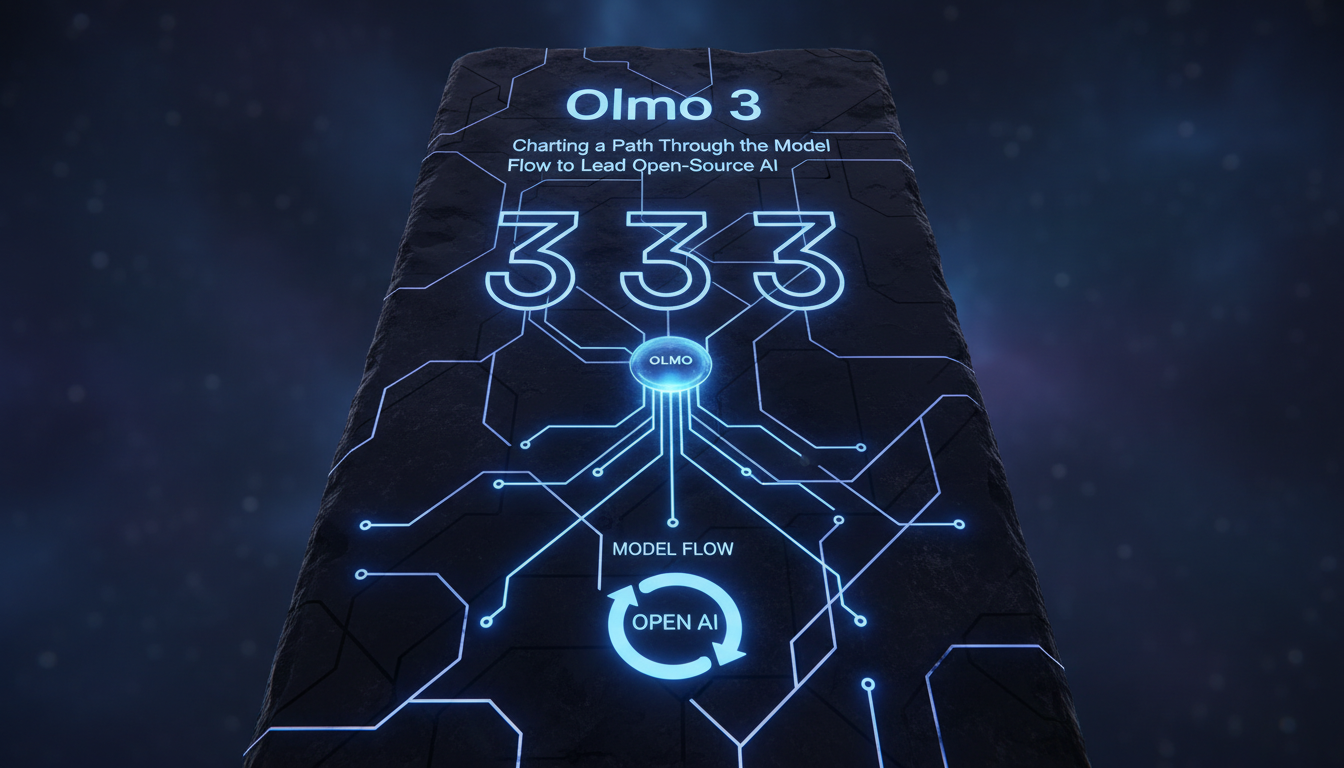
The landscape of artificial intelligence is currently defined by a paradox: as models become more capable, their internal mechanisms often become more opaque. While the term “open source” is liberally applied to various heavyweights in the generative AI space, true scientific reproducibility remains a rarity. Enter the Allen Institute for AI (AI2) and its latest milestone. Olmo 3: Charting a path through the model flow to lead open-source AI represents not just a software release, but a philosophical correction to the trajectory of modern machine learning.
Unlike proprietary counterparts that hide their training recipes behind corporate firewalls, Olmo 3 offers a complete autopsy of the generative process. From the curation of the Dolma dataset to the granular specifics of hyperparameter tuning, this model invites researchers, enterprise developers, and ethicists to scrutinize the entire pipeline. This article serves as a technical pillar page, dissecting the architecture, the training dynamics, and the strategic implications of Olmo 3 for the broader open-source AI projects ecosystem.
The Philosophy of Full-Stack Transparency in Olmo 3
To understand the significance of Olmo 3, one must first distinguish between “open weights” and “open science.” Models like Llama 3 or Mistral have popularized the distribution of model weights, allowing developers to run inference locally. However, the data mixtures, training code, and intermediate checkpoints often remain proprietary secrets. This “black box” approach limits the ability of the scientific community to understand bias, verify safety, or improve upon the architecture fundamentally.
Olmo 3 dismantles this barrier by exposing the “model flow.” This concept refers to the end-to-end visibility of the model’s creation lifecycle. By releasing the full training data (Dolma), the training code, the evaluation suite (OLMo-Eval), and the intermediate checkpoints, AI2 has charted a path that turns the model from a product into a platform for inquiry. This strategy positions Olmo 3 not merely as a tool for text generation, but as a baseline for the future of AI research trends.
Defining the Model Flow Architecture
The “model flow” is the circulatory system of a Large Language Model (LLM). In Olmo 3, this flow is documented and accessible at every node:
- Data Curation: The filtering logic applied to the pre-training corpus.
- Tokenization Strategy: How raw text is converted into numerical representations, impacting multilingual capabilities.
- Training Dynamics: The loss curves and optimizer states accessible via hundreds of checkpoints.
- Post-Training Adaptation: The specific recipes used for instruction tuning and Reinforcement Learning from Human Feedback (RLHF).
Insert flow diagram illustrating the Olmo 3 pipeline from raw data to final inference weights here
Technical Architecture: Under the Hood of Olmo 3
Olmo 3 builds upon the transformer architecture with significant optimizations designed for scale and stability. While the exact parameter counts vary across the model family (typically ranging from 7B to 70B+), the architectural choices in Olmo 3 reflect a maturity in open-source engineering.
Rotary Positional Embeddings (RoPE) and Context Windows
One of the critical upgrades in Olmo 3 is the handling of long-context dependencies. Utilizing high-frequency Rotary Positional Embeddings (RoPE), the model sustains coherence over extended context windows, rivaling proprietary models in retrieval-augmented generation (RAG) tasks. This capability is crucial for enterprise applications where analyzing extensive legal documents or codebases is required.
The Switch to Mixture-of-Experts (MoE)
In its larger variants, Olmo 3 adopts a sparse Mixture-of-Experts (MoE) architecture. This approach activates only a subset of parameters for any given token, decoupling inference cost from total model size. By doing so, Olmo 3 achieves high-performance benchmarks while maintaining a manageable computational footprint for inference—a key consideration for widespread adoption in multimedia news strategy workflows and automated reporting tools.
SwiGLU Activation and Stability
The model utilizes SwiGLU activation functions, which have become the gold standard for performance in Llama-class models. However, Olmo 3 introduces specific tweaks to layer normalization to prevent training divergence, a common issue when scaling fully open-source models on diverse hardware configurations.
The Dolma Dataset: The Fuel of Open Source
A model is only as good as the data it consumes. For Olmo 3, that fuel is the Dolma dataset—a massive, open corpus designed to mitigate the legal and ethical risks associated with web-scraped data. Unlike the opaque datasets of closed models, Dolma is fully inspectable.
The curation process for Olmo 3 involved rigorous deduplication and personally identifiable information (PII) scrubbing. This transparency allows enterprise users to conduct data lineage audits, ensuring that the model outputs do not infringe on copyright or leak sensitive information. For developers building investigative reporting AI tools, knowing the source of the model’s knowledge is a requirement for verification and fact-checking.
- Web Content: Carefully filtered Common Crawl dumps.
- Academic Papers: Open access scientific repositories.
- Code: Permissive license repositories (GitHub, etc.).
- Conversational Data: Cleaned forum discussions to capture nuance.
Reproducibility as a Feature
The central value proposition of Olmo 3: Charting a path through the model flow to lead open-source AI is reproducibility. In the current AI climate, many “open” models cannot be reproduced because the training infrastructure is tied to specific, proprietary hardware clusters. AI2 challenges this by releasing the training logs and the exact environment configurations used.
This allows third-party researchers to fork the training process from any checkpoint. If a research team wants to test a new hypothesis on learning rates, they do not need to retrain from scratch (burning millions of dollars in compute). They can pick up from step 100,000 of the Olmo 3 training run. This capability drastically accelerates the pace of innovation and democratizes access to high-level model research.
Benchmarking Olmo 3: Performance vs. Transparency
Historically, there has been a “transparency tax”—a belief that fully open models lag behind closed models in raw performance. Olmo 3 aims to close this gap. Preliminary benchmarks indicate that Olmo 3 performs competitively against Llama 3 and GPT-4 variants in standard reasoning and coding tasks.
Reasoning and Logic
On benchmarks like ARC-Challenge and HellaSwag, Olmo 3 demonstrates advanced reasoning capabilities. The transparent nature of the training data allows researchers to pinpoint exactly why the model excels or fails at specific logic puzzles, creating a feedback loop for improvement that is impossible with closed models.
Coding and Mathematics
Leveraging a heavy mix of Python and technical documentation in the Dolma dataset, Olmo 3 shows robust performance in code generation. This makes it an ideal candidate for integration into open-source IDE assistants and automated DevOps workflows.
Insert chart comparing Olmo 3 benchmarks against Llama 3 and Mistral Large here
Integrating Olmo 3 into Enterprise Workflows
For Chief Technology Officers (CTOs) and decision-makers, the shift to Olmo 3 is driven by governance. In regulated industries such as finance, healthcare, and journalism, the ability to explain AI behavior is paramount.
Fine-Tuning and Domain Adaptation
Because the full training recipe is available, fine-tuning Olmo 3 is more deterministic than fine-tuning black-box models. Organizations can align the model to their specific voice or compliance standards with higher precision. For newsrooms, this means creating an editorial assistant that adheres strictly to a style guide without the unpredictable hallucinations often seen in closed models trained on unknown data mixtures.
Cost Efficiency and Carbon Footprint
AI2 has also prioritized the disclosure of the carbon footprint associated with training Olmo 3. This transparency assists organizations in calculating their Scope 3 emissions, a growing requirement for ESG (Environmental, Social, and Governance) reporting. Furthermore, the efficiency of the MoE architecture reduces inference costs, making scale deployment viable.
The Strategic Role of Evaluation: OLMo-Eval
Alongside the model, the release of the OLMo-Eval framework provides a standardized harness for testing. Evaluation in AI is notoriously difficult, with “contamination” (where test data accidentally leaks into training data) skewing results. Because Olmo 3’s training data is public, decontamination is verifiable.
OLMo-Eval supports a wide range of tasks, from question answering to toxicity detection. This allows developers to rigorously test the model against their specific use cases before deployment, ensuring that the “model flow” results in a safe and reliable product.
Legal and Ethical Implications
The release of Olmo 3 forces a conversation about the legal status of AI weights and data. By engaging with the legal community and releasing under the Apache 2.0 license (or similar permissive structures), AI2 provides a safer harbor for commercial adoption. The transparency of the data lineage offers a defense against copyright claims that plague opaque models, as users can verify that the model was trained on permissible sources.
Future Outlook: The Open Source Pivot
As we look toward the next generation of AI, the methodology pioneered by Olmo 3—charting a path through the model flow—is likely to become the standard for scientific AI. The days of accepting high benchmark scores without understanding the underlying mechanism are numbering. OpenSourceAI News predicts that the “Olmo Standard” of releasing data, code, and weights will pressure other labs to increase transparency, ultimately benefiting the entire ecosystem.
The roadmap for Olmo 4 and beyond likely includes multimodal capabilities, further integration of video and audio processing, and even deeper interpretability tools that allow users to visualize neuron activation in real-time. By leading open-source AI through radical transparency, Olmo 3 secures its place not just as a model, but as a movement.
Frequently Asked Questions – FAQs
What makes Olmo 3 different from Llama 3?
While both are high-performance models, Llama 3 typically releases only the model weights. Olmo 3 releases the weights, the complete training data (Dolma), the training code, the training logs, and the evaluation suite. This makes Olmo 3 a “truly open” model suitable for deep scientific research and verifiable compliance, whereas Llama 3 is considered “open weights.”
Can I use Olmo 3 for commercial applications?
Yes, Olmo 3 is generally released under permissive licenses (such as Apache 2.0) that allow for commercial use. However, its primary advantage for commerce is legal safety; because the training data is known, companies can better assess copyright risks compared to models with undisclosed data sources.
What hardware is required to run Olmo 3?
This depends on the specific parameter size (e.g., 7B, 70B). The 7B version can run on consumer-grade GPUs with appropriate quantization. The larger MoE variants require enterprise-grade hardware (like NVIDIA A100s or H100s) for efficient inference, though optimization techniques like 4-bit quantization can lower these requirements significantly.
How does the “model flow” improve AI safety?
By exposing the entire pipeline—from data selection to final weights—researchers can identify exactly where biases or safety vulnerabilities are introduced. This allows for root-cause fixes (e.g., removing toxic data sources) rather than just patching the output with safety filters, resulting in a fundamentally more robust system.
Is Olmo 3 better at coding than GPT-4?
While GPT-4 generally holds the state-of-the-art crown for generalized reasoning, Olmo 3 is highly competitive in coding tasks, especially when fine-tuned. Its open nature allows developers to inspect its training on code repositories, making it a preferred choice for building secure, on-premise coding assistants where data privacy is critical.