Architecting Enterprise Media: A Technical Deep Dive into Google Vids, Veo, and Lyria Integration
As a senior architect embedded in frontier tech research, observing the trajectory of multi-modal generative AI systems reveals a profound paradigm shift in enterprise software. The recent deployment of Google Vids is not merely an iterative update to the Google Workspace ecosystem; it is a masterclass in distributed inference, multi-modal transformer orchestration, and retrieval-augmented generation (RAG). By integrating the Veo video generation model and the Lyria audio synthesis engine directly into a collaborative cloud environment, Google has effectively abstracted the computationally prohibitive barriers of multimedia production. This technical analysis reconstructs the foundational architecture of Google Vids, exploring the engineering feats required to process zero-shot video generation with minimal inference latency, while maintaining enterprise-grade security and context awareness.
The Architectural Evolution of Enterprise Video Generation
Historically, enterprise video production was fundamentally constrained by deterministic, latency-bound rendering pipelines. Traditional workflows necessitated sequential bottlenecks: scripting, storyboarding, asset acquisition, timeline orchestration, and finally, hardware-intensive rasterization. The compute allocation required for these processes was largely static, relying on local GPUs or expensive cloud-rendering farms. Google Vids entirely bypasses this legacy framework by replacing deterministic rendering with probabilistic generative synthesis. The platform acts as a high-level orchestration layer, translating natural language and enterprise data inputs into multi-modal prompts that are asynchronously processed by Google’s TPU clusters. This shift transforms video creation from a linear, asset-bound task into a continuous, iterative dialogue with a foundation model.
From Latency-Bound Rendering to Real-Time Inference
The core engineering challenge in deploying a system like Google Vids at a planetary scale is the management of inference latency. Video generation requires the continuous, autoregressive or diffusion-based synthesis of high-fidelity spatial-temporal data. To achieve near real-time responsiveness within the browser interface, Google leverages a highly optimized microservices architecture. When a user inputs a prompt or selects a document to base a video on, the frontend does not merely send a string to a monolithic API. Instead, it compiles an Abstract Syntax Tree (AST) of the user’s intent, breaking down the request into parallelizable sub-tasks: script generation via an LLM (likely an optimized Gemini variant), voiceover synthesis via Lyria, and visual asset generation via Veo. These tasks are routed through a dynamic load balancer to specialized TPU v5e pods, which utilize advanced weights and biases configurations to ensure predictable performance despite fluctuating concurrent enterprise loads.
Under the Hood: Veo and Lyria Integration in Google Vids
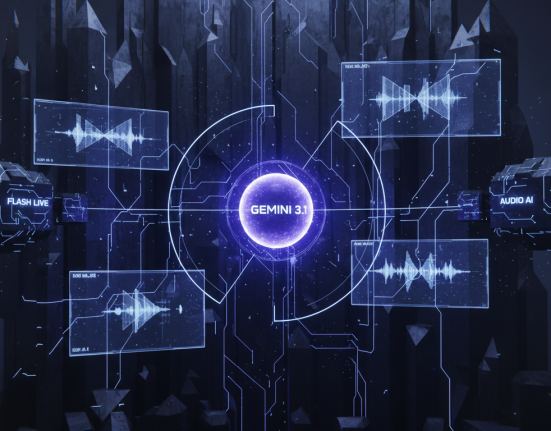
The true technical marvel of Google Vids lies in its dual-engine generative backend. While Gemini handles the semantic heavy lifting, the actual media synthesis is delegated to Veo and Lyria. These models represent the bleeding edge of multi-modal research, designed specifically to handle the complexities of temporal continuity and high-fidelity frequency reconstruction.
The Veo Video Generation Model: Diffusion Mechanisms and Latency
Veo is Google’s premier video generation model, operating on an advanced latent diffusion framework. Unlike pixel-space diffusion models that suffer from exponential compute costs as resolution scales, Veo compresses frames into a lower-dimensional latent space using a powerful Variational Autoencoder (VAE). The diffusion process—adding and iteratively removing Gaussian noise to form images—occurs within this compressed manifold, drastically reducing the required floating-point operations per second (FLOPS). This architectural decision is what allows Google Vids to operate seamlessly within a web browser without requiring a dedicated edge GPU. Furthermore, Veo is deeply integrated with the transformer architecture. It utilizes cross-attention layers to map text embeddings (derived from the user’s prompt or Workspace documents) to the visual latent representations, ensuring high prompt adherence and semantic fidelity.
Transformer-Based Temporal Consistency
The most notorious failure mode of early video generation models was a lack of temporal consistency—objects mutating, backgrounds warping, and physics breaking down between frames. Veo solves this through a spatial-temporal attention mechanism. Instead of generating frames in isolation, the transformer processes overlapping context windows of latent frames. The self-attention matrices calculate the relationships not just across the spatial dimensions (height and width of a single frame) but across the temporal axis (time). By explicitly encoding positional information for both space and time, Veo effectively maintains the identity of objects and the continuity of motion, ensuring that the generated B-roll and visual assets in Google Vids meet stringent enterprise quality standards without jitter or hallucination artifacts.
Lyria: Generative Audio and Parameter-Efficient Fine-Tuning (PEFT)
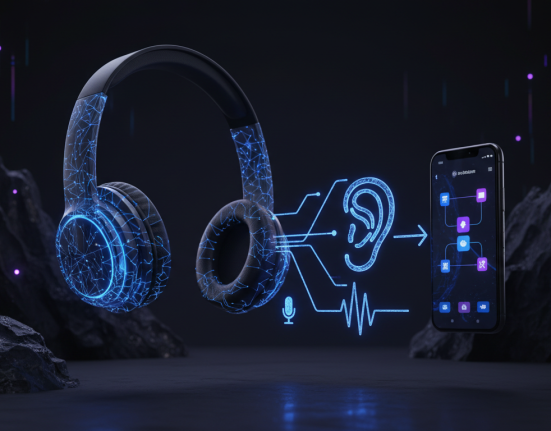
While Veo handles the visual domain, the auditory landscape of Google Vids is powered by Lyria, DeepMind’s state-of-the-art generative audio model. Synthesizing human speech and background music that align perfectly with visual cues requires overcoming significant sampling rate challenges. Audio waveforms at 44.1kHz contain 44,100 data points per second. Lyria manages this high dimensionality by operating in a compressed acoustic token space, likely utilizing a hierarchical seq2seq architecture. It translates textual scripts generated by Gemini into semantic tokens, which are then decoded into acoustic features and finally vocoded into high-fidelity waveforms. To ensure the voiceovers sound natural and contextually appropriate for varying enterprise scenarios (e.g., a formal quarterly earnings report versus an upbeat marketing pitch), Google likely employs parameter-efficient fine-tuning (PEFT) techniques like LoRA (Low-Rank Adaptation). This allows the system to rapidly swap specific tonal weights dynamically without having to load entirely new foundation models into memory, further optimizing inference latency.
Orchestrating Audio-Visual Weights and Biases
Synchronizing Lyria’s audio outputs with Veo’s visual generation requires a sophisticated orchestration layer. Google Vids acts as the timeline interface, but on the backend, it calculates the temporal metadata of both media streams. The system aligns phoneme generation timestamps from Lyria with the frame-rate generation parameters of Veo. This deterministic alignment ensures that text overlays, transitions, and generated B-roll snap perfectly to the pacing of the voiceover. By managing the weights and biases of these overlapping processes through a unified multi-modal latent space, the architecture guarantees a cohesive final output that belies the complex distributed computing occurring milliseconds prior.
Retrieval-Augmented Generation (RAG) in Google Workspace
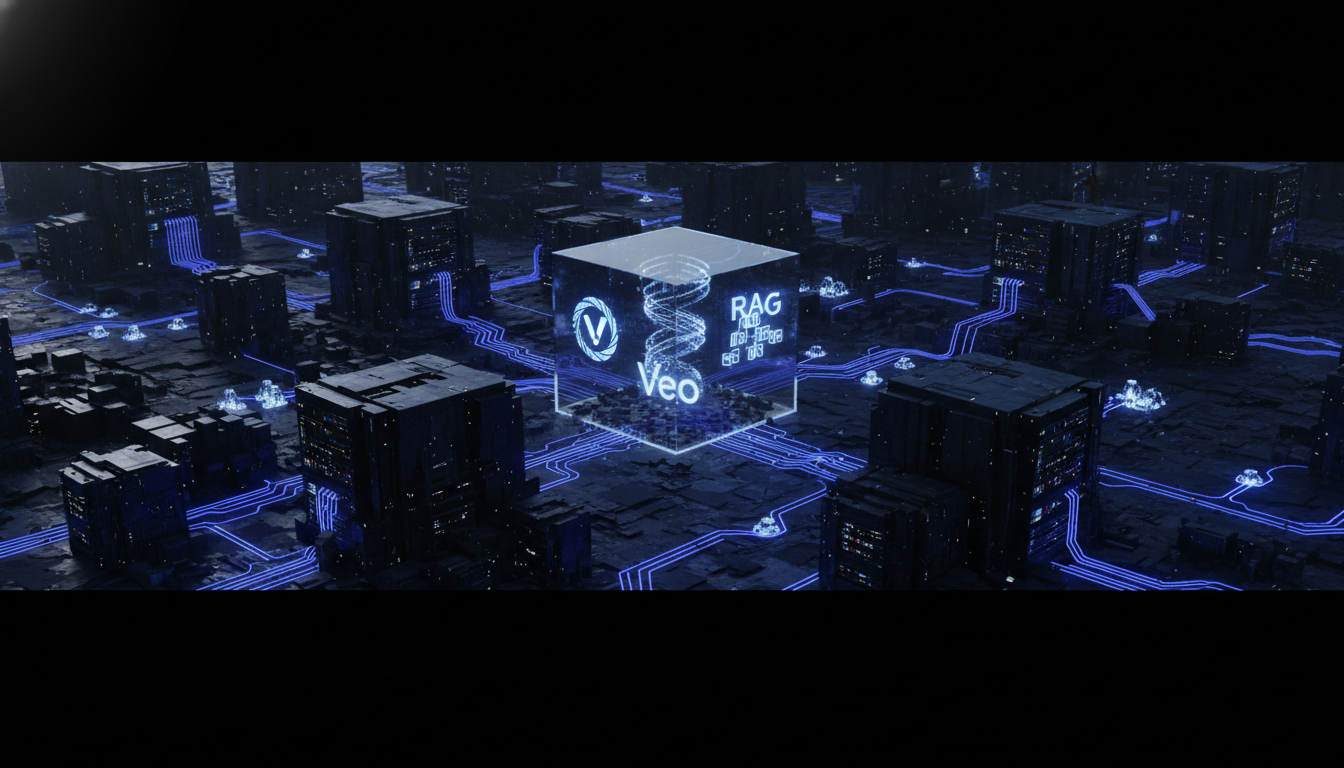
A generative model is only as useful as the context it is grounded in. Google Vids distinguishes itself not just through its media synthesis, but through its profound integration with the Google Workspace data ecosystem. This is achieved through an advanced implementation of Retrieval-Augmented Generation (RAG), which transforms a user’s static documents, spreadsheets, and slide decks into a dynamically queryable knowledge graph.
Contextual Grounding in Google Docs and Drive
When a user prompts Google Vids to “create a training video based on the Q3 onboarding doc,” the system initiates a highly optimized RAG optimization pipeline. The monolithic LLM (Gemini) does not attempt to ingest the entire document directly into its context window, which would increase compute costs and degrade reasoning fidelity. Instead, the backend retrieves the specified document via the Google Drive API, sanitizes the raw text, and segments it into semantically coherent chunks. These chunks are then passed through an embedding model (like Gecko) to generate dense vector representations. This vectorization process mathematically encodes the semantic meaning of the enterprise data, mapping it into a high-dimensional space where concepts can be easily clustered and retrieved based on relevance.
Vector Embeddings for Storyboard Construction
Once the document is vectorized, the core orchestration engine queries this temporary vector index to extract the most salient points required for a video storyboard. The retrieved context is formatted and injected into the system prompt. This augmented prompt forces the LLM to ground its script generation strictly in the provided enterprise data, drastically mitigating the risk of hallucination. The LLM acts as an automated director, breaking the synthesized information into distinct scenes. For each scene, it generates parallel outputs: a segment of the script for Lyria, a visual prompt for Veo, and typography instructions for the text overlay engine. This seamless RAG pipeline bridges the gap between unstructured text data and highly structured, multi-modal video narratives, representing a quantum leap in automated enterprise communication.
The Enterprise Economics of Zero-Cost AI Video Scaling
The narrative that Google Vids enables users to “create, edit and share videos at no cost” (as part of existing Workspace tiers) is an aggressive disruption of the enterprise SaaS market, enabled entirely by Google’s proprietary silicon and vertically integrated infrastructure. Deploying multi-modal generative AI is notoriously expensive. To offer this at scale without additional per-seat micro-transactions requires unprecedented compute efficiency.
Compute Allocation and Cloud TPU Utilization
Google mitigates the exorbitant costs of video inference through its custom Tensor Processing Units (TPUs). By co-designing the hardware (TPU v5p and v5e) and the software stack (JAX, XLA compiler), Google achieves hardware utilization rates that off-the-shelf GPU clusters cannot match. The XLA (Accelerated Linear Algebra) compiler specifically optimizes the matrix multiplications inherent in the transformer architecture, fusing operations to reduce memory bandwidth bottlenecks. When a Workspace user clicks “Generate” in Google Vids, their request is batched with thousands of others, utilizing continuous batching techniques that keep the TPUs saturated at near 100% compute capacity. This massive scale dilutes the marginal cost of inference per user to fractions of a cent.
Managing Inference Costs at Enterprise Scale
Furthermore, Google Vids employs intelligent caching and pre-computation. Not every request triggers a full, deep Veo generation from scratch. The system utilizes a vast library of pre-generated, highly modular stock assets and templates. When possible, the AI acts as an intelligent compositor—layering dynamically generated text overlays and Lyria voiceovers onto static or cached visual backdrops. Full zero-shot latent diffusion via Veo is reserved for specific, highly customized visual prompts where caching fails. This tiered approach to generative synthesis—balancing heavy diffusion models with lightweight composition—is the architectural secret to providing a high-value, computationally intensive application at zero apparent cost to the end-user.
Technical Deep Dive FAQ
- How does Google Vids manage inference latency during real-time video compilation?
- Google Vids manages inference latency by decoupling the generation processes. Scripting (Gemini), audio (Lyria), and visual generation (Veo) are processed as parallel microservices on highly optimized TPU v5e clusters. Furthermore, the system utilizes continuous batching and PagedAttention mechanisms to maximize memory throughput, delivering initial frames or storyboard layouts asynchronously while heavier latent diffusion tasks complete in the background.
- What is the role of RAG optimization in Google Vids?
- RAG (Retrieval-Augmented Generation) is foundational to grounding Google Vids in enterprise reality. It allows the system to securely ingest data from Google Docs, Slides, and Drive, convert that unstructured data into vector embeddings, and retrieve semantically relevant chunks to build highly accurate, context-aware video scripts and storyboards without hallucinating facts.
- How does the Veo model ensure temporal consistency in generated video?
- Veo ensures temporal consistency by employing a spatial-temporal attention mechanism within its transformer architecture. Unlike standard image models that only look at 2D space, Veo’s self-attention layers process overlapping windows of frames across the time axis. This continuous encoding of positional information allows the model to map the physics and visual identity of objects smoothly across time, preventing flickering or structural degradation.
- Can parameter-efficient fine-tuning (PEFT) be utilized for enterprise-specific outputs?
- While initially generalized, Google’s architecture intrinsically supports PEFT methods like LoRA. This allows the backend to dynamically adapt models like Lyria or Gemini to match specific corporate branding guidelines, tonal requirements, or specialized industry vocabularies by only swapping out a tiny fraction of the model’s overall weights during inference.
- How does the architecture balance high-fidelity generation with “zero cost” scaling?
- The economic viability of offering Google Vids within existing Workspace subscriptions stems from hardware-software co-design. Google uses its proprietary TPUs and the XLA compiler to execute matrix multiplications with unmatched efficiency. Additionally, the system employs a tiered synthesis approach, utilizing intelligent caching and modular asset composition for standard requests, reserving computationally expensive zero-shot diffusion only for novel, complex visual prompts.
This technical analysis was developed by our editorial intelligence unit, leveraging insights from the original briefing found at this primary resource.