The Compute Imperative: Analyzing Microsoft’s $1B AI Hyperscale Expansion in Thailand
In the rapidly accelerating arms race for artificial intelligence supremacy, compute is the new global currency. From the perspective of architectural design at frontier AI research labs, the deployment of physical infrastructure is no longer a downstream IT concern; it is the fundamental bottleneck dictating the pace of algorithmic scaling. Microsoft’s unprecedented $1 billion capital injection into Thailand’s AI and cloud infrastructure represents a critical pivot in distributed compute topology. This is not merely an expansion of Azure availability zones; it is a strategic maneuver to decentralize inference pipelines, localize Foundation Model (FM) fine-tuning, and architect a robust ecosystem capable of sustaining next-generation Transformer architectures across Southeast Asia.
Architecting Distributed Edge Compute for Foundation Models
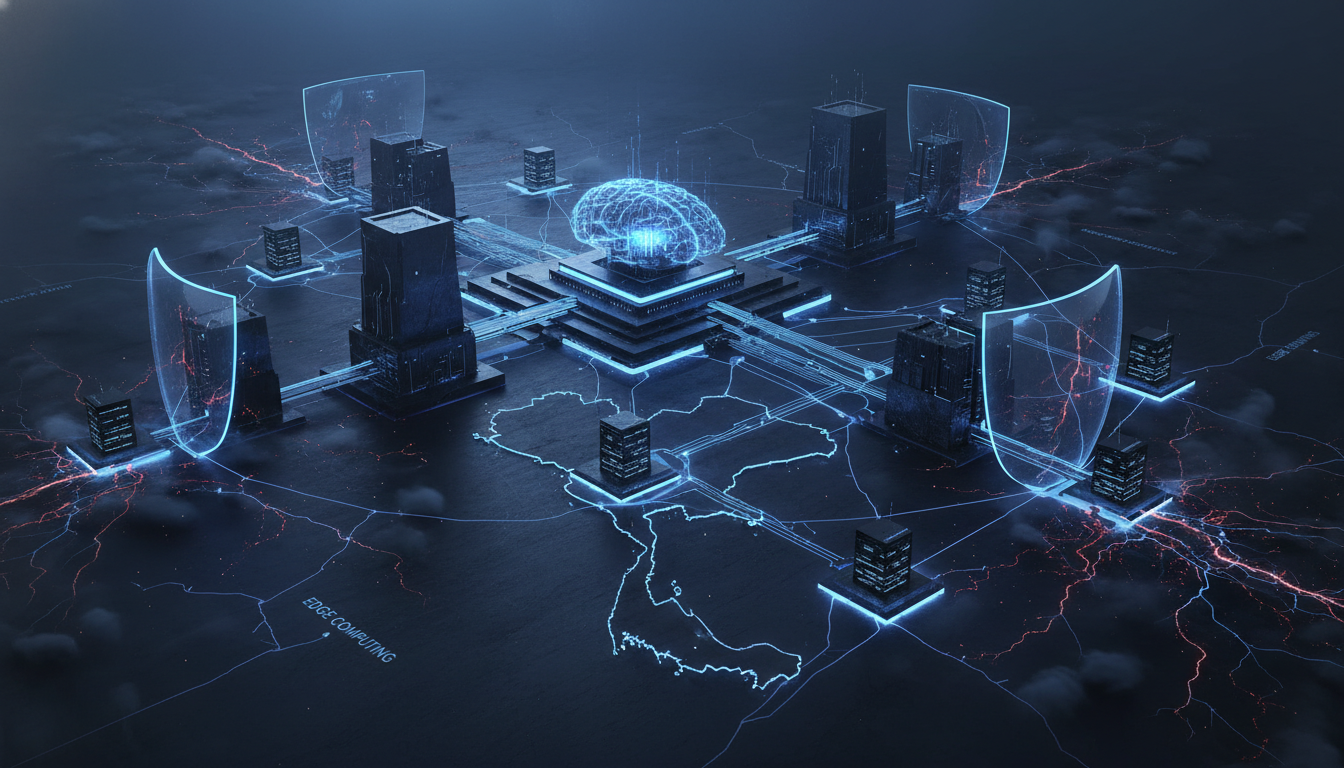
To understand the technical magnitude of this deployment, we must examine the limitations of centralized hyperscale data centers. Currently, deploying massive trillion-parameter models involves routing global API requests through centralized clusters, introducing unacceptable inference latency for synchronous enterprise applications. By establishing localized AI data centers in Thailand, Microsoft is drastically reducing the physical distance between the end-user application and the GPU clusters executing the forward pass of the neural network.
Overcoming Latency in Synchronous Inference
Inference latency in Large Language Models (LLMs) is fundamentally constrained by memory bandwidth and network propagation delays. Time to First Token (TTFT) and Inter-Token Latency (ITL) are critical metrics for user-facing AI. When a request originates from Southeast Asia and must traverse transatlantic fiber to a US-based cluster, the network overhead alone can add hundreds of milliseconds of latency, degrading the performance of real-time multi-agent systems and interactive AI copilots. Deploying massive H100 or B200 Tensor Core GPU clusters natively in Thailand effectively pushes inference to the edge. This localized compute topology enables the deployment of complex, low-latency applications such as real-time voice-to-voice translation, high-frequency algorithmic trading agents, and autonomous robotic control systems that demand sub-50-millisecond response times.
Data Sovereignty and Distributed RAG Architectures
Beyond latency, the $1 billion investment solves a critical bottleneck in enterprise AI adoption: data sovereignty. Financial institutions, healthcare providers, and government agencies in Thailand are strictly bound by localized data residency regulations (such as the PDPA). They cannot legally route sensitive PII or proprietary corporate data through foreign jurisdictions to utilize advanced LLMs. The establishment of local Azure AI infrastructure unlocks the ability to architect highly secure, sovereign Retrieval-Augmented Generation (RAG) pipelines. In a sovereign RAG architecture, vector databases (such as Milvus or Pinecone), embedding models, and the generative LLM all reside within the same secure, geographically isolated network boundary. This allows Thai enterprises to leverage the cognitive reasoning capabilities of models like GPT-4 seamlessly over their internal enterprise data lakes without ever exposing secure weights, biases, or raw data payloads to the public internet.
The Intricacies of Localized Model Training and Tokenization
While inference is a primary driver, the availability of sovereign compute is equally crucial for localized model training and Parameter-Efficient Fine-Tuning (PEFT). The semantic nuances of the Thai language present unique challenges for standard tokenizer architectures, such as Byte-Pair Encoding (BPE) utilized by GPT models. Because default tokenizers are heavily biased toward Latin characters, Thai text often suffers from severe token fragmentation.
Continuous Pre-Training (CPT) for Thai Linguistic Capabilities
Token fragmentation means that a single Thai word might be split into five or six separate tokens, rapidly depleting the model’s context window and exponentially increasing inference compute costs (which scale quadratically with sequence length in standard attention mechanisms). With $1 billion in localized infrastructure, Thai AI researchers and enterprises now have the raw compute necessary to conduct Continuous Pre-Training (CPT) on existing open-weight models (like Llama 3 or Mistral). By expanding the vocabulary size and updating the tokenizer to natively support Thai syntax, researchers can drastically compress the token representation of the Thai language. This requires massive distributed tensor parallelism across thousands of interconnected GPUs, utilizing high-bandwidth NVLink and InfiniBand networks—exactly the type of sophisticated infrastructure this investment brings to the region.
Parameter-Efficient Fine-Tuning (PEFT) at the Edge
Furthermore, localized compute democratizes access to PEFT methodologies like Low-Rank Adaptation (LoRA) and Quantized LoRA (QLoRA). Instead of updating the billions of parameters in a foundation model, Thai developers can freeze the pre-trained model weights and inject trainable rank decomposition matrices into the Transformer’s self-attention layers. This allows regional enterprises to rapidly fine-tune specialized models for local legal, medical, or customer service domains using a fraction of the compute, optimizing the specific weights and biases required for highly contextual localized tasks.
The Skilling Paradigm: Cultivating Regional AI Architects
Silicon alone does not yield a functional AI ecosystem. A highly sophisticated compute cluster is effectively inert without the human capital required to orchestrate it. Microsoft’s commitment includes a massive skilling initiative aimed at training over 100,000 developers and IT professionals in Thailand. From the perspective of global AI deployment, this is a calculated effort to build a localized army of Machine Learning Engineers, Data Scientists, and AI Architects.
Transitioning from Prompt Engineering to Systems Architecture
The curriculum demanded by modern AI infrastructure extends far beyond basic prompt engineering. To fully leverage localized hyperscale clusters, this workforce must master the orchestration of distributed training runs, understanding how to balance batch sizes against GPU VRAM constraints, mitigating out-of-memory (OOM) errors during large-scale gradient descent, and managing complex MLOps pipelines. They will need to be proficient in deploying quantization techniques (like AWQ or GPTQ) to fit multi-billion parameter models onto smaller, more cost-effective inference endpoints. By cultivating this high-level technical expertise locally, Microsoft is ensuring that its physical infrastructure is met with the corresponding algorithmic talent necessary to drive massive enterprise consumption of Azure AI services.
Energy Constraints and Sustainable Hyperscale Engineering
A $1 billion data center expansion inherently triggers severe engineering challenges regarding power density and thermal management. Training and serving frontier models requires staggering amounts of electricity. AI data centers operate at rack densities that routinely exceed 40-50 kW, compared to the 5-10 kW average of traditional enterprise servers. Developing this infrastructure in a tropical climate like Thailand introduces unique complexities in cooling efficiency and Power Usage Effectiveness (PUE).
Liquid Cooling and Infrastructure Optimization
Traditional air cooling is largely insufficient for dense clusters of high-TDP (Thermal Design Power) AI accelerators. We anticipate this infrastructure will heavily leverage direct-to-chip liquid cooling or immersion cooling technologies to maintain optimal junction temperatures across the GPU matrices. Furthermore, mitigating the undefined states in distributed tensor operations caused by thermal throttling will be critical. Any fluctuation in clock speeds across a synchronized GPU cluster during a massive training run can lead to straggler nodes, desynchronized gradients, and catastrophic failures in model convergence. Microsoft’s deployment will require cutting-edge data center engineering to ensure stable, continuous power delivery and thermal equilibrium in a challenging environmental envelope.
Conclusion: A New Node in the Global AI Supercomputer
Microsoft’s $1 billion deployment in Thailand transcends regional economic development; it is the physical instantiation of a decentralized global AI supercomputer. By mitigating latency, ensuring data sovereignty, enabling localized tokenization and fine-tuning, and rapidly upskilling the regional workforce, this architecture provides the essential foundation for Southeast Asia’s transition into the frontier AI economy. As AI models continue to scale exponentially in both parameter count and capability, distributing the massive compute required to sustain them is the only viable path forward for the industry.
Technical Deep Dive FAQ
1. How does localized compute reduce inference latency for LLMs?
Localized compute physically moves the GPU clusters executing the model’s forward pass closer to the end-user. This reduces the network propagation delay, minimizing Time to First Token (TTFT) and improving Inter-Token Latency (ITL) by eliminating transatlantic or transpacific fiber hops.
2. What is Sovereign RAG and why is it necessary?
Sovereign RAG (Retrieval-Augmented Generation) ensures that all components of an AI application—including the foundational model, vector database, and enterprise data—remain within a specific geographic and legal boundary. This is critical for complying with strict data residency laws and preventing sensitive corporate data from traversing international networks.
3. Why do standard tokenizers struggle with the Thai language?
Most standard tokenizers are trained predominantly on English/Latin text corpora. Consequently, they do not efficiently recognize the sub-word structures of the Thai language, resulting in severe token fragmentation. This bloats the context window and massively increases the computational cost of inference.
4. What role does PEFT play in regional AI deployments?
Parameter-Efficient Fine-Tuning (PEFT) allows developers to adapt massive pre-trained models to highly specific local tasks without the prohibitive computational cost of full-parameter tuning. Techniques like LoRA only update a small set of added parameters, enabling rapid, cost-effective customization of AI models for local enterprise needs.
5. How are high-density AI data centers cooled in tropical climates?
Due to the massive heat generated by AI accelerators (GPUs/TPUs), traditional air cooling is insufficient. Modern AI data centers utilize direct-to-chip liquid cooling or closed-loop immersion cooling systems to manage thermal loads efficiently, ensuring that processors do not thermal-throttle and cause latency or gradient synchronization errors during distributed workloads.
This technical analysis was developed by our editorial intelligence unit, leveraging insights from the original briefing found at this primary resource.