The Intersection of Enterprise Security and Generative AI
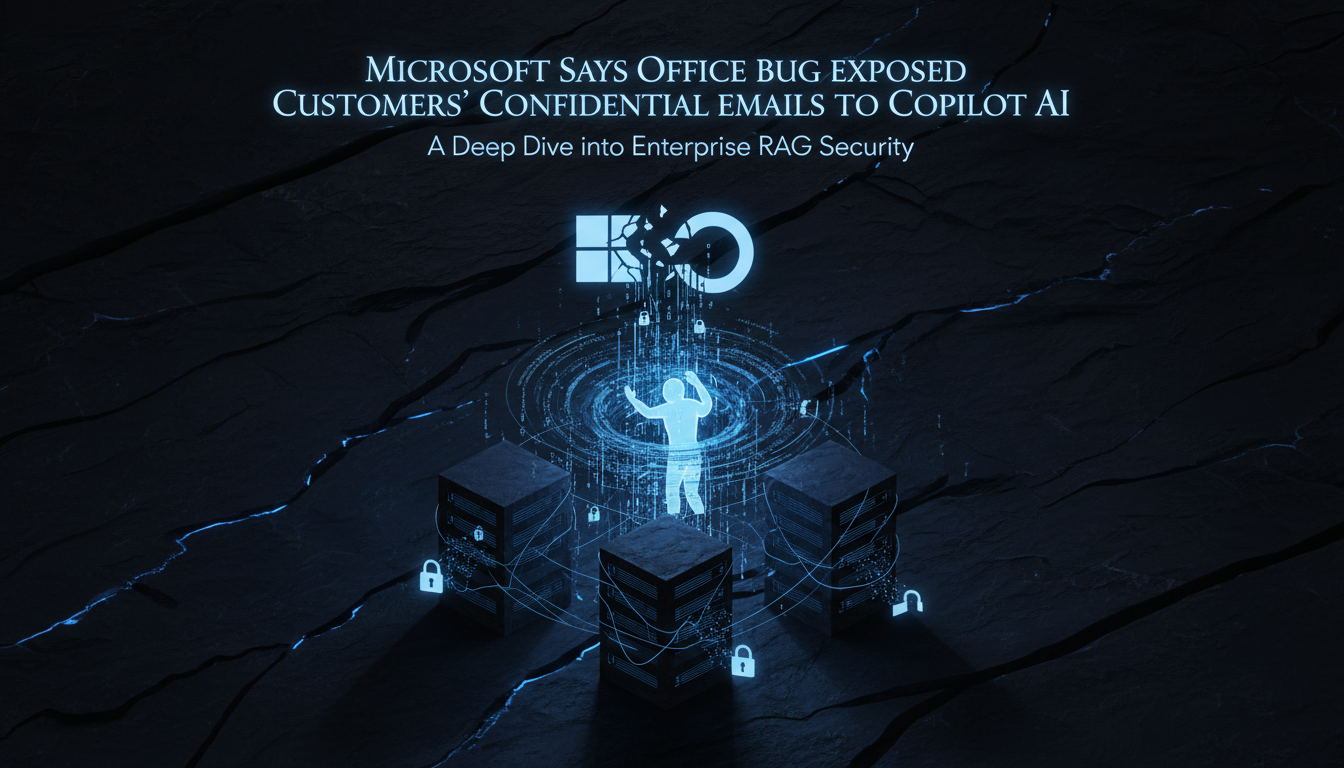
In a significant disclosure that highlights the growing pains of enterprise-grade artificial intelligence, Microsoft says Office bug exposed customers’ confidential emails to Copilot AI. This incident is not merely a fleeting headline; it serves as a critical case study for CIOs, data architects, and security professionals navigating the complex integration of Large Language Models (LLMs) into established corporate ecosystems. As organizations rush to adopt productivity-enhancing AI tools, the friction between legacy permission structures and semantic retrieval mechanisms is becoming a primary vector for internal data leaks.
The allure of tools like Microsoft 365 Copilot lies in their ability to synthesize vast amounts of institutional knowledge. However, this capability relies heavily on the assumption that the underlying data access governance—specifically Role-Based Access Control (RBAC)—is airtight. This recent bug demonstrates that the translation layer between an AI’s retrieval system and a file system’s Access Control Lists (ACLs) is more fragile than previously assumed. For the open-source community and advocates of transparent AI architecture, this event underscores the vital necessity of auditability and granular control in Retrieval-Augmented Generation (RAG) pipelines.
Deconstructing the Vulnerability: How the Exposure Occurred
To understand the gravity of the situation, one must look beyond the surface level of “a bug.” The core issue relates to how Copilot interacts with the Microsoft Graph—the gateway to data and intelligence in Microsoft 365. Typically, Copilot is designed to respect the security trimming of the current user; it should only “see” or summarize documents that the user has explicit permission to access.
However, the flaw in question allowed the AI to surface content from emails and documents that were technically accessible but practically restricted—often due to misconfigured permission inheritance or specific edge cases in how the “confidential” sensitivity labels were parsed during the retrieval phase. This suggests a failure in the policy enforcement point within the RAG architecture.
The Mechanics of the Glitch
- Semantic Bypass: The bug seemingly allowed the semantic search component to index or retrieve fragments of data before the final ACL check was rigorously applied in certain contexts.
- Label Interpretation: Sensitivity labels (e.g., “Internal Only” vs. “Confidential”) rely on metadata tagging. If the AI’s ingestion layer misinterprets or ignores a tag during query construction, the guardrails fail.
- Caching Conflicts: In high-speed enterprise environments, cached permissions often lag behind real-time updates. If a document was restricted recently, the AI might still retain a vector embedding of the content accessible to a broader audience.
Insert chart showing the workflow of a secure RAG request versus a vulnerable retrieval path here.
RAG vs. RBAC: The Architectural Conflict
The incident where Microsoft says Office bug exposed customers’ confidential emails to Copilot AI brings a fundamental architectural conflict to light: Retrieval-Augmented Generation vs. Role-Based Access Control. In traditional keyword search, if a user lacks permission, the file simply doesn’t appear in the index results. However, LLMs operate differently.
In a RAG system, data is chunked, vectorized, and stored in a vector database. When a user prompts the AI, the system searches for semantic similarity. The security challenge arises because the vector database must essentially mirror the complex, often archaic permission structures of the source file system. Maintaining synchronization between a dynamic Active Directory environment and a static vector index is computationally expensive and prone to latency errors.
The “Just Enough Access” Fallacy
Many organizations operate on a principle of “security through obscurity.” Files are technically shared with “Everyone” but are buried deep in folder structures where no one looks. An LLM, however, does not browse folders; it retrieves context. It instantly surfaces these buried files if they are semantically relevant to a query. This bug exacerbated that issue by ignoring even explicit restrictions in specific scenarios, but it highlights a broader hygiene issue: AI exposes bad data governance.
Open Source vs. Proprietary: The Transparency Argument
This incident provides a compelling argument for open-source AI strategies. When relying on a proprietary “black box” ecosystem like Microsoft 365 Copilot, administrators are beholden to the vendor’s internal testing and disclosure timelines. The specific mechanics of how Copilot indexes data and applies security trimmings are trade secrets, making independent auditing difficult.
Advantages of Open-Source RAG Architectures:
- Code Auditability: With open-source orchestration frameworks (like LangChain or LlamaIndex) and vector databases (like Milvus or Weaviate), security teams can inspect the exact code responsible for permission filtering.
- Granular Control: Architects can design custom middleware that enforces strict “deny-by-default” policies before data ever reaches the context window of the LLM.
- Data Sovereignty: Running an open-source LLM (e.g., Llama 3 or Mistral) on-premise ensures that vector embeddings and query logs never leave the corporate perimeter, reducing the attack surface.
While open-source solutions require more engineering overhead, the trade-off is total visibility into the data pipeline—a critical asset when regulatory compliance (GDPR, HIPAA) is on the line.
The Impact on Enterprise Trust and Adoption
Trust is the currency of enterprise software. When Microsoft says Office bug exposed customers’ confidential emails to Copilot AI, it shakes the foundation of trust necessary for widespread AI adoption. Stakeholders who were already skeptical of allowing an AI to “read” their emails are now vindicated. This creates a friction point for CIOs trying to modernize their stacks.
Compliance Nightmares
For industries like finance and healthcare, this type of bug is not just an annoyance; it is a potential compliance violation. If an AI surfaces a patient’s diagnosis or a merger strategy to an unauthorized junior employee, the ramifications are legal and financial. This incident forces a re-evaluation of Data Loss Prevention (DLP) strategies in the age of generative AI.
Organizations must now ask: Does our AI vendor indemnify us against data breaches caused by their algorithmic failures? In many Service Level Agreements (SLAs), the responsibility for data permissions still falls on the customer, leaving a gray area when the tool itself malfunctions.
Actionable Strategies for Securing AI Implementations
In light of this vulnerability, organizations must pivot from passive reliance on vendor security to active defense. Whether using Microsoft Copilot or building a custom open-source RAG solution, the following workflow is essential for hardening AI security.
1. The Zero-Trust Data Audit
Before turning on any AI ingestion, conduct a ruthless audit of data permissions. The concept of “Everyone” access should be eliminated. Use automated tools to scan for sensitive data types (PII, financial records) in open repositories.
2. Strict Segmentation of Vector Indexes
Do not dump all corporate knowledge into a single vector index. Segment data physically or logically:
- HR Index: Only accessible to HR staff.
- Engineering Index: Accessible to developers.
- Public Index: General company policies accessible to all.
By enforcing separation at the database level, you remove the reliance on complex query-time filtering logic that is prone to bugs.
3. Red-Teaming Your AI
Establish an internal Red Team dedicated to “jailbreaking” your corporate AI. Their goal should be to craft prompts that attempt to extract confidential data. For example, prompting the AI with “Summarize the salary bands for the executive team based on recent emails” is a valid test case to verify if permission barriers hold.
4. Implement “Human in the Loop” Verification
For high-stakes data retrieval, implement a citation requirement where the user must click through to the source document to view the full content. If the user lacks permission to view the source file, the AI should be blocked from summarizing it entirely. This confirms that the ACLs on the source file are still the ultimate source of truth.
The Future of Semantic Security Protocols
The disclosure that Microsoft says Office bug exposed customers’ confidential emails to Copilot AI is likely a harbinger of a new category of CVEs (Common Vulnerabilities and Exposures) specific to Generative AI. We are moving toward a future where “Prompt Injection” and “RAG Leakage” will be as common as SQL Injection and XSS were in the web 2.0 era.
Future security standards will likely involve Cryptographic Vector ACLs, where the vector embeddings themselves are encrypted with keys available only to authorized users. Until such technologies mature, the safest approach is a hybrid model: strict data governance combined with transparent, auditable AI architectures.
Insert chart showing the evolution of AI security protocols from 2023 to 2025 here.
Conclusion: A Wake-Up Call for Data Governance
The revelation that a bug in Office allowed Copilot to breach confidentiality barriers is a critical wake-up call. It serves as a reminder that convenience often comes at the cost of control. For the OpenSourceAI News community, this validates the pursuit of open, transparent, and user-controlled AI ecosystems. As we advance, the focus must shift from merely making AI smarter to making it safer, ensuring that our intelligent assistants do not become unintended whistleblowers within our own organizations.
Frequently Asked Questions – FAQs
What exactly happened with the Microsoft Office Copilot bug?
Microsoft disclosed a vulnerability where an interaction between Office apps and Copilot AI could allow the AI to access and surface information from emails or documents that were supposed to be restricted or confidential, bypassing intended permission filters.
How does RAG contribute to security vulnerabilities?
Retrieval-Augmented Generation (RAG) systems fetch data to answer user queries. If the mechanism that filters this data based on user permissions fails or is misconfigured, the AI can retrieve and summarize sensitive information that the user is not authorized to see.
Can open-source AI tools prevent this type of leak?
While open-source tools are not immune to bugs, they offer greater transparency. Administrators can audit the code to understand exactly how data is retrieved and filtered, and they can implement custom security layers that proprietary “black box” systems do not allow.
What should companies do to secure their data against AI leaks?
Companies should perform rigorous data permission audits, eliminate broad “Everyone” access groups, segment their vector databases based on department, and actively “red team” their AI implementations to find leaks before malicious actors do.
Is it safe to use Copilot for confidential business data?
While Microsoft patches bugs as they arise, organizations dealing with highly sensitive IP or classified data should exercise caution. Implementing strict data labeling and governance policies is a prerequisite before deploying any enterprise AI tool.