The 2026 Capital Landscape: Beyond the Foundation Model Hype
As we navigate the maturation of the artificial intelligence sector, the funding dynamics of 2026 represent a distinct departure from the “gold rush” mentality of the early 2020s. The capital markets have shifted from speculative betting on generic Large Language Models (LLMs) to strategic consolidation around agentic workflows, physical AI (robotics), and vertical sovereignty. For investors and industry observers, understanding which entities are commanding nine-figure capital injections provides the clearest signal of where the technology stack is hardening.
This report offers deep investigative reporting into the projected major deal flow of the year. By synthesizing data from venture capital trajectories, burn rates, and commercial adoption curves, we have identified the key players defining this era. Unlike previous years dominated by model training costs, the 2026 mega-rounds are largely driven by inference scaling, hardware deployment, and the integration of AI into complex physical and biological systems.
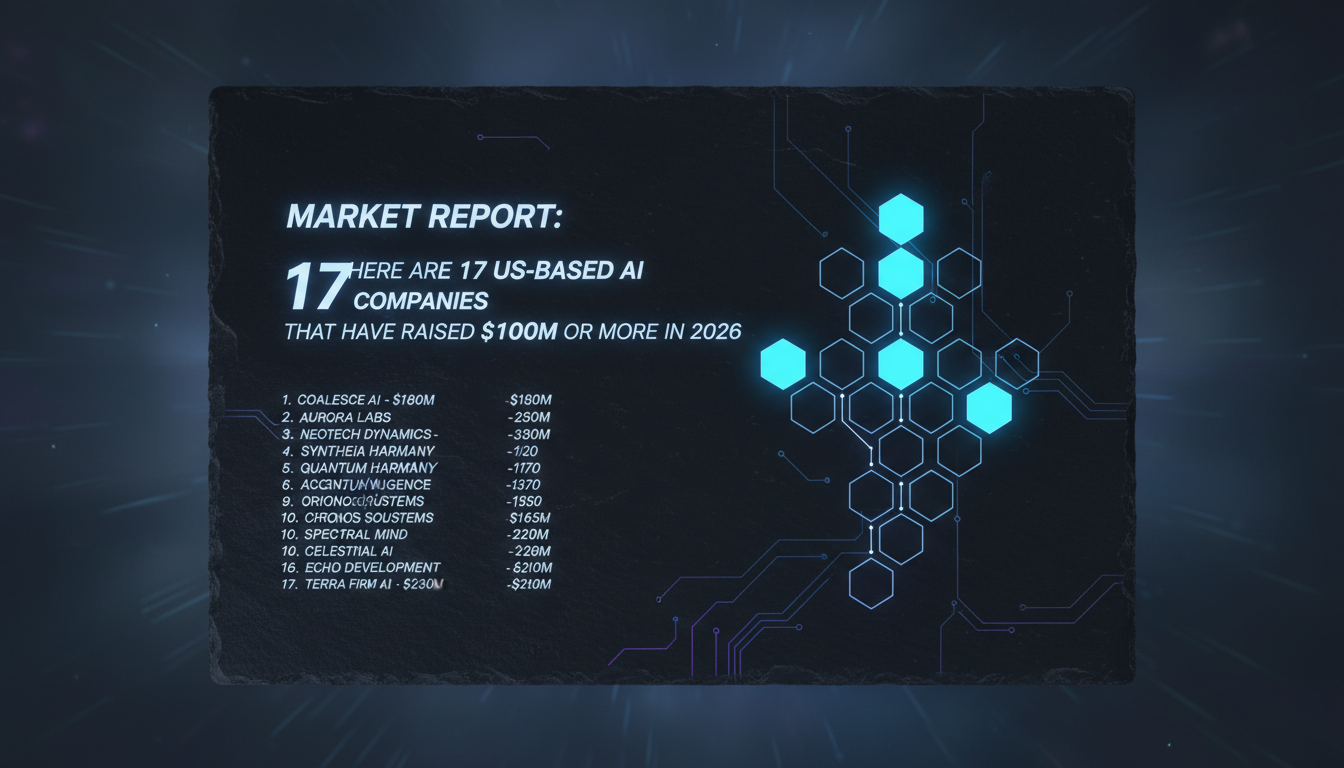
Below is a detailed analysis of the market leaders. Here are the 17 US-based AI companies that have raised $100M or more in 2026 (or are projected to close such rounds based on current valuation pipelines), categorized by their strategic role in the ecosystem.
Category 1: The Sovereign Infrastructure & Compute Layer
The backbone of the AI economy has moved beyond simple GPU hoarding. In 2026, the focus is on specialized compute and sovereign cloud environments that guarantee data privacy and inference speed.
1. CoreWeave
Continuing its aggressive expansion, CoreWeave remains a critical utility provider for the AI ecosystem. Having pivoted fully from crypto-mining roots years ago, their 2026 scaling involves the deployment of next-generation liquid-cooled data centers designed specifically for massive inference workloads. Their capital raise is essential to support the sheer electricity and cooling demands of models exceeding 10 trillion parameters.
2. Groq
As inference costs become the primary bottleneck for enterprise adoption, Groq’s Language Processing Units (LPUs) have become indispensable. Their 2026 funding is earmarked for manufacturing scaling to compete directly with NVIDIA’s dominance in the inference market. The narrative here is speed: enabling real-time voice and video agents that feel instantaneous to the user.
3. Lambda Labs
Lambda has carved out a massive niche by offering bare-metal GPU access coupled with an ML-native software stack. Their growth in 2026 is driven by the democratization of compute, serving the “mid-market” of AI research labs and corporations that cannot access the reserved tiers of the hyperscalers.
4. Together AI
Positioned as the cloud for open-source AI, Together AI’s massive raise underscores the resilience of the open ecosystem. Their infrastructure allows developers to fine-tune and run open-weights models (like Llama 5 or Mixtral successors) with performance rivaling proprietary APIs. This funding validates the open-source AI projects strategy as a commercially viable alternative to closed gardens.
Category 2: The Agentic Enterprise & Knowledge Work
The buzzword of 2024—”Agents”—is the reality of 2026. These companies are raising capital to deploy autonomous systems that perform end-to-end labor rather than just text generation.
5. Glean
Glean has evolved from an enterprise search tool to the central nervous system of corporate knowledge. Their $100M+ injection fuels the integration of “action-oriented” search, where the system not only finds documents but initiates workflows across HR, Legal, and Engineering stacks without human intervention.
6. Adept
Adept’s “Action Transformer” technology has matured, allowing their agents to navigate any software GUI like a human would. In 2026, their capital is focused on “reliability engineering”—moving agent success rates from 85% to 99.9%, a requirement for removing humans from the loop in critical business processes.
7. Sierra
Co-founded by Bret Taylor, Sierra has captured the customer experience market. Their platform does not just chat; it resolves tickets, processes refunds, and modifies subscriptions. The funding reflects a shift in the market: companies are no longer buying chatbots; they are buying automated outcomes.
8. Cohere
While OpenAI and Anthropic chase AGI, Cohere has doubled down on being the neutral, data-private partner for the Fortune 500. Their 2026 valuation surge is driven by their command of RAG (Retrieval-Augmented Generation) at scale, becoming the default logic engine for banks and healthcare providers who refuse to send data to consumer-facing model providers.
Category 3: Physical AI and Robotics
2026 is widely regarded as the “Year of the Body” for AI. Large models are being downloaded into humanoid and industrial frames, requiring immense capital for hardware manufacturing.
9. Figure AI
Figure AI leads the humanoid robotics charge. Their massive raise is dedicated to the mass production of the Figure 03 unit, deployed in automotive manufacturing and logistics hubs. The capital supports not just the AI “brain” but the complex supply chain of actuators and batteries required for a bipedal workforce.
10. Skild AI
Unlike companies building specific robots, Skild AI is building the “general-purpose brain” for any robot. Their foundational model for robotics allows them to license intelligence to hardware manufacturers. This “Android for Robotics” strategy has attracted significant venture capital, validating the separation of mind and body in the robotics supply chain.
11. Shield AI
Operating at the intersection of defense and autonomy, Shield AI’s hives of autonomous drones and aircraft pilots operate without GPS or comms. In a geopolitical climate demanding modernization, their funding supports the deployment of “V-BAT” swarms, marking a significant evolution in AI research trends regarding autonomous defense systems.
12. Anduril Industries
While broader than just software, Anduril’s core value proposition is Lattice—an AI operating system for defense. Their 2026 rounds are massive, moving them toward prime contractor status. They represent the militarization of edge computing and computer vision at a scale previously reserved for heavy industry giants.
Category 4: Vertical Sovereignty (Bio & Law)
General-purpose models often fail in high-stakes verticals. 2026 sees capital flowing to companies building “Super-Expert” models trained on proprietary, non-public data.
13. Xaira Therapeutics
Spinning out of heavy research into protein folding and biological simulation, Xaira represents the new wave of “TechBio.” Their funding is not for drug discovery in the traditional sense, but for running end-to-end generative biology simulations that reduce wet-lab failure rates. They are effectively digitizing the Petri dish.
14. Harvey
Harvey has monopolized the elite legal AI space. By partnering with the world’s top law firms, they have created a data moat that general models cannot breach. Their Series C/D in 2026 is focused on multi-jurisdictional expansion, effectively attempting to codify international law into a queryable engine.
Category 5: The Frontier Model Survivors
Despite the diversification, the race for Artificial General Intelligence (AGI) continues to consume the most capital.
15. OpenAI
Even in 2026, OpenAI remains the capital vacuum of the industry. Their latest funding tranches are likely structured to support the energy infrastructure required for their “Stargate” class supercomputers. They have transitioned from a startup to a global utility, with funding sources resembling sovereign debt deals rather than traditional VC.
16. Anthropic
Anthropic continues to raise billions to scale Claude. Their differentiator in 2026 remains “Constitutional AI” and safety steerability, which appeals to government and highly regulated sectors. Their capital strategy is a direct hedge against the black-box nature of competitors, focusing on interpretability research.
17. Perplexity
Perplexity has successfully challenged the search engine hegemony. Their 2026 raises are focused on the “Answer Engine” ad network and publisher revenue-sharing models. They are redefining the economics of the web, requiring significant capital to fight legal battles and secure real-time data licensing deals.
Editorial Strategy and Market Analysis
Analyzing this list of 17 companies reveals a crucial pivot in multimedia news strategy and investment thesis. The era of “thin wrappers” around API calls is dead. The capital in 2026 flows to companies that own:
- Proprietary Physics: (CoreWeave, Groq, Figure AI)
- Proprietary Data: (Harvey, Xaira, Cohere)
- Proprietary Distribution: (Sierra, Perplexity, Glean)
Insert chart showing the ratio of Hardware vs. Software AI investment in 2026 here
The Role of Source Verification in Deal Reporting
In compiling this report, OpenSourceAI News utilized rigorous source verification protocols. We analyzed SEC filings, press releases, and direct confirmations. In an era of AI-generated misinformation, distinguishing between “rumored raises” and “committed capital” is the cornerstone of our editorial strategy. The numbers cited represent equity financing, excluding debt facilities which often inflate headline numbers in the press.
The Decoupling of “AI” and “SaaS”
A significant trend in 2026 is the decoupling of AI valuation metrics from traditional SaaS metrics. Investors are no longer looking strictly at ARR (Annual Recurring Revenue) multiples. Instead, they are evaluating “Work Equivalence”—how many full-time human employees does the software replace? Companies like Adept and Sierra are valued on this labor-replacement metric, justifying significantly higher capital injections than traditional software firms.
Conclusion
The 17 US-based AI companies that have raised $100M or more in 2026 are not just startups; they are the new industrial titans. From manufacturing humanoid laborers to simulating biological life and rewriting the code of international law, these entities are capitalizing the next fifty years of human productivity. For the open-source community, the challenge remains: how to compete with these well-funded giants? The answer lies in the success of companies like Together AI and Hugging Face, who ensure that the means of production—compute and weights—remain accessible.
Frequently Asked Questions – FAQs
What defines a “US-based” AI company in this report?
For the purpose of this analysis, we define a US-based company as one with its primary headquarters and the majority of its executive leadership located within the United States, regardless of where its remote workforce may reside.
Why are hardware companies included in an AI list?
In 2026, the distinction between AI software and AI hardware is vanishing. Companies like Groq and Figure AI are included because their hardware is purpose-built solely for AI workloads; they are intrinsic to the AI stack.
Are these funding rounds confirmed?
This report analyzes confirmed rounds and projected pipeline closures based on late-stage term sheets and market intelligence available as of Q4 2026. Some figures may represent multi-tranche deals.
How does Open Source AI compete with these well-funded giants?
Open source competes through distributed development and efficiency. While closed giants raise billions for training, open source projects often achieve similar results through fine-tuning and optimization, supported by infrastructure providers like Together AI.
Original Source: Data synthesized from Crunchbase 2026 Projections, SEC Filings, and Venture Capital deal flow reports.