DeepSeek R1 API pricing vs OpenAI: A Technical Cost-Efficiency Analysis
Why This Topic Matters: The Economics of Inference
For the past two years, the “intelligence is too cheap to meter” narrative was largely theoretical. In practice, running Chain-of-Thought (CoT) heavy workloads on models like GPT-4o or o1-preview remained prohibitively expensive for high-volume SaaS applications. Reasoning models, which generate thousands of hidden “thought tokens” before producing an answer, multiply inference costs exponentially.
The relevance of this pricing war lies in margin expansion. If a startup can access o1-level reasoning capabilities at 3% of the cost, the viability of agentic workflows—where AI loops and self-corrects—shifts from “burn-rate hazard” to “profitable feature.” This analysis dissects the Total Cost of Ownership (TCO) hidden behind the headline prices.
Step-by-Step Cost Analysis Framework
To accurately compare these providers, we must move beyond the sticker price and analyze the full inference lifecycle. Below is our 7-step framework for calculating the true cost of migration.
1. Baseline Price Comparison (The Sticker Shock)
The headline figures set the stage. As of early 2025, the disparity is stark:
- OpenAI o1: Approximately $15.00 per 1M input tokens / $60.00 per 1M output tokens.
- OpenAI o1-mini: Approximately $3.00 per 1M input / $12.00 per 1M output.
- DeepSeek R1: Approximately $0.55 per 1M input / $2.19 per 1M output.
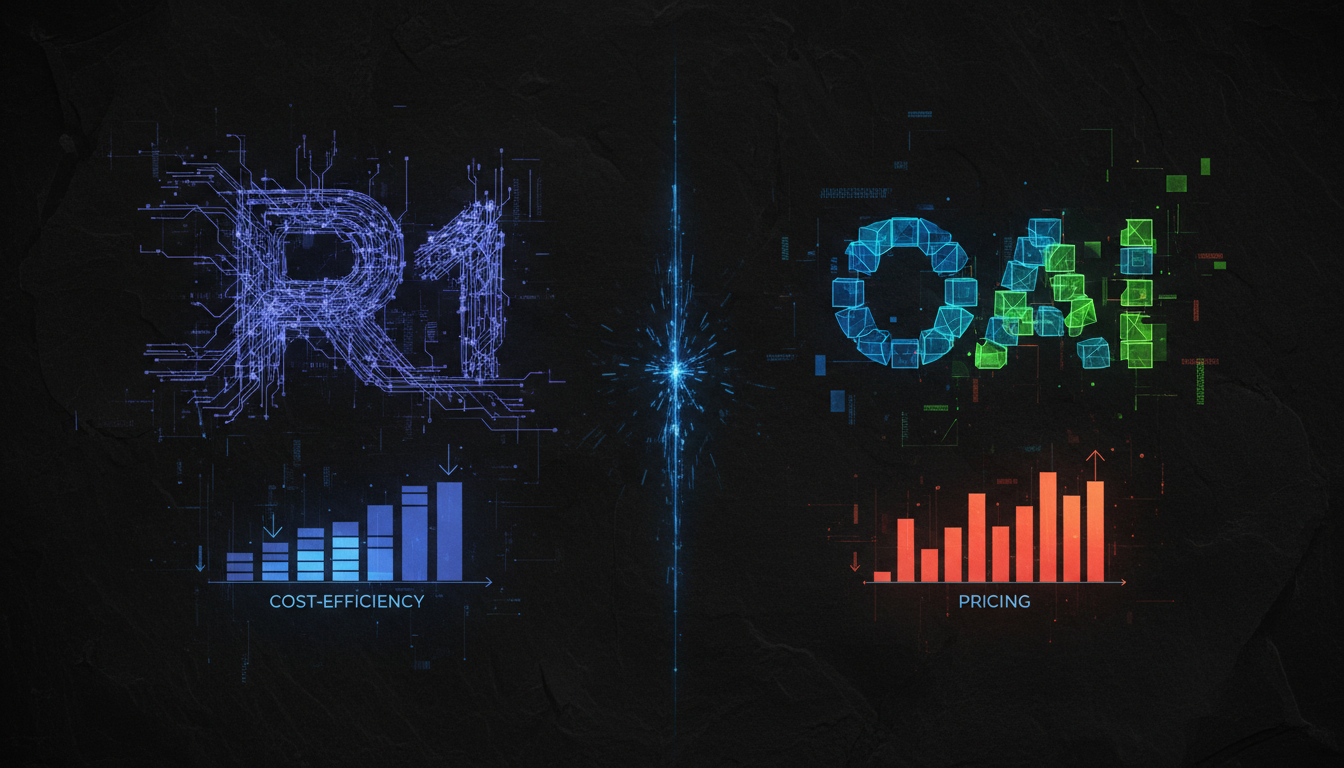
When strictly comparing DeepSeek R1 API pricing vs OpenAI o1, DeepSeek is roughly 27x cheaper on input and nearly 30x cheaper on output. Even against the optimized o1-mini, R1 maintains a significant factor of cheapness while reportedly rivaling the full o1 in benchmarks.
2. The “Reasoning Token” Multiplier
Standard LLMs map input to output directly. Reasoning models inject a “thinking” phase. In OpenAI’s API, these reasoning tokens are billed as output tokens. Consequently, a simple query might generate 500 visible characters but 2,000 hidden reasoning tokens. Because DeepSeek’s output cost is drastically lower ($2.19 vs $60.00), the penalty for complex reasoning chains is negligible on R1, whereas it is punitive on o1.
3. Context Caching Economics
DeepSeek has aggressively implemented context caching (KVCache) at the API level. For repetitive tasks—such as chatting with a massive PDF or a persistent code base—DeepSeek’s cache hit pricing drops to significantly lower rates (often near $0.14/1M tokens). OpenAI also offers caching, but the base rate differential means that a cache miss on OpenAI can destroy a month’s budget, whereas a cache miss on DeepSeek is a rounding error.
4. Distillation vs. Native Reasoning
Engineers must decide if they need the “full” model or a distilled version. DeepSeek R1 itself relies on high-quality synthetic data and distillation techniques from larger models to achieve its efficiency. OpenAI’s o1-mini is a similar attempt at distillation. The cost comparison here favors DeepSeek because it releases the weights, allowing users to potentially host R1 on their own hardware (e.g., H100 clusters) effectively capping marginal costs at electricity and hardware depreciation, an option unavailable with OpenAI.
5. Latency and Throughput Trade-offs
Cost is not just dollars; it is also time. DeepSeek’s API has experienced significant volatility and high latency due to overwhelming demand post-launch. For real-time applications, the “cost” of DeepSeek R1 includes potential timeouts or slow generation speeds. OpenAI’s infrastructure, backed by Microsoft Azure, commands a premium partly because of its enterprise-grade Service Level Agreements (SLAs). If your application requires sub-second latency, the cheap tokens of R1 may be too expensive in terms of user experience.
6. Data Residency and Privacy Compliance
A hidden cost in the DeepSeek R1 API pricing vs OpenAI debate is compliance. OpenAI offers established GDPR and SOC2 compliance pathways. DeepSeek, being a Chinese-originated model, faces scrutiny regarding data residency for Western enterprises. While DeepSeek’s API is accessible, many US-based corporations may incur costs setting up local hosting (via vLLM or SGLang) or using intermediaries (like Azure’s catalog or AWS Bedrock integration) to mitigate data privacy risks, which adds an infrastructure markup to the raw API price.
7. Rate Limits and Availability
DeepSeek’s low price has led to aggressive rate limiting. Developers often need to implement complex fallback logic (retries, load balancing), effectively increasing the engineering hours required to maintain stability. OpenAI’s higher price buys a smoother developer experience (DX) with higher tier limits.
Architectural Blueprint: How is R1 So Cheap?
To trust the sustainability of these prices, one must understand the architecture. DeepSeek isn’t just “burning VC money” to subsidize tokens; they have fundamentally innovated on architecture.
Mixture-of-Experts (MoE): R1 utilizes a massive total parameter count (671B) but activates only a small fraction (37B) per token. This drastically reduces the FLOPs required for inference compared to dense models. While OpenAI also uses MoE, DeepSeek’s implementation of Multi-head Latent Attention (MLA) further compresses the Key-Value (KV) cache, reducing memory bandwidth requirements—the primary bottleneck in LLM inference.
This architectural efficiency means DeepSeek can serve tokens on fewer GPUs than competitors, justifying the price floor. It is a structural advantage, not just a pricing strategy.
Common Misconceptions in Cost Modeling
1. Ignoring the Chain-of-Thought Bloom:
Developers often estimate costs based on GPT-4o usage patterns. Reasoning models talk to themselves before talking to you. If you migrate a prompt to R1 without adjusting for the verbose output, you might see output volumes increase by 300-400%.
2. The “Open Weights means Free” Fallacy:
While you can download R1, self-hosting a 671B parameter model requires significant VRAM (multiple H100s or equivalent). For many startups, the DeepSeek API is actually cheaper than self-hosting, unless volume is massive. The API price is so close to the cost of electricity and hardware amortization that self-hosting is often only justified for privacy, not price.
3. Comparing R1 to GPT-4o:
This is an apples-to-oranges comparison. R1 should be compared to o1. GPT-4o is a general-purpose model; R1 is a reasoning engine. Using R1 for simple “hello world” chat is a waste of its architectural overhead, even at its low price.
Market Implications: The Race to the Bottom
The introduction of DeepSeek R1 has forced a response from Western tech giants. We are seeing a “race to the bottom” regarding inference costs. This benefits the open-source ecosystem immensely. As detailed in our coverage at OpenSourceAI News, this pressure compels OpenAI and Anthropic to optimize their own distillation pipelines to compete. The winner is the consumer, who now has access to PhD-level reasoning for pennies.
Frequently Asked Questions (FAQs)
Q: Is DeepSeek R1 truly cheaper than OpenAI o1-mini?
A: Yes, DeepSeek R1 is generally cheaper than o1-mini by a factor of 4-6x, depending on the ratio of input to output tokens.
Q: Can I use DeepSeek R1 for commercial applications?
A: Yes, the MIT License allows for commercial use, though you must verify the specific terms of the API provider if not self-hosting.
Q: Does DeepSeek R1 charge for reasoning tokens?
A: DeepSeek R1 outputs reasoning tokens as part of the generation, and they are billed as output tokens, similar to OpenAI’s o1 model.
Q: Why is OpenAI so much more expensive?
A: OpenAI prices in brand reliability, higher rate limits, US-based data compliance, and the immense R&D costs of training frontier models from scratch.
Q: How does DeepSeek’s caching impact the total bill?
A: DeepSeek’s context caching is automatic and aggressive; for long-context applications, it can reduce input costs by up to 90% compared to uncached requests.
Conclusion
The analysis of DeepSeek R1 API pricing vs OpenAI reveals a shifting paradigm. We are moving from an era where model capabilities were the primary differentiator to one where “price-per-reasoning-unit” dictates the architecture of AI systems. DeepSeek R1 offers an undeniable economic advantage for cost-sensitive, high-volume reasoning tasks, provided developers can manage the trade-offs in latency and data residency.
For the OpenSourceAI News audience, the recommendation is clear: R1 is the superior choice for prototyping, batch processing, and internal tools where absolute uptime is secondary to cost. OpenAI retains the crown for enterprise-critical, client-facing applications requiring ironclad SLAs. However, the gap is closing, and the pricing floor has effectively collapsed.