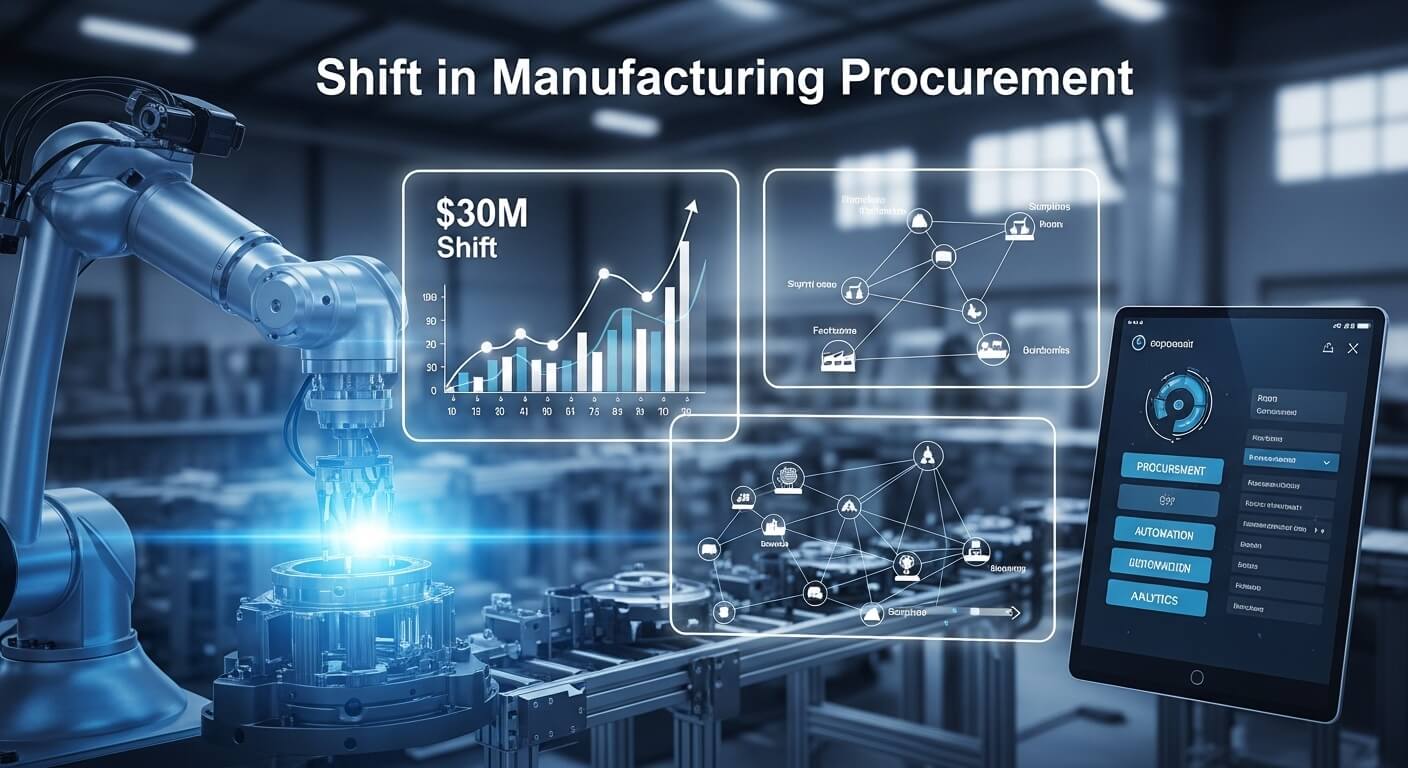
The Agentic Industrial Revolution: Deconstructing the $30M Shift in Manufacturing Procurement
Editorial Analysis by the Applied AI Research Desk — The manufacturing sector has long been the graveyard of digital transformation initiatives. While SaaS proliferated across CRM and HR, the physical supply chain remained stubbornly analog, tethered to PDF schematics, email threads, and Excel purgatory. The recent $30M Series A secured by Didero signals a pivotal architectural shift: we are moving from static Supply Chain Management (SCM) tools to Agentic AI workflows. This is not merely an interface update; it is the deployment of autonomous reasoning engines capable of traversing the unstructured data chaos of global procurement.
The Failure of Deterministic Software in Supply Chains
To understand the magnitude of the agentic shift, one must first diagnose the pathology of traditional procurement software. Legacy ERP systems operate on deterministic logic. They require structured inputs—clean SKUs, precise quantities, and standardized vendor codes—to function. However, the reality of hardware development is fundamentally unstructured.
Engineers communicate via technical drawings (CAD), messy bills of materials (BOMs), and ad-hoc email specifications. In this environment, deterministic software fails because it lacks the semantic understanding to bridge the gap between a Request for Quote (RFQ) and a vendor’s distinct catalog nomenclature. This creates a massive manual friction layer where highly paid procurement managers act as human middleware, translating PDF data into ERP fields.
The Agentic Paradigm: Reasoning over Retrieval
The infusion of $30M into Didero validates a new technical hypothesis: Large Language Models (LLMs) configured as autonomous agents are the only scalable solution to procurement friction. Unlike standard generative chat interfaces, an agentic architecture involves an orchestration layer where the model is granted:
- Tool Use Capabilities: The ability to execute API calls, scrape vendor portals, and parse document binaries.
- Long-Horizon Planning: Breaking down a complex procurement goal (e.g., “Source 5,000 units of a specific capacitor compliant with EU RoHS”) into discrete execution steps.
- Multi-Modal Ingestion: Simultaneously processing visual data (schematics) and textual data (contract terms).
Technical Deep Dive: The Architecture of Procurement Autopilot
Didero’s approach, and the broader trend it represents, relies on sophisticated integration of Retrieval-Augmented Generation (RAG) and neuro-symbolic reasoning. Let’s architecturally deconstruct how an AI agent places manufacturing procurement on “autopilot.”
1. Unstructured Data Normalization via Multi-Modal Transformers
The first challenge in procurement is ingestion. Vendor communication is notoriously fragmented. An agentic system utilizes optical character recognition (OCR) enhanced by vision-language models (such as GPT-4o or Claude 3.5 Sonnet variants) to digitize PDFs and images. However, mere text extraction is insufficient. The system must perform entity extraction and normalization.
For instance, an agent identifying a part number in a messy email thread must cross-reference it with a vector database of global component availability. This involves embedding part descriptions into a high-dimensional vector space and performing cosine similarity searches to find matches across disparate vendor catalogs, even when the nomenclature differs (e.g., “Resistor 10k” vs. “10k Ohm Res 0603”).
2. The Agentic Control Loop: Perception, Reasoning, Action
The “autopilot” claim rests on the agent’s ability to close the loop without human intervention. The architecture typically looks like this:
- Perception: The system detects a new BOM upload or a stock shortage alert.
- Reasoning (CoT): Using Chain-of-Thought prompting, the model evaluates the urgency, identifies potential vendors based on historical performance (latency, quality, price), and formulates a negotiation strategy.
- Action: The agent generates specific RFQs and sends them via email or API. Crucially, it parses the incoming responses. If a vendor replies with a counter-offer in a PDF, the agent extracts the pricing data, updates the comparison matrix, and either accepts the bid (if within pre-set weights and biases for budget) or triggers a human review.
The Economics of Inference vs. Labor
The valuation of Didero suggests venture capital is betting on the arbitrage between inference costs and skilled labor costs. Manufacturing procurement involves high-context switching. A human procurement officer might spend 30 minutes reading a schematic and drafting emails to three vendors. Even with premium inference pricing, an agentic workflow performs this task for cents on the dollar, with near-zero latency.
Latency and Throughput in Physical Supply Chains
Speed is the new inventory. By automating the administrative overhead of sourcing, companies reduce their Time-to-Quote (TTQ). In hardware, where lead times can stretch to months, shaving weeks off the procurement administrative phase directly impacts Time-to-Market. The agentic model allows for parallel processing—negotiating with 50 vendors simultaneously—a feat impossible for a human team without massive headcount scaling.
Challenges in Deployment: Hallucination and Trust
Despite the high-tech veneer, deploying agents in financial workflows introduces non-trivial risks. The primary concern is hallucination in numerical data. If an LLM misreads a price per unit or a Minimum Order Quantity (MOQ), the financial repercussions are immediate.
To mitigate this, robust architectures employ verification layers—deterministic code execution (Python sandboxes) that validates the LLM’s output against the raw extracted data before executing a purchase order. This “Code Interpreter” approach ensures that the math holds up, bridging the gap between probabilistic token generation and deterministic financial accounting.
Future Horizon: The Self-Healing Supply Chain
The logical endpoint of Didero’s technology is the Self-Healing Supply Chain. In this future state, agents don’t just react to orders; they predict them. By integrating with predictive maintenance sensors and sales forecasts, an agentic system could identify a likely component failure or stockout weeks in advance, source the replacement, and have it delivered to the factory floor before the human operator is even aware of the risk.
This moves us from “Just-in-Time” manufacturing (which is fragile) to “Just-in-Case” resilience, managed entirely by autonomous software agents optimization for cost and speed vectors.
Technical Deep Dive FAQ
How does Agentic AI differ from standard RAG implementations in procurement?
Standard RAG retrieves information to answer a user’s query. Agentic AI uses RAG to retrieve context but then takes autonomous action based on that data. It doesn’t just tell you who sells the part; it negotiates the price and places the order via API or email.
What is the role of Vector Databases in this architecture?
Vector databases are critical for semantic matching. They allow the system to understand that “M3 screw” and “3mm machine bolt” are semantically related, enabling the agent to find parts across vendors that use different terminologies without rigid keyword matching.
How are ‘Human-in-the-Loop’ protocols enforced?
Architectures typically define confidence thresholds. If the model’s confidence in a parse or negotiation falls below a set weight (e.g., 95%), or if the total transaction value exceeds a pre-defined cap, the workflow automatically pauses and routes the decision to a human interface for manual approval.
Can these agents handle ITAR or GDPR compliant data?
Yes, provided the inference architecture is private. Enterprise deployments often utilize virtual private clouds (VPC) or on-premise open-weights models (like Llama 3 or Mixtral) fine-tuned on proprietary supply chain data to ensure sensitive schematics never leave the secure environment.