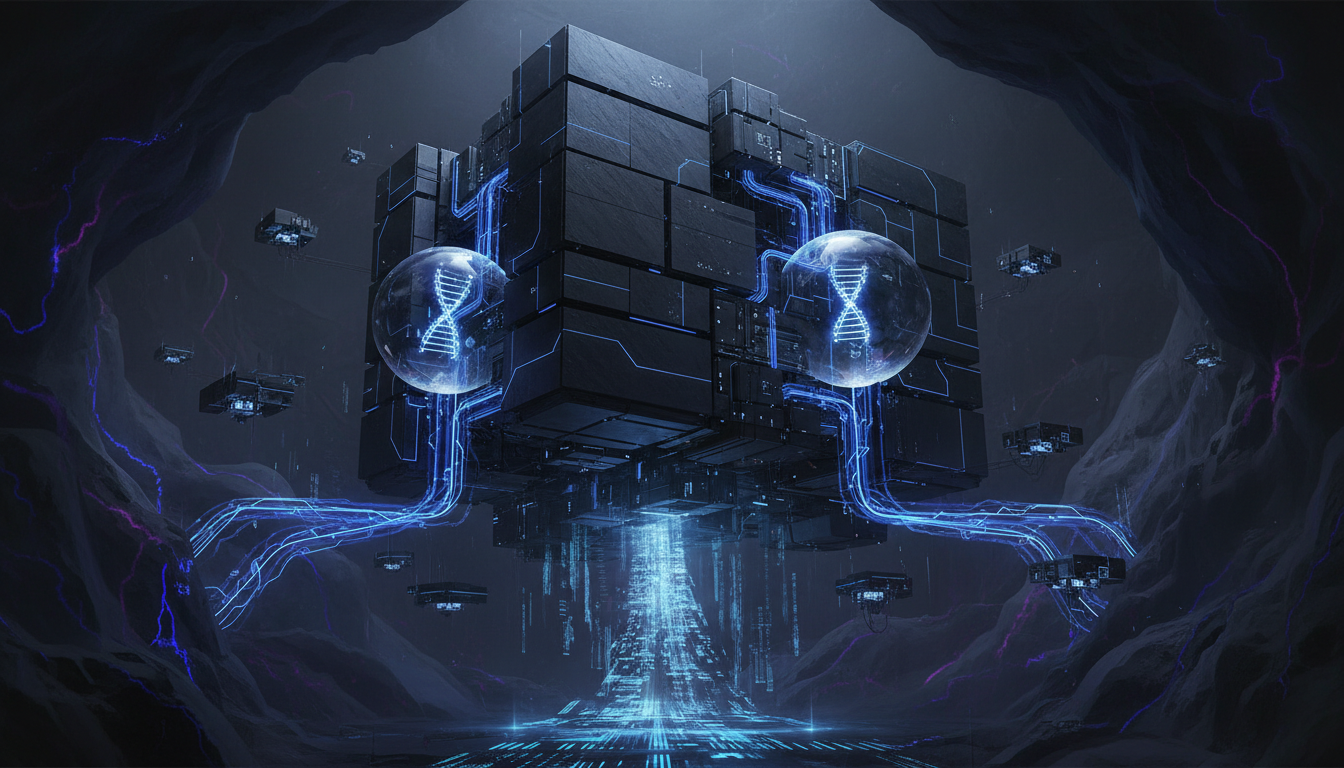
The Computational Ark: Architecting AI Pipelines for Genomic Preservation and Biodiversity Security
Executive Brief: As the biosphere approaches a critical threshold of biodiversity loss, legacy conservation methods are failing to scale. This analysis explores the deployment of advanced Machine Learning architectures—specifically Computer Vision and Natural Language Processing (NLP)—to digitize, catalog, and secure the genetic source code of Earth’s most vulnerable species.
The Technical Urgency of Bio-Digital Convergence
We are currently engineering the most significant backup system in planetary history. The operational premise is simple yet computationally incredibly demanding: to create a redundant storage system for the genetic diversity of the natural world before the hardware (the species themselves) suffers catastrophic failure. In the lexicon of systems architecture, we are attempting a hot-swap of biological data into a digital-genomic substrate.
However, the bottleneck has historically not been the storage of biological material—cryobanks like the “Frozen Zoo” at the San Diego Zoo Wildlife Alliance have been operational for decades—but the metadata association and retrieval latency. A vial of frozen fibroblast cells is useless without a structured, queryable history of the specimen’s phenotype, lineage, and health metrics. This is where Artificial Intelligence intervenes, transforming physical bio-banking into a high-availability data ecosystem.
Ingesting the ‘Frozen Zoo’: OCR Meets Genomics
The primary challenge in modern conservation genomics is the “analog debt.” Decades of crucial biological data exist on handwritten index cards, typewritten ledgers, and fragmented physical logs. To train robust predictive models for genetic viability, this unstructured data must be normalized.
Structuring Unstructured Analog Data
The architecture deployed by leading tech partnerships utilizes advanced Optical Character Recognition (OCR) pipelines enhanced by custom Large Language Models (LLMs) tuned for biological taxonomy. Unlike standard OCR, which simply digitizes text, these pipelines must perform Entity Recognition (ER) to distinguish between a species name, a date of collection, and a karyotype notation.
The workflow typically follows this sequence:
- Image Acquisition: High-resolution scanning of analog logs (e.g., the 50-year archive of the Frozen Zoo).
- Preprocessing: Noise reduction, binarization, and deskewing to prepare aged paper records for analysis.
- Semantic Extraction: Utilizing Transformer-based models (such as BERT variants fine-tuned on scientific literature) to parse relationships. For instance, linking a specific sample ID to a handwritten note about a chromosomal anomaly.
Knowledge Graphs in Conservation Biology
Once data is digitized, it is not merely stored in relational databases (RDBMS); it is ingested into Graph Databases. This allows researchers to visualize lineage and genetic interrelatedness as nodes and edges. By applying graph neural networks (GNNs) to this data, conservationists can predict distinct genetic lines that are underrepresented in the frozen archive, directing physical resources to secure those specific samples in the wild. This shifts conservation from reactive collecting to predictive, data-driven sampling.
Computer Vision in Phenotypic Mapping
While NLP handles the historical records, Computer Vision (CV) is revolutionizing the in-situ monitoring of live populations. The genetic viability of a species is intrinsically linked to its phenotypic expression in the wild. Traditional tagging (RFID, physical banding) is invasive and stress-inducing. The modern alternative is biometric identification via deep learning.
Biometric Identification Architectures
The current state-of-the-art leverages Convolutional Neural Networks (CNNs) optimized for pattern recognition. Just as facial recognition systems map nodal points on a human face, conservation AI maps the unique stochastic patterns of animal coats—the stripes of a zebra, the spots of a cheetah, or the whisker patterns of a polar bear.
Key technical considerations include:
- Pose Invariance: Models must identify an individual animal regardless of camera angle, occlusion by foliage, or lighting conditions. This requires training on massive synthetic datasets where 3D models of animals are rotated and rendered in various environments to ensure model robustness.
- Edge Inference: Because these systems often deploy in remote locations with zero connectivity (e.g., the Amazon basin or the Arctic), the inference models must be compressed via techniques like Quantization and Pruning to run on low-power edge devices (like Raspberry Pi-based camera traps or specialized NPUs) without sacrificing significant accuracy.
- Re-Identification (ReID): The metric of success is the ReID score. High-fidelity ReID allows researchers to track the lifespan, breeding success, and migration patterns of specific genomic carriers without ever touching the animal.
Predictive Genetics: From Sequence to Survival
The convergence of digitized records and live monitoring feeds into the ultimate goal: Genomic Rescue. By sequencing the samples stored in cryobanks, AI models can analyze the genome for deleterious recessive alleles versus vital diversity.
Machine Learning algorithms, specifically those designed for dimensionality reduction (like t-SNE or UMAP applied to genomic data), help visualize the genetic distance between individuals. This is critical for “genetic matchmaking” in captivity breeding programs. The algorithm suggests breeding pairs that maximize heterozygosity, effectively engineering a more resilient population immune to the bottlenecks that drive extinction.
Furthermore, Deep Learning models are now being applied to DNA methylation data (epigenetics) to determine the biological age of an animal from a simple sample, providing insights into population demographics that were previously impossible to ascertain without long-term observational studies.
Infrastructure and Scalability
Processing genomic data is a High-Performance Computing (HPC) endeavor. A single whole-genome sequence can be hundreds of gigabytes. Multiplying this by thousands of individuals requires cloud-native architectures.
Cloud-Native Genomic Pipelines
The standard stack involves utilizing containerized workflows (Docker/Kubernetes) to manage the bioinformatics tools. Workflow languages like WDL (Workflow Description Language) or Nextflow orchestrate the data movement. Utilizing cloud TPUs (Tensor Processing Units) accelerates the training of the models required to interpret this data, reducing weeks of calculation into hours. This velocity is vital; in conservation, time is the scarcest resource.
Technical Deep Dive FAQ
How does AI handle the ‘Small Data’ problem in endangered species?
Unlike commercial AI trained on billions of images, endangered species data is scarce. Engineers utilize Few-Shot Learning and Transfer Learning. A model is pre-trained on a large generic dataset (like ImageNet) or a related common species, and then fine-tuned on the limited dataset of the endangered animal. Additionally, Synthetic Data Generation (using GANs) creates artificial training images to bolster the dataset.
What is the role of NLP in genetic preservation?
NLP acts as the bridge between legacy analog knowledge and modern digital databases. It automates the extraction of phenotypic and location data from decades of handwritten logs, linking this metadata to physical genetic samples. Without NLP, these frozen samples are context-free and scientifically significantly less valuable.
Can these models run offline in the field?
Yes. Through model optimization techniques such as quantization (reducing precision from 32-bit floating point to 8-bit integers) and weight pruning, complex CNNs can be deployed on edge devices (Edge TPUs or microcontroller-class hardware) to perform real-time inference on battery power.
How does this impact the ‘Frozen Zoo’ specifically?
The Frozen Zoo contains viable cell cultures from over 1,000 taxa. AI helps prioritize which of these samples should be sequenced first based on the immediate threats to the living population, effectively triaging genetic rescue efforts based on data-driven risk assessment.