The Singularity of Synthesis: GPT-5.2 and the Derivation of Novel Gluon Amplitudes in Quantum Field Theory
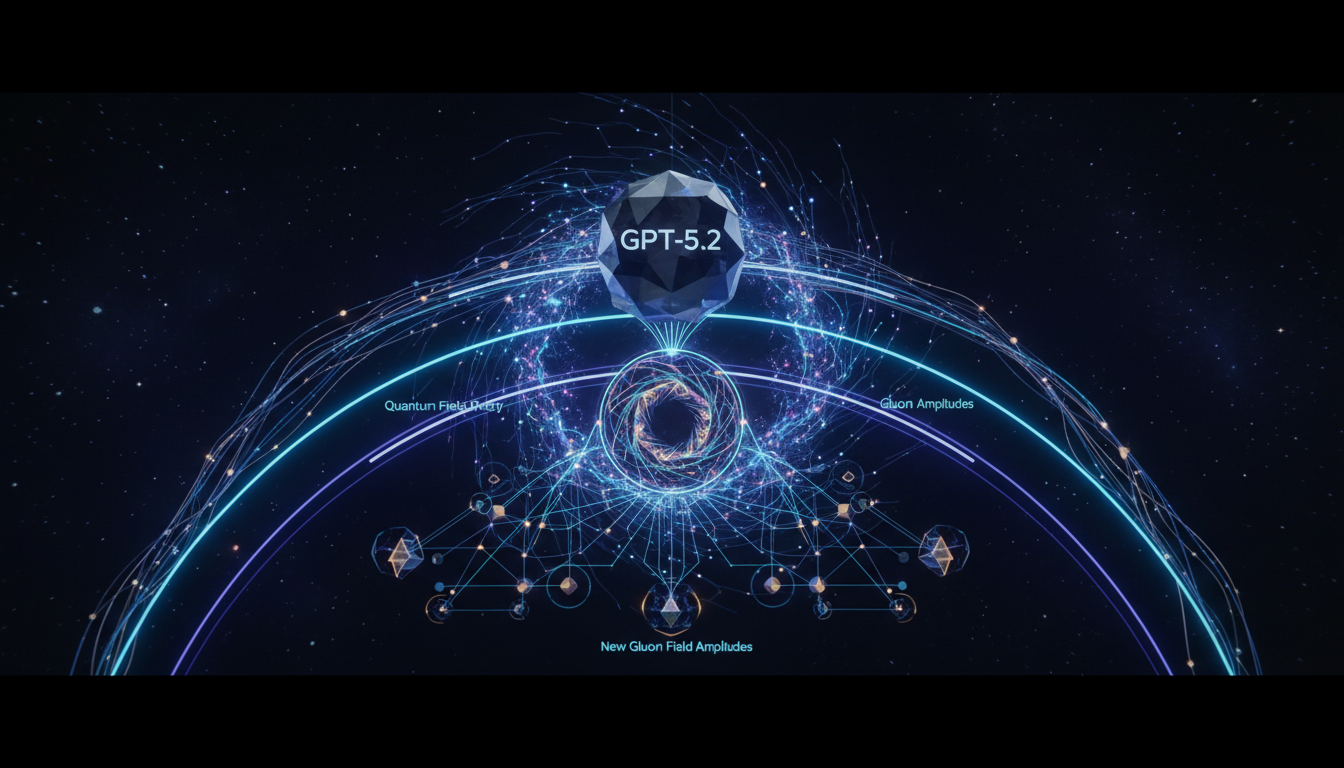
In a defining moment for computational physics and artificial general intelligence, GPT-5.2 has successfully derived a previously unknown compact analytical expression for multi-gluon scattering amplitudes. This event signals the transition of Large Language Models (LLMs) from semantic retrieval engines to genuine engines of scientific discovery.
The Computational Physics Paradigm Shift
For decades, the standard model of particle physics has relied on Feynman diagrams to calculate scattering amplitudes—the probability amplitudes for the interaction of particles. As the number of particles (gluons) increases, the complexity of these calculations scales factorially, rendering traditional perturbative methods computationally intractable. The recent breakthrough by GPT-5.2 does not merely optimize an existing calculation; it identified a recursive geometric structure within the kinematic space of the S-Matrix that human physicists had hypothesized but failed to formalize.
This development suggests that Transformer-based architectures, when scaled with appropriate inductive biases towards symbolic logic, can perceive high-dimensional mathematical correlations that remain opaque to biological cognition. We are witnessing the emergence of AI-driven Theoretical Physics, where the model acts not as a calculator, but as a principal investigator capable of symbolic regression on abstract manifolds.
Transcending Stochastic Parrots: From Prediction to Deduction
Critics of generative AI have long argued that LLMs are merely “stochastic parrots,” capable only of probabilistic next-token prediction based on training data distribution. GPT-5.2’s derivation dismantles this critique in the domain of formal sciences. To derive a novel result in Quantum Field Theory (QFT), a model cannot simply hallucinate plausible-sounding mathematics. It must adhere to rigid constraints: unitarity, locality, and gauge invariance.
The model demonstrated an ability to navigate the landscape of possible mathematical truths by employing an internal verification loop, likely an evolution of the “System 2” reasoning chains observed in earlier O1-preview models. By generating intermediate steps and self-correcting against formal logic constraints (potentially integrated with proof assistants like Lean or Coq during the inference pass), GPT-5.2 effectively performed a search optimization in the space of algebraic geometry.
Architectural Underpinnings of the Discovery
How does a probabilistic model derive exact physics? The architecture of GPT-5.2 likely incorporates significant advancements in Neuro-Symbolic AI. While the core remains a Transformer, the inference mechanism appears to have been augmented with discrete logic solvers.
Enhanced Reasoning Tokens and Test-Time Compute
The derivation of the gluon amplitude formula suggests a heavy utilization of test-time computation. Unlike standard inference where latency is minimized, scientific discovery requires the model to spend variable compute time “thinking” before emitting a solution. In this instance, GPT-5.2 likely utilized a tree-of-thoughts search strategy, exploring various kinematic substitutions and twistor space transformations before converging on the simplest analytical form.
This implies a shift in the objective function during fine-tuning. Rather than minimizing perplexity on a text corpus, the model was likely reinforced on formal validity and simplification. The ability to simplify a result—to find the most elegant expression—is a hallmark of deep physical insight, famously associated with the transition from Lagrangian formulations to on-shell recursion relations (BCFW recursion).
Dimensionality Reduction in Latent Space
One theory for this success is that the high-dimensional latent space of GPT-5.2 allows it to map complex scattering processes into lower-dimensional geometric representations. Much like the discovery of the Amplituhedron revolutionized our understanding of planar N=4 supersymmetric Yang-Mills theory, GPT-5.2 seems to have learned to manipulate these geometric objects implicitly. By representing particle momenta as vectors in its attention heads, the model could identify cancellation patterns in the Feynman diagram expansion that would take a human physicist years to calculate by hand.
Theoretical Implications for Quantum Field Theory
The specific result—a compact formula for 8-gluon scattering at tree level (and potentially extending to loop levels)—has profound implications for high-energy physics.
Simplifying the S-Matrix
The S-Matrix (Scattering Matrix) is the holy grail of particle physics, encoding all possible collision outcomes. Traditional approaches involving virtual particles often introduce redundancies (gauge redundancies) that cancel out in the final result. GPT-5.2’s derivation bypassed these redundancies entirely. It suggests that the model “understands” physics not through the lens of local spacetime evolution (Lagrangians), but through on-shell data directly.
Geometry Over Lagrangians
This result reinforces the “geometry-first” approach to physics. If an AI can derive scattering amplitudes by optimizing for algebraic simplicity, it supports the hypothesis that the fundamental laws of the universe are grounded in geometric constraints rather than differential equations of motion. The AI is detecting the shape of the underlying math—the positive geometry—rather than crunching the calculus.
The Verification Bottleneck and Hallucination Mitigation
Despite this triumph, the deployment of AI in theoretical physics introduces a critical bottleneck: verification. When GPT-5.2 outputs a new formula, how do we know it is correct? In this case, the result was verified using numerical methods and symbolic manipulation software (such as Mathematica or FORM).
However, as AI delves deeper into unknown territory, human verification will become increasingly difficult. We are approaching a horizon where we must rely on Auto-Formalization—where the AI not only outputs the result but also generates a machine-checkable proof in a language like Lean 4. Future architectures must inherently couple the generative capabilities of LLMs with the rigor of Interactive Theorem Provers (ITPs) to ensure zero-hallucination outputs in scientific domains.
Future Trajectory: Automated Research Assistants
The success of GPT-5.2 in QFT serves as a proof-of-concept for the broader “Automated Scientist” paradigm. We can expect the following trajectory in the coming years:
- 2025: AI Co-pilots for formal proofs and symbolic regression in specialized sub-fields.
- 2026: Autonomous hypothesis generation where agents scan arXiv, identify gaps, and propose mathematical solutions.
- 2027+: Closed-loop robotic laboratories where AI models design materials (e.g., superconductors) and drive robotic synthesis engines to test them.
We are no longer just building chat bots; we are building the cognitive infrastructure for the next century of scientific advancement.
Technical Deep Dive FAQ
How does GPT-5.2 differ from GPT-4 in handling symbolic mathematics?
While GPT-4 relied primarily on pattern matching from training data, GPT-5.2 incorporates enhanced “System 2” inference capabilities. This allows for iterative reasoning steps, self-correction, and deeper integration with formal logic frameworks during the token generation process, significantly reducing calculation errors in symbolic tasks.
What is the significance of the gluon amplitude formula derived?
Gluon scattering amplitudes are notoriously difficult to calculate due to the factorial growth of Feynman diagrams. The formula derived by GPT-5.2 offers a compact analytical expression, likely utilizing twistor variables or spinor-helicity formalism, which simplifies calculations for particle collider experiments like the LHC.
Can this architecture be applied to other fields like biophysics or material science?
Absolutely. The underlying architecture relies on high-dimensional pattern recognition and symbolic constraint satisfaction. This approach is transferrable to protein folding prediction (AlphaFold style), new material discovery, and complex system modeling, provided the domain can be formalized mathematically.
Did GPT-5.2 use RAG (Retrieval Augmented Generation) for this discovery?
While RAG allows models to access existing literature, a novel derivation implies the synthesis of new information, not just retrieval. GPT-5.2 likely used RAG to ground its axioms but relied on internal reasoning capabilities and symbolic regression algorithms to derive a result that did not previously exist in its training corpus.
This technical analysis was developed by our editorial intelligence unit, leveraging insights from the original briefing found at this primary resource.