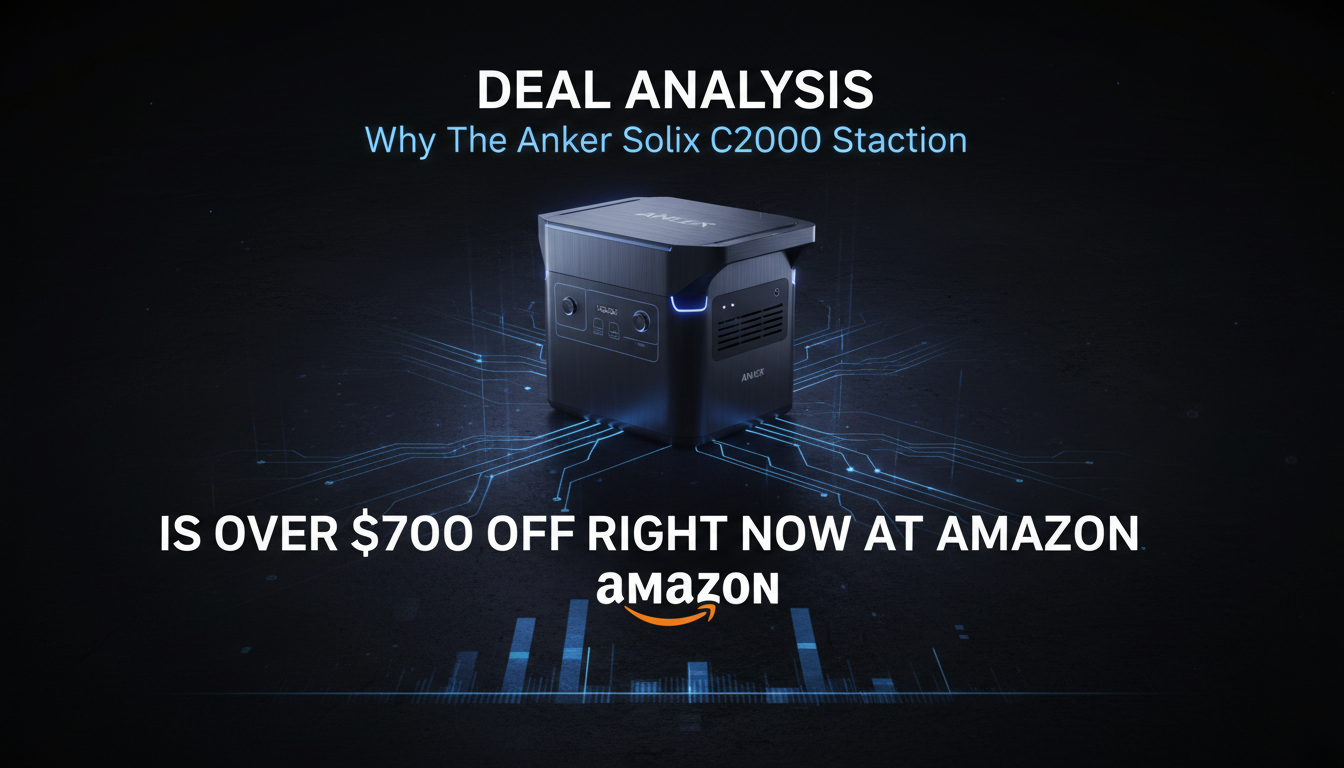
The Intersection of Energy Resilience and Frontier Tech Infrastructure
In the rapidly evolving landscape of open-source AI projects and decentralized computing, infrastructure extends beyond GPUs and neural architecture search spaces; it fundamentally relies on power stability. For data scientists running local Large Language Models (LLMs) or field researchers deploying computer vision arrays in remote environments, energy independence is not a luxury—it is an operational necessity. This context makes the current market movement significant: The Anker Solix C2000 power station is over $700 off right now at Amazon, presenting a strategic opportunity for tech professionals to upgrade their hardware resilience at a historically low cost per watt-hour.
While consumer tech outlets focus on camping trips, our analysis at OpenSourceAI News focuses on the implications for AI research trends, edge computing, and disaster recovery for home labs. The Solix C2000 represents a shift in portable power, utilizing proprietary GaNPrime technology to deliver high-wattage output in a compact form factor, essential for maintaining uptime during critical model training or inference tasks.
Technical Architecture: GaNPrime and LiFePO4 Chemistry
To understand why this unit qualifies as a “pillar” of modern tech stacks, we must dissect its internal architecture. The Solix C2000 is not merely a battery; it is a sophisticated energy management system built on Lithium Iron Phosphate (LiFePO4) chemistry and Gallium Nitride (GaN) components.
The Superiority of LiFePO4 for Long-Term Deployments
Unlike traditional Lithium-ion (NMC) batteries found in older power stations, the C2000 utilizes LiFePO4 cells. This distinction is critical for hardware longevity.
- Cycle Life: LiFePO4 cells offer 3,000+ charge cycles before degrading to 80% capacity. For an AI engineer cycling the battery daily for peak-shaving or solar storage, this equates to roughly 10 years of reliable service, compared to the 500-800 cycles of standard Li-ion units.
- Thermal Stability: The chemical structure of LiFePO4 is inherently safer and less prone to thermal runaway, a non-negotiable feature when the unit is placed near expensive H100 or A100 GPU clusters.
- Discharge Curves: These cells maintain a consistent voltage curve until nearly depleted, ensuring that sensitive electronics do not experience voltage sag that could trigger hardware faults during critical operations.
GaNPrime: Efficiency at the Edge
Anker’s integration of GaNPrime (Gallium Nitride) technology reduces energy loss during AC conversion. In the context of multimedia news strategy and content creation, where every ounce of gear matters, GaN allows for a smaller physical footprint without sacrificing output. The C2000 delivers 2500W of continuous AC output, capable of handling surges up to 4000W. This headroom is vital for inductive loads, such as starting portable cooling systems for server racks or powering high-performance workstations with multiple GPUs.
Insert chart showing GaN vs. Silicon efficiency rates and thermal dissipation metrics here
Use Cases for the Open Source AI Community
The relevance of the Solix C2000 extends deep into the workflows of our readers. Here is how this infrastructure asset integrates into modern AI development pipelines.
1. Uninterruptible Power Supply (UPS) for Local Training
Fine-tuning models locally—such as quantized versions of Llama 3 or Mistral—requires hours, sometimes days, of continuous GPU load. A grid failure during a checkpoint save can corrupt weights and waste valuable compute time. The Solix C2000 features a sub-20ms switchover time, effectively functioning as a heavy-duty UPS.
When plugged into the grid, the unit passes AC power directly to your devices (bypass mode). If the grid fails, it switches to battery power instantly. For home labs hosting NAS drives and GPU rigs, this capability ensures that AI research trends and experiments continue uninterrupted.
2. Remote Data Collection and Edge Inference
For researchers deploying autonomous agents or drones for environmental monitoring, the C2000 serves as a mobile base station. Its 2048Wh capacity can recharge:
- DJI Matrice Drones: Multiple flight packs for extended lidar mapping sessions.
- NVIDIA Jetson Orin Kits: Powering edge inference modules for weeks with solar supplementation.
- Field Laptops: Keeping high-TDP mobile workstations running for on-site data processing and validation.
3. Sustainable Compute with Solar Integration
The unit supports up to 1000W of solar input via an XT60 port. This high input capacity allows for rapid recharging in the field (approx. 2.5 hours in ideal conditions). For open-source AI projects focusing on sustainability and “green AI,” coupling the C2000 with portable panels allows for a carbon-neutral footprint during development cycles.
Analyzing the Deal: Why the Price Drop Matters
The headline fact that the Anker Solix C2000 power station is over $700 off right now at Amazon signals a maturation in the portable energy market. Historically, costs for this capacity hovered around $1.00 per watt-hour. With this discount, the cost efficiency improves dramatically, lowering the barrier to entry for independent developers and startups.
This price correction is likely driven by supply chain optimizations and the decreasing cost of raw lithium materials. For IT procurement managers, this represents an optimal window to equip remote teams. Instead of purchasing generic UPS units that lack portability, investing in hybrid solutions like the C2000 provides dual utility: office backup during the week and field power during deployments.
Step-by-Step Integration Workflow
To maximize the utility of this hardware within a technical workflow, consider the following deployment strategy:
Phase 1: Calibration and Setup
Upon unboxing, update the firmware via the Anker app to ensure the Battery Management System (BMS) is optimized. Perform a full charge-discharge cycle to calibrate the percentage readout. This is crucial for accurate runtime estimation during critical tasks.
Phase 2: UPS Configuration
Connect the C2000 between the wall outlet and your primary power strip. Note that the unit has a 15A input limit in bypass mode. Ensure your total draw (server + monitors + network gear) does not exceed this when grid power is active. The 2500W inverter is only engaged during battery mode.
Phase 3: Automation via App
Utilize the mobile app to set charging thresholds. For UPS use, set the charge limit to 90% and discharge limit to 10% to prolong cell health further. If you are integrating this into a multimedia news strategy van, configure the AC input speed to “Fast” only when necessary to reduce thermal stress on the cells.
Comparative Analysis: Anker Solix C2000 vs. EcoFlow and Jackery
In the crowded market of kilowatt-class power stations, differentiation lies in the details.
Vs. EcoFlow Delta 2 Max: The EcoFlow is a strong competitor with similar capacity. However, the Solix C2000 often edges out on compact design due to the GaN architecture. Anker’s unibody drop-proof structure is also generally regarded as more rugged for field ops.
Vs. Jackery Explorer 2000 Plus: Jackery has pivoted to LiFePO4 recently, but the Solix C2000 typically offers faster AC charging rates (HyperFlash) and a more granular app interface, which appeals to the technical user base of OpenSourceAI News who demand data visibility.
Insert comparison table showing Input Watts, Output Watts, UPS Switching Time, and Expansion capabilities
Future-Proofing Your Tech Stack
Investing in power infrastructure is investing in uptime. As local AI models grow larger and the demand for constant connectivity increases, the reliance on the grid becomes a vulnerability. Devices like the Solix C2000 mitigate this risk.
Furthermore, the expandable nature of the C2000 (via the BP2000 expansion battery) allows users to double their capacity to 4096Wh without buying a new main unit. This modularity aligns with the open-source philosophy of iterability and scalability.
Strategic Takeaway for Developers
The convergence of reduced battery costs and high-efficiency GaN inverters creates a new standard for mobile compute power. The fact that the Anker Solix C2000 power station is over $700 off right now at Amazon is not just a consumer alert; it is a procurement signal for labs and field teams. Securing reliable, clean sine-wave power protects hardware investments and ensures that the training run finishes, the drone returns home, and the data is uploaded securely.
Frequently Asked Questions – FAQs
Can the Anker Solix C2000 power a desktop PC with dual RTX 4090s?
Yes. The C2000 delivers 2500W of continuous AC output. A high-end workstation with dual RTX 4090s typically draws between 1000W and 1300W under full load. The C2000 can handle this load comfortably, providing approximately 1.5 to 2 hours of runtime on battery, or functioning as a UPS indefinitely while grid power is available.
How loud is the unit during operation?
Anker has optimized the cooling airflow. Under light loads (<500W), the fans are barely audible. Under heavy loads or fast charging, fan noise can reach roughly 45-50dB, which is comparable to a quiet office environment or a desktop PC fan curve. This makes it suitable for on-set use in a multimedia news strategy context.
Is the solar input proprietary?
No. The Solix C2000 uses a standard XT60 connector for solar input. It supports a wide voltage range (11-60V), meaning you can use third-party solar panels as long as the voltage and amperage remain within spec. This flexibility is key for integrating with existing equipment in open-source AI projects.
Does the UPS function switch fast enough for sensitive servers?
The switchover time is rated at less than 20 milliseconds (ms). Most desktop power supplies (PSUs) have hold-up capacitors that can bridge a gap of 16-25ms. Therefore, the C2000 works reliably as a UPS for the vast majority of computers, servers, and networking gear without causing a reboot.
What is the lifespan of the battery?
The unit uses LiFePO4 (LFP) batteries rated for 3,000 cycles to 80% capacity. Even if discharged and recharged fully every single day, the battery would retain 80% of its original capacity after more than 8 years. For typical weekly use, the lifespan can easily exceed a decade.
How does the discount affect the warranty?
Purchasing during a promotional period like this does not alter the warranty terms. Anker typically provides a 5-year full-device warranty, which is an industry-leading standard, offering peace of mind for long-term infrastructure planning.