DeepSeek-V3 vs GPT-4o Coding Benchmark: The Paradigm Shift in Automated Engineering
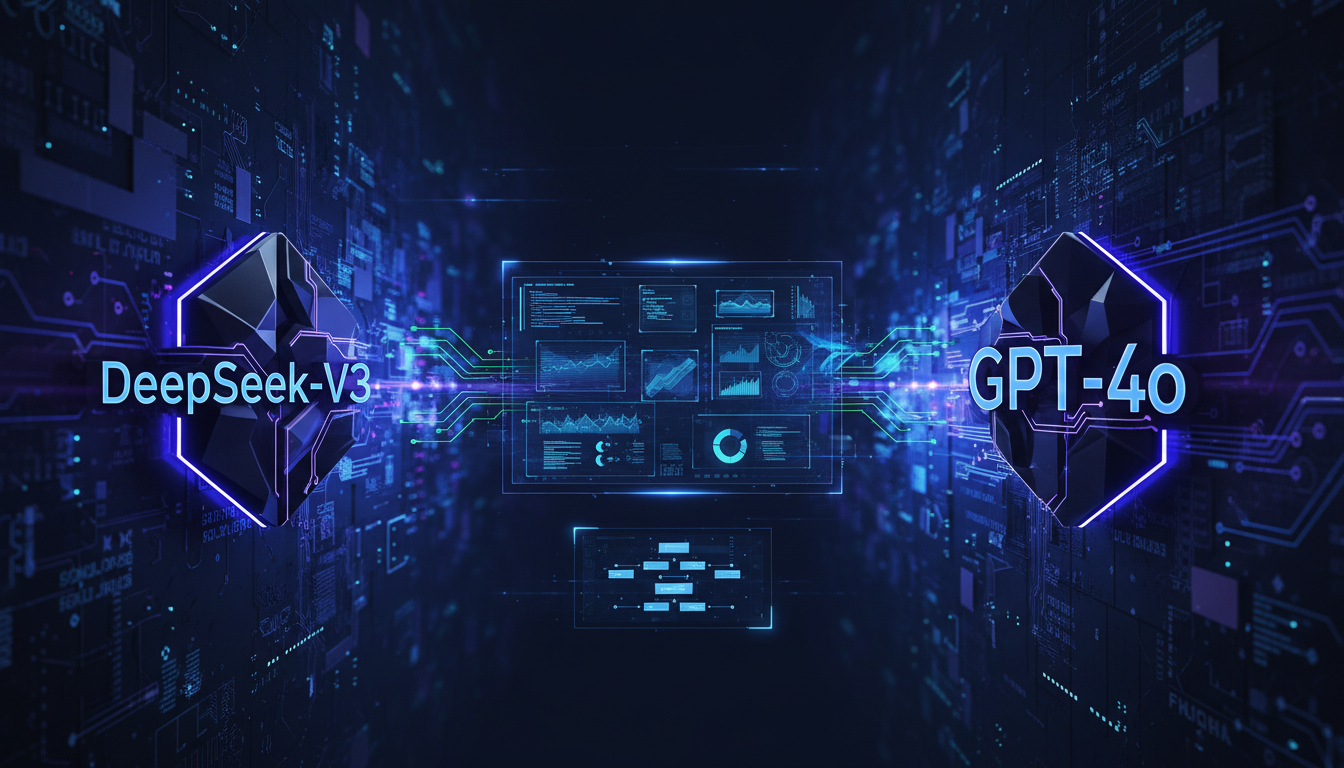
The release of DeepSeek-V3 marks a pivotal moment in the trajectory of open-weight Large Language Models (LLMs), challenging the hegemony of proprietary giants like OpenAI. By achieving state-of-the-art (SOTA) performance metrics that rival GPT-4o, specifically within the domain of code generation and algorithmic reasoning, DeepSeek-V3 has fundamentally altered the value equation for enterprise-grade AI integration.
This analysis deconstructs the architectural nuances, inference economics, and raw performance metrics defining the DeepSeek-V3 vs GPT-4o coding benchmark landscape. We move beyond surface-level comparisons to evaluate the implications of Mixture-of-Experts (MoE) scaling, Multi-head Latent Attention (MLA), and the democratization of high-fidelity code synthesis.
The Architectural Schism: Advanced MoE vs. Proprietary Black Box
To understand the performance parity observed in the DeepSeek-V3 vs GPT-4o coding benchmark data, one must first analyze the underlying infrastructure. DeepSeek-V3 employs a massive Mixture-of-Experts (MoE) architecture with 671 billion total parameters, yet it maintains high efficiency by activating only 37 billion parameters per token. This allows for the encoding of vast knowledge bases while maintaining inference latency comparable to much smaller dense models.
In contrast, while GPT-4o’s architecture remains opaque, industry consensus suggests a massive scale dense or MoE hybrid optimized for multimodal reasoning. The technical breakthrough for DeepSeek lies in its implementation of Multi-head Latent Attention (MLA) and DeepSeekMoE, an auxiliary-loss-free load balancing strategy. These innovations address the KV cache bottlenecks that typically plague long-context coding tasks (up to 128k tokens), ensuring that retrieval augmentation and repo-level code understanding remain performant.
Training Dynamics and Precision
DeepSeek-V3 utilized approximately 14.8 trillion tokens during pre-training, leveraging FP8 mixed-precision training to maximize compute efficiency on H800 clusters. This massive data ingestion focuses heavily on mathematical logic and programming languages, directly contributing to its surge in leaderboard standings.
DeepSeek-V3 vs GPT-4o Coding Benchmark: The Data Analysis
The core of this evaluation rests on empirical performance across standardized coding evaluations. The DeepSeek-V3 vs GPT-4o coding benchmark showdown is not merely about passing unit tests; it is about the complexity of reasoning required to generate functional, secure, and optimized code.
LiveCodeBench and SOTA Leaderboards
On LiveCodeBench, a dynamic benchmark designed to prevent data contamination by testing on problems released after the model’s training cutoff, DeepSeek-V3 has demonstrated exceptional capability. In the Pass@1 metric—indicating the model’s ability to solve a problem on the first attempt—DeepSeek-V3 achieves scores that statistically tie with or marginally outperform GPT-4o in specific subsets of Python and C++ generation.
- HumanEval & MBPP: In classical benchmarks like HumanEval (canonical Python problems), DeepSeek-V3 consistently scores in the high 80s to low 90s percentage range, effectively matching the capabilities of GPT-4o (Release May 2024).
- Algorithmic Reasoning (Codeforces): DeepSeek-V3 has shown a 99th percentile performance on Codeforces tailored evaluations, a proxy for competitive programming capability. This suggests the model does not just “autocomplete” code but understands algorithmic complexity.
- SWE-bench Verified: In software engineering agentic tasks, V3 demonstrates robust issue-resolution capabilities, though GPT-4o retains a slight edge in complex, multi-file dependency resolution due to its mature post-training reinforcement learning (RLHF) pipeline.
Mathematical Reasoning Correlation
Coding performance is inextricably linked to mathematical reasoning. On the AIME 2024 (American Invitational Mathematics Examination) benchmark, DeepSeek-V3 recorded a pass rate significantly higher than previous open-source iterations, closing the gap with GPT-4o. This mathematical grounding is critical for data science coding tasks, matrix operations, and neural network implementation code.
The Economics of Inference: A 10x Disruption
Perhaps the most aggressive differentiator in the DeepSeek-V3 vs GPT-4o coding benchmark discussion is the cost-to-performance ratio. DeepSeek-V3’s API pricing structure is set at approximately $0.14 per 1 million input tokens and $0.28 per 1 million output tokens.
Compared to GPT-4o’s tier, this represents a magnitude of difference (often >10x cheaper depending on the specific OpenAI tier compared). For technical architects designing CI/CD pipelines, automated code review bots, or RAG-based documentation assistants, this price elasticity allows for massive-scale deployment that was previously cost-prohibitive.
Optimized Inference Through FP8
The native support for FP8 inference allows DeepSeek-V3 to run on reduced hardware footprints compared to dense models of similar capability. This efficiency is crucial for organizations looking to self-host high-fidelity coding models, removing data privacy concerns associated with sending proprietary codebases to external APIs.
Critical Technical Innovations Driving Performance
The parity observed in the DeepSeek-V3 vs GPT-4o coding benchmark results is driven by specific engineering choices:
1. Multi-Head Latent Attention (MLA)
Standard Multi-Head Attention (MHA) creates massive Key-Value (KV) caches during long-context inference, which is typical in analyzing large code repositories. MLA compresses this KV cache significantly, reducing memory bandwidth pressure. This allows DeepSeek-V3 to maintain context over thousands of lines of code without the latency degradation seen in unoptimized architectures.
2. Dual-Pipe MoE Load Balancing
Traditional MoE models suffer from expert under-utilization or routing collapse. DeepSeek utilizes a novel load-balancing strategy that ensures expert activation is evenly distributed without relying on heavy auxiliary losses that can degrade primary task performance. This results in sharper, more accurate code generation as the “coding experts” within the model are effectively engaged.
Technical Deep Dive FAQ
Does DeepSeek-V3 support function calling for agentic workflows?
Yes, DeepSeek-V3 has been fine-tuned for tool use and function calling, making it a viable backend for agentic frameworks like LangChain or AutoGen. While GPT-4o is currently the gold standard for function calling reliability, V3’s performance is sufficient for most production-grade code interpreter tasks.
How does the context window compare between the two models?
DeepSeek-V3 supports a 128k token context window, similar to GPT-4o’s standard offering. However, due to the MLA architecture, V3 often processes the upper limits of this context with lower latency, making it superior for “chat with your codebase” applications.
Is DeepSeek-V3 truly open source?
DeepSeek-V3 is an open-weights model licensed under a permissive MIT-style license (with standard usage restrictions), allowing for commercial use and modification. This contrasts with GPT-4o, which is a strictly closed, API-gated product.
What is the hardware requirement to self-host DeepSeek-V3?
Due to its 671B parameter size (even with MoE sparsity), self-hosting requires significant VRAM. Typically, a cluster of H100s or A100s (8x80GB) is required for efficient inference, specifically when leveraging FP8 quantization. It is not suitable for consumer-grade GPUs without extreme quantization, which degrades coding performance.